A 1928 sale deed was a certified copy. The High Court said it wasn't enough. The Supreme Court disagreed — and restored the title to 2.61 acres.
The High Court reversed a 100-year-old title claim because the original deed wasn't produced. The Supreme Court held: a certified copy of a registered deed is admissible as secondary evidence — no need for ancient document presumption or independent witness.
16
years.
The High Court reversed a 100-year-old title claim because the original deed wasn't produced. The Supreme Court held: a certified copy of a registered deed is admissible as secondary evidence — no need for ancient document presumption or independent witness.
The 1928 sale deed was a certified copy. The High Court said: not good enough. The Supreme Court just said something different — and restored the title to 2.61 acres.
For nearly three decades, Appaiya held a piece of land in Thimmanayakanur village, Madurai District. He bought it in 1963. His vendor had bought it in 1928. Two registered sale deeds, one after the other — a clean chain. Then in 1994, the neighbours tried to push him off the land. Appaiya walked into court with a problem he never expected: the 1928 deed was only a certified copy. The trial court accepted it. The first appellate court accepted it. The High Court did not — and sliced his claim from 2 acres 61 cents down to 96 cents. The question that reached the Supreme Court was deceptively simple: can a certified copy of a registered sale deed prove ownership all by itself?
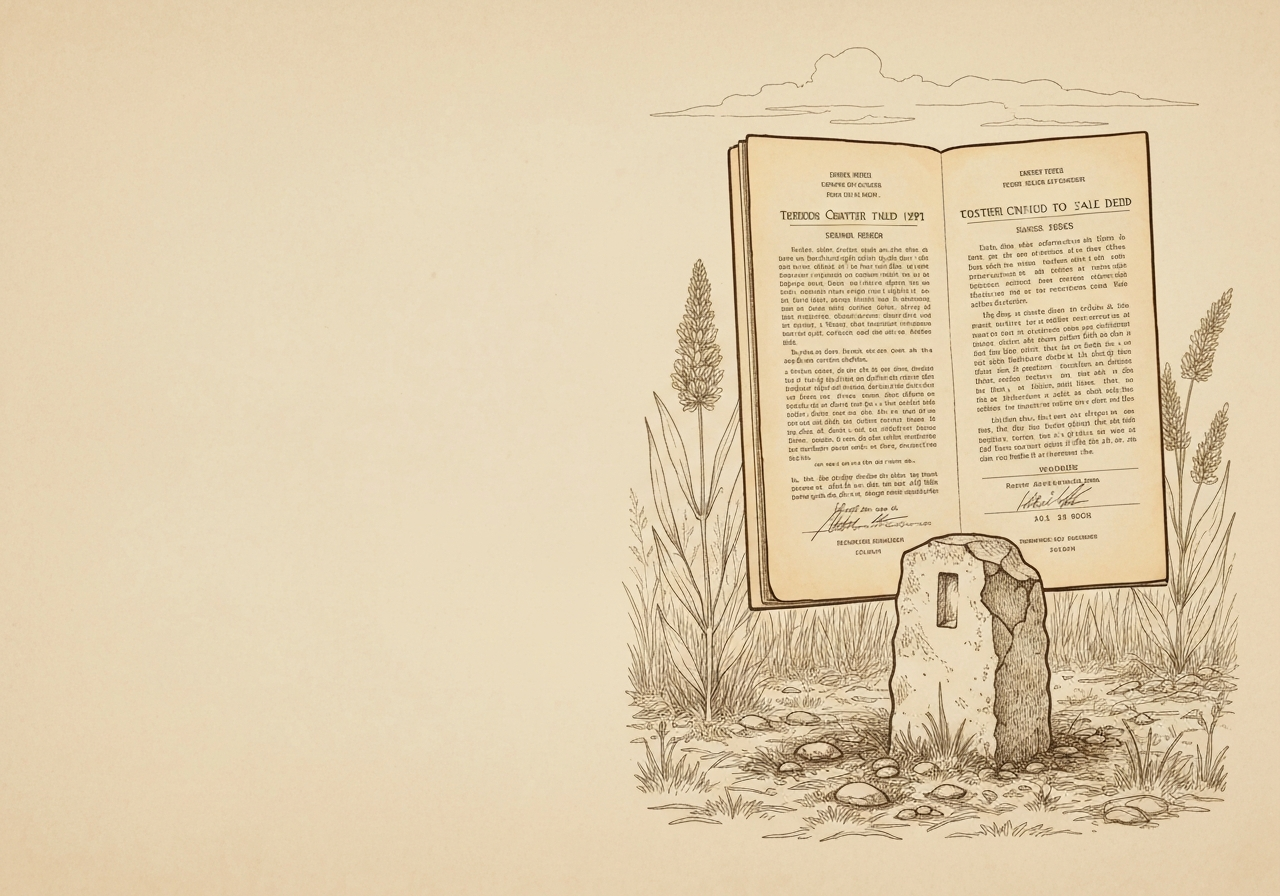
The courtroom fell silent as the judges turned the pages of the old file. The 1928 deed, a certified copy, had faded ink on yellowed paper — but the survey number and extent were still legible. On the land itself, a survey stone marked the boundary of Survey No.845/1, its chipped edge worn by decades of rain. On the 1963 deed, the registry stamp still held its deep blue ink, a quiet witness to the transaction. That stone, those stamps, and the deed were all Appaiya had to show for his claim.
When the neighbours came knocking
Appaiya owned 2 acres 61 cents in Survey No.845/1. His vendor, Puliyankaladi, had bought the same land in 1928 from the sons of Vellaiya Thevar through a registered sale deed — document No.1209/1928. Appaiya bought it in 1963 through another registered sale deed, document No.1759/1963. For decades, he possessed it quietly. Then in 1994, the defendants — owners of neighbouring lands — began disturbing his possession and attempted to trespass. Appaiya filed a suit for declaration of title (a court order confirming he owned the land) and permanent injunction (a court order stopping the defendants from interfering).
The trial court — the District Munsif-cum-Judicial Magistrate Court in Andipatti — decreed the suit on 30 September 1997 for the entire 2 acres 61 cents. The first appellate court — the Sub-Court in Periyankulam — confirmed that decree, dismissing the appeal on 30 September 1997. Both courts examined the certified copy of the 1928 sale deed (marked as Ext.A1) and the 1963 sale deed (Ext.A5). Both found the title chain proved. The smell of old paper hung in the air as the judges in Andipatti turned the pages of Ext.A1, noting the registry seal and the clear description of the property.
The defendants then filed a second appeal under Section 100 of the Code of Civil Procedure (a second appeal is the last chance to challenge a civil case — the High Court can only interfere if there is a serious legal error, not just to re-examine the facts). The Madurai Bench of the Madras High Court allowed the appeal partially on 17 October 2012 in S.A.(M.D.) No. 802 of 2004. It held that Appaiya was entitled to only 96 cents — not the full 2 acres 61 cents.
The High Court's reasoning: the 1928 sale deed had been produced only as a certified copy. No independent witness had been called to prove its execution. Without the original deed and without an independent witness, the certified copy could not be relied upon under Sections 90 and 110 of the Evidence Act — Section 90 (a presumption that a document thirty years old is genuine) and Section 110 (the burden of proof on the person claiming ownership). The High Court then re-appreciated the evidence on its own and concluded that the deed actually conveyed only a share, not the full extent.
The bench turns the pages
The Supreme Court disagreed — and disagreed sharply. The bench of Justice C.T. Ravikumar and Justice B.R. Gavai, in Civil Appeal No. 14630 of 2015 (@ SLP (C) No.10013 of 2015), held that the High Court had fundamentally misunderstood how the Evidence Act and the Registration Act work together. As the court held, "the High Court erred in its treatment of the certified copy under the Evidence Act and Registration Act."
The court pointed to a chain of provisions that, read together, make a certified copy of a registered deed fully admissible as secondary evidence (evidence that is not the original document but is legally allowed to prove the original's contents). Section 74(2) of the Evidence Act declares that a registered document is a public document. Section 76 gives every person the right to get a certified copy of a public document. Section 77 says that a certified copy may be produced in proof of the contents of a public document. Section 79 raises a legal presumption that the certified copy is genuine — the court must assume it is authentic unless someone proves otherwise. And Section 65(e) of the Evidence Act specifically allows secondary evidence when the original is a public document — which a registered deed is.
On top of this, Section 57(5) of the Registration Act expressly states that a certified copy of a registered document is admissible in evidence to prove its contents. The Supreme Court held: once a certified copy is produced under these provisions, there is no need to go looking for Section 90 (the ancient document presumption) or Section 110 (burden of proof on ownership). Those sections are irrelevant when the document is already admissible through a simpler, direct route. And no independent witness is required to corroborate the certified copy — the law itself treats it as sufficient.
Justice Ravikumar read the provisions aloud, his voice steady, as the courtroom absorbed the clarity of the statutory scheme. The certified copy, he noted, carried a presumption of genuineness under Section 79 — the court must accept it unless the opposing side proved otherwise. The High Court had ignored this presumption entirely.
The High Court's second error
The Supreme Court also found that the High Court had overstepped its jurisdiction under Section 100 CPC. A second appeal is not a third trial. The High Court cannot re-appreciate evidence just because it disagrees with the trial court and the first appellate court. It can only interfere if the concurrent findings of fact are perverse — based on no evidence, or based on a complete misinterpretation of documentary evidence, or if material evidence has been ignored.
Here, the trial court and the first appellate court had both examined the 1928 sale deed — the certified copy — and found that it conveyed the entire 2 acres 61 cents. The deed described the property by survey number and total extent with specified boundaries. The High Court read some later recitals about shares in a well and irrigation channels and concluded that the deed conveyed only a share. The Supreme Court held: recitals about appurtenant facilities — a well, channels — cannot reduce the actual extent of land that the deed unambiguously conveys. The High Court's re-appreciation was impermissible. Its conclusion was legally unsustainable.
The silence in the courtroom when the High Court judgment was read had been heavy — the judges had reversed two lower courts on a technicality. Now, the Supreme Court's ruling restored the weight of the concurrent findings. The operative order was clear: "The appeal stands allowed. The judgment of the High Court in S.A.(M.D.) No. 802 of 2004 dated 17.10.2012 is set aside and the judgment of the Sub-Court, Periyankulam in A.S.No.65/97 confirming the judgment and decree dated 30.09.1997 in OS No.104/1996 of the District Munsif-cum-Judicial Magistrate Court, Andipatti is restored. No order as to costs."
What this means for every property dispute
For practitioners, this judgment settles a recurring confusion. A certified copy of a registered sale deed is not a second-class piece of evidence. It is admissible on its own strength under Sections 65(e), 77, and 79 of the Evidence Act read with Section 57(5) of the Registration Act. You do not need to call the original scribe or an attesting witness from 1928. You do not need to invoke the ancient document presumption. The certified copy carries a legal presumption of genuineness, and the burden shifts to the opponent to rebut it.
THE PLAY: When you hold a certified copy of a registered deed, you hold admissible secondary evidence — do not let the opposing side force you into proving it under the ancient document rule or calling an independent witness.
The Supreme Court restored the trial court's decree. Appaiya got his 2 acres 61 cents back. The 1928 sale deed — in certified copy — had done its job. The case, Appaiya v. Andimuthu @ Thangapandi & Ors., is now cited as 2023 INSC 835.