A 1974 detention order still haunts a family—here's why the Supreme Court said it's valid
Roshan Lal was detained during the Emergency. Decades later, his son challenged the order and the forfeiture of family properties. The Court found no infirmity.
45
years.
Roshan Lal was detained during the Emergency. Decades later, his son challenged the order and the forfeiture of family properties. The Court found no infirmity.
His father was detained in 1974. The son challenged the order in 1996. The Supreme Court just ruled—and the detention still stands.
Roshan Lal was a gold smuggler, or so the government believed. In November 1974, police in Amritsar picked him up under the Maintenance of Internal Security Act (MISA — a law that allowed preventive detention without trial during the Emergency). A month later, the government issued a fresh detention order under COFEPOSA (the Conservation of Foreign Exchange and Prevention of Smuggling Activities Act, 1974 — a law aimed at economic offenders). Roshan Lal would not see freedom for nearly three years.
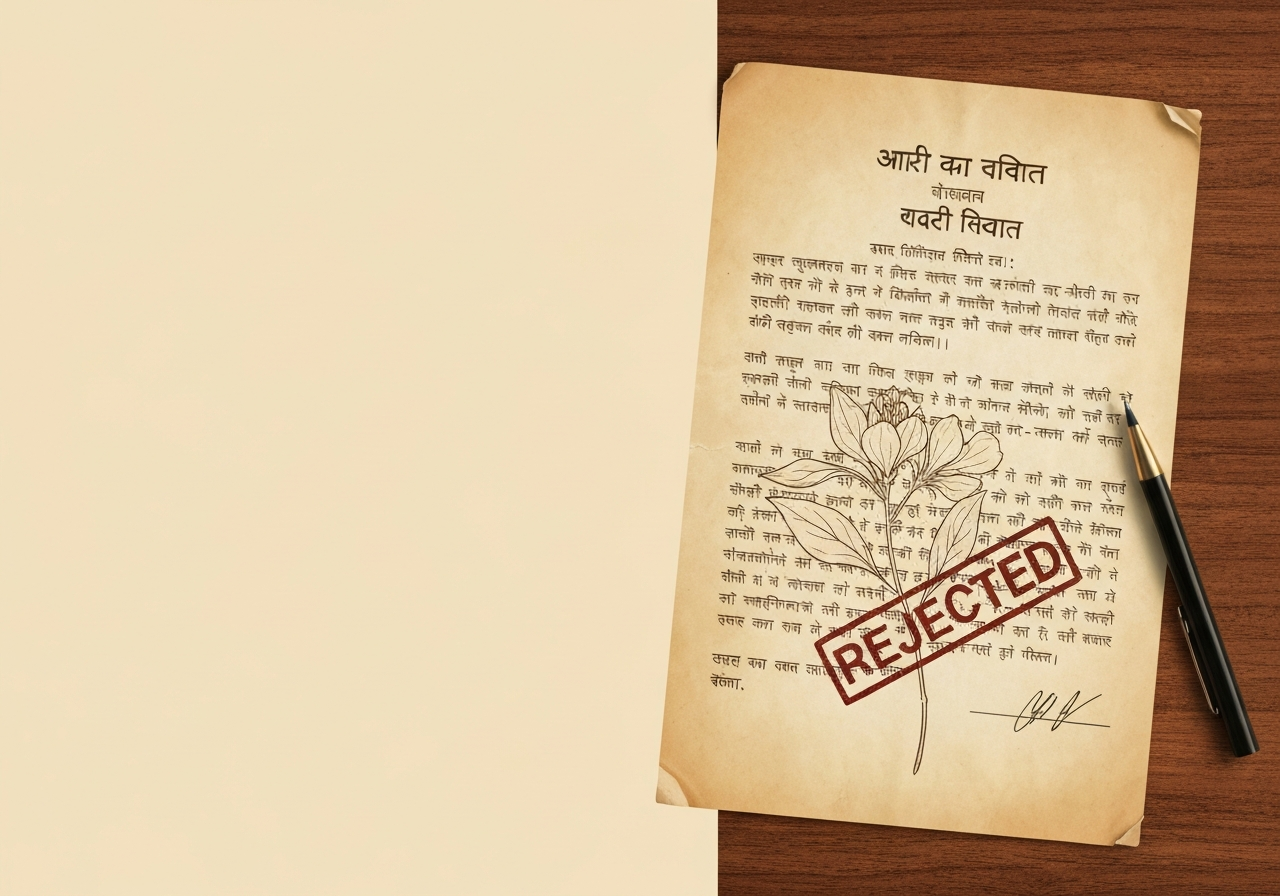
The file that reached the Supreme Court decades later was thin, its pages yellowed with age. The handwritten grounds of detention in Hindi, dated 19 December 1974, sat at the top of the stack — a document that had not been touched for over forty years. The courtroom fell silent as the bench of Justice Uday Umesh Lalit and Justice Hemant Gupta began reading the judgment on 8 April 2019.
When the Emergency swallowed the case
Roshan Lal's detention stretched through the Emergency (1975-1977), when civil liberties were suspended across India. He filed a writ petition in the Punjab and Haryana High Court in 1975, challenging the COFEPOSA order. The petition was dismissed as "infructuous" — meaningless, since he was released after the Emergency lifted in 1977. But the government was not done with him.
In 1976, Parliament passed SAFEMA (the Smugglers and Foreign Exchange Manipulators Forfeiture of Property Act — a law that let the state seize assets acquired through smuggling). In 1978, the Competent Authority under SAFEMA declared Roshan Lal's properties — and those of his wife — as illegally acquired and ordered their forfeiture. The gold seizure report from the Pakistan border, which had triggered the original detention, now formed the basis for taking away everything the family owned. The Appellate Tribunal upheld the order. Roshan Lal challenged this before the Supreme Court, which bundled his case with dozens of others in the landmark Amratlal batch. A nine-judge bench disposed of those petitions in 1994 with general directions, but did not specifically rule on Roshan Lal's detention.
The son picks up the fight
Two years later, in 1996, Roshan Lal's son Narender Kumar filed a fresh writ petition in the Delhi High Court. He challenged both the 1974 detention order and the 1978 forfeiture order. The High Court threw it out on the ground of res judicata — the principle that a matter already decided by a court cannot be re-litigated. Narender appealed to the Supreme Court, which in 2004 sent the case back to the High Court for a fresh hearing on merits — meaning the court had to examine the actual arguments, not just the procedural bar.
On remand, the Delhi High Court again dismissed the petition. Narender appealed once more. The Supreme Court heard the matter in April 2019. The smell of old paper filled the courtroom as the case was called — a file that had travelled from 1974 through the Emergency, through the nine-judge bench, through two rounds of the Delhi High Court, and finally back to the Supreme Court.
The trap in the law's fine print
The central question was deceptively simple: could SAFEMA be applied to a person like Roshan Lal, who had been detained under COFEPOSA but whose detention order had never been formally revoked or set aside by a court?
Section 2(2)(b) of SAFEMA says the law applies to any person who has been detained under COFEPOSA. But a proviso (an exception clause) carves out four situations where SAFEMA does not apply:
- Part (i): if the detention order has been revoked by the government under specific conditions
- Part (ii): if the detention period has expired and the person has been released
- Part (iii): if the detention order has been set aside by a court
- Part (iv): if the person has been discharged or acquitted in related criminal proceedings
The government argued that Roshan Lal's detention order was under Section 3(1) of COFEPOSA — the basic detention power — and that neither Section 9 (which deals with declarations for certain types of detentions) nor Section 12A (special provisions during Emergency) applied. Since the order was never revoked under the conditions in Part (i), and never set aside by a court under Part (iv), SAFEMA applied fully.
Narender Kumar's lawyers argued that the detention order suffered from fundamental flaws: the detaining authority had not applied its mind properly, the grounds of detention were not supplied in a language Roshan Lal understood, and his representation against detention had not been considered fairly.
Why the Supreme Court said no
The bench examined each argument and found it hollow.
First, the Court noted that Roshan Lal had filed a writ petition in 1975 challenging the detention order. That petition was dismissed as infructuous in 1978. Crucially, Roshan Lal had not pressed for a decision on the merits of the detention order. He had let it go. The SAFEMA proceedings were already underway by then, and he knew the detention order was the foundation of the forfeiture case. By not fighting the detention order when he had the chance, he could not now — through his son — resurrect the challenge.
Second, the Court examined the claim that the grounds of detention were not supplied in a language Roshan Lal understood. The record showed that the grounds were served in Hindi, which Roshan Lal could read. The Supreme Court observed that "no grievance was raised regarding language of grounds of detention at any stage" — not in 1975, not in 1978, not even in 1996. The Court refused to entertain a complaint that had slept for decades.
Third, the Court found that Roshan Lal's representation against detention had been considered and rejected by the Punjab government on 11 February 1975. There was no evidence that the rejection was arbitrary or that the representation was ignored. The file showed the representation, dated 17 January 1975, with the government's endorsement — "rejected" — stamped across it in faded ink.
Finally, the Court rejected the argument that the COFEPOSA detention order was a mere duplication of the earlier MISA order. The grounds under COFEPOSA related specifically to smuggling activities — dealing in smuggled gold from Pakistan — which were distinct from the general security grounds under MISA. There was no non-application of mind.
The forfeiture that could not be undone
The Court also upheld the forfeiture order. Since the detention order was valid, and SAFEMA applied to Roshan Lal, the Competent Authority had correctly identified his properties as illegally acquired. The Appellate Tribunal had confirmed this. The nine-judge bench in Amratlal had already upheld the constitutional validity of SAFEMA. There was nothing left to challenge.
The Court dismissed both appeals — Criminal Appeal No. 1492 of 2009 and Criminal Appeal No. 1493 of 2009. The bench held that where an order of detention under Section 3(1) simpliciter of COFEPOSA — to which neither Section 9 nor Section 12A applied — had not been revoked under conditions stipulated in Part (i) of the proviso to Section 2(2)(b) of SAFEMA, and had not been set aside by a court of competent jurisdiction under Part (iv), the provisions of SAFEMA must apply to the detenu. There was no escape from the law's fine print.
THE PLAY: If you let a detention order go unchallenged on merits when you had the chance, you cannot later use it to attack a forfeiture proceeding that depends on that order.
The son fought for twenty-three years. The detention order his father faced in 1974 still stands — untouched, unbroken, and now, unreachable.