A 95-year-old sale deed was just a photocopy. The court said: that's enough.
The Supreme Court reversed a High Court that threw out a certified copy of a 1928 registered deed, ruling that such copies are automatically admissible as secondary evidence without extra witnesses.
95
years.
The Supreme Court reversed a High Court that threw out a certified copy of a 1928 registered deed, ruling that such copies are automatically admissible as secondary evidence without extra witnesses.
The only proof of a 1928 land sale was a certified copy. The High Court said it needed witnesses. The Supreme Court said: no — the law had already settled this question a century ago.
Two acres and sixty-one cents of agricultural land in Thimmanayakanur village, Madurai District. That was what Appaiya claimed was his. The sons of Vellaiya Thevar had sold it to one Puliyankaladi in 1928 under a registered sale deed. Puliyankaladi then sold it to Appaiya in 1963. The defendants, who owned adjacent lands, disputed the plaintiff's title to the entire extent, claiming portions belonged to them.
Both the trial court and the first appellate court looked at the documents and ruled for Appaiya. Then the Madras High Court, in a second appeal (a limited appeal that only examines serious legal errors, not factual disputes), threw out the 1928 deed. The reason: the deed was a certified copy, not the original, and the High Court said such a copy needed independent witnesses to prove it was genuine. Appaiya had lost nearly half his land on a technicality.
When a 95-year-old deed became a problem
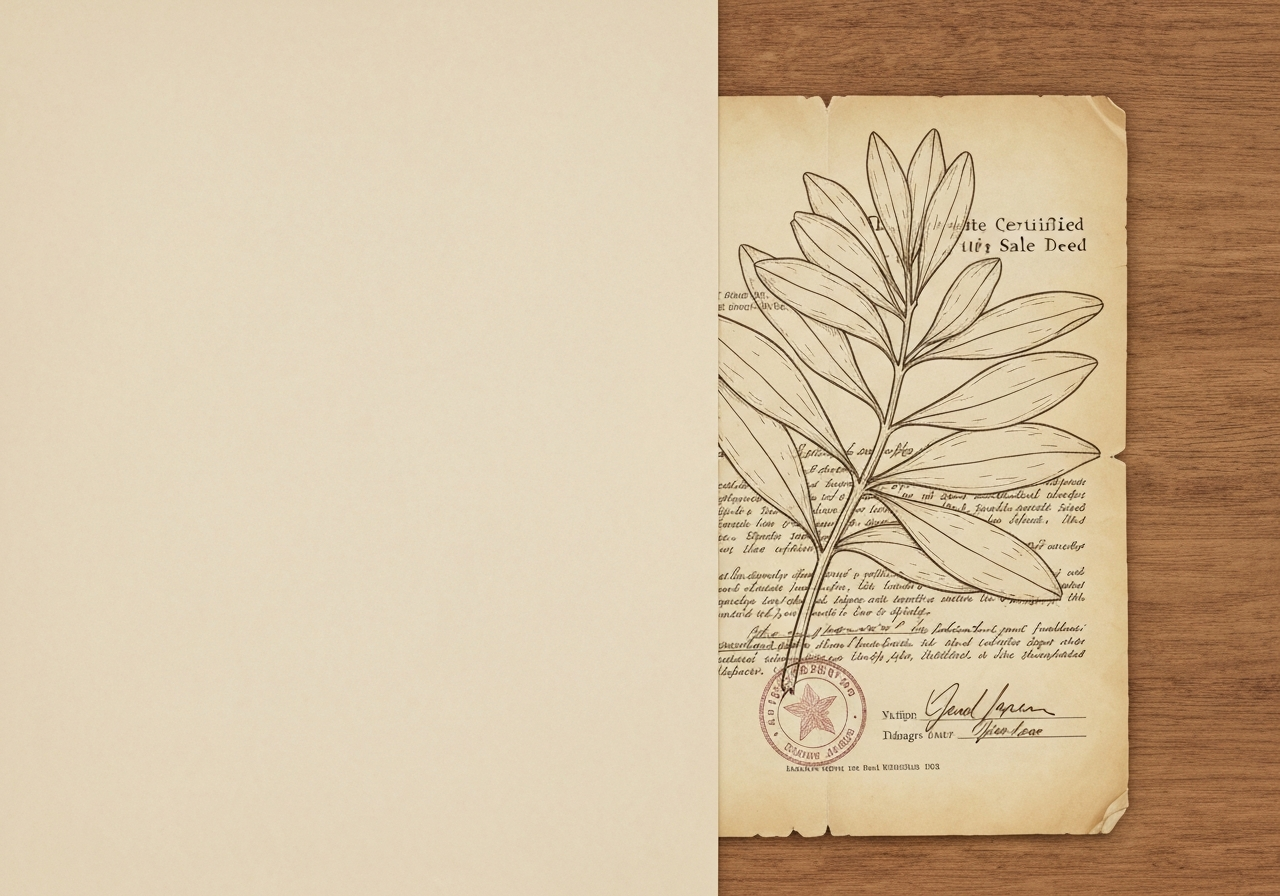
The original 1928 sale deed — Ext.A1 in the court records — was a registered document. Registration means it was officially recorded with the government's registration office. But by the time the case reached trial, the original had been lost or destroyed. What Appaiya had was a certified copy — a copy issued and sealed by the government office that holds the original records. The courtroom fell silent as the file was opened; the copy was thin, the paper brittle with age, and the registrar's stamp still visible after nearly a century.
The trial court — the District Munsif-cum-Judicial Magistrate Court, Andipatti — had accepted this certified copy as valid proof of the 1928 sale. It didn't ask for witnesses who had seen the original being signed. It didn't need to. The document was registered, and the copy was certified. That, the trial court said, was enough. The first appellate court — the Sub-Court, Periyankulam — confirmed this reasoning, dismissing the defendants' appeal.
The High Court disagreed. It held that under Section 90 of the Evidence Act (a rule that lets courts presume documents over thirty years old are genuine if they come from proper custody), a certified copy needed independent witness corroboration. Without someone who could testify that the original existed and was properly executed, the High Court said, the copy was worthless. It reduced Appaiya's entitlement from the full 2 acres 61 cents to just 96 cents.
The statutory shortcut the High Court missed
The Supreme Court saw the error immediately. The High Court had reached for Section 90 — the ancient document rule — when the law had already provided a cleaner, more direct path.
That path runs through five provisions that work together like a lock and key:
- Section 74(2) of the Evidence Act — documents kept by a public officer, including registered documents in the government's registration office, are "public documents."
- Section 65(e) — when the original of a public document is lost or cannot be produced, secondary evidence (like a certified copy) is allowed.
- Section 77 — certified copies of public documents may be produced in place of the original to prove the document's contents.
- Section 79 — the court shall presume every certified copy is genuine — that the officer who issued it had the authority to do so, and that the copy is accurate.
- Section 57(5) of the Registration Act — certified copies of registered documents are admissible for the purpose of proving the contents of the original.
The Supreme Court held that these provisions create a complete, self-contained system. A certified copy of a registered deed is admissible as secondary evidence (evidence that proves the contents of a document when the original is unavailable) without any need for Section 90's ancient document presumption or for independent witnesses. The certification itself carries the legal presumption of genuineness. The Court stated: "A certified copy of a registered sale deed, being a copy of a public document under Section 74(2) of the Evidence Act, is admissible as secondary evidence under Section 65(e) read with Sections 77 and 79 of the Evidence Act and Section 57(5) of the Registration Act, to prove the contents of the original."
Why the High Court's approach was wrong
The bench of Justice C.T. Ravikumar and Justice B.R. Gavai identified two fundamental errors in the High Court's judgment.
First, the High Court had treated a certified copy of a registered document as if it were an ordinary old document that needed to be "proved" through Section 90. But Section 90 applies to documents that are not public records — private papers found in someone's cupboard, for instance. A registered deed kept in a government registration office is a public document under Section 74(2). Its certified copy is admissible under Sections 77 and 79 without any additional hoop-jumping.
Second, the High Court had reversed concurrent findings of fact (findings that both lower courts had agreed on) without showing that those findings were perverse — that is, based on no evidence, or on a complete misreading of the evidence. The Supreme Court cited its own precedent in Santosh Hazari v. Purushottam Tiwari (2001) and Vidhyadhar v. Manikrao (1999) to reiterate that a High Court in second appeal under Section 100 of the Code of Civil Procedure (the provision that allows a second appeal only on substantial questions of law) cannot simply re-evaluate facts and substitute its own view. It can only intervene if the lower courts' findings are legally unsustainable.
The trial court and first appellate court had correctly applied the Evidence Act. Their factual findings on title were based on admissible evidence. The High Court had no business disturbing them.
The procedural journey in detail
The dispute wound its way through four tiers of the judiciary. It began in the District Munsif-cum-Judicial Magistrate Court, Andipatti, which on 30 September 1997 decreed the suit in favour of the plaintiff, declaring his title over the entire 2 acres 61 cents. The defendants appealed to the Sub-Court, Periyankulam, which on 11 August 1999 dismissed the appeal and confirmed the trial court's decree. The defendants then filed a second appeal under Section 100 CPC before the Madurai Bench of the Madras High Court. On 17 October 2012, the High Court allowed the appeal in part, reversing the concurrent judgments and limiting the plaintiff's entitlement to 96 cents. The plaintiff then approached the Supreme Court under Article 136 of the Constitution, which grants special leave to appeal against any judgment of a High Court. On 20 September 2023, the Supreme Court allowed the appeal, set aside the High Court's judgment, and restored the concurrent decrees of the trial court and first appellate court. No order as to costs was made.
What this means for every property dispute
This judgment is a clean, practical ruling that saves thousands of property cases from getting stuck on a procedural technicality. In a country where original sale deeds from the 1920s, 1930s, and 1940s have often been lost, eaten by termites, or destroyed in floods and fires, the certified copy from the registration office is often the only surviving record of a transaction.
The Supreme Court has now made it clear: that certified copy is enough. You don't need to find the 90-year-old neighbour who watched the deed being signed. You don't need to invoke ancient document presumptions. The statutory framework already guarantees admissibility.
The ruling also reinforces a broader principle of appellate discipline. A High Court exercising second appellate jurisdiction under Section 100 CPC cannot treat itself as a third trial court. It cannot reweigh evidence or substitute its own factual preferences for those of the trial court and first appellate court. Its power is confined to correcting errors of law that are substantial — errors that go to the root of the case. The High Court in this case had overstepped that boundary, and the Supreme Court pulled it back.
The judgment cites a string of precedents that reinforce this position. In Santosh Hazari v. Purushottam Tiwari (2001), the Supreme Court held that a second appeal under Section 100 is not a regular appeal but a restricted one confined to substantial questions of law. In Vidhyadhar v. Manikrao (1999), the Court reiterated that concurrent findings of fact cannot be disturbed unless they are perverse. In Yadarao Dajiba Shrawane v. Nanilal Harakchand Shah (2002) and Lankeshwar Malakar v. R. Deka (2006), the Court applied the same principle. In SK. Bhikan v. Mehamoodabee (2017), the Court emphasised that the High Court must frame a substantial question of law before hearing a second appeal. And in R. Nainar Pillai v. Subbiah Pillai (2007), the Madras High Court itself had held that a certified copy of a registered document is admissible without Section 90 — a precedent the High Court in this case had apparently overlooked.
THE PLAY: When the original registered deed is lost, produce the certified copy from the registration office — it is admissible as secondary evidence under Sections 65(e), 77, and 79 of the Evidence Act read with Section 57(5) of the Registration Act, without any need for Section 90 or independent witnesses.
The Supreme Court restored the original decree. Appaiya got his two acres and sixty-one cents back.