A criminal writ petition gave every NCLT advocate free Wi-Fi.
A Supreme Court order on a criminal writ petition forced the NCLT to roll out free Wi-Fi at all 16 benches, but the network is still in test mode and practitioners have a narrow window to shape the final standard operating procedure.
Connected.
Free Wi-Fi.
At every bench.
A Supreme Court order on a criminal writ petition forced the NCLT to roll out free Wi-Fi at all 16 benches, but the network is still in test mode and practitioners have a narrow window to shape the final standard operating procedure.
Free Wi-Fi at NCLT: The Supreme Court order that finally connected India's corporate benches
When Sarvesh Mathur filed a criminal writ petition against the Registrar General of the Punjab and Haryana High Court, he probably didn't expect it to result in free internet for every advocate and litigant walking into a National Company Law Tribunal bench. But that's exactly what happened.
On 29 April 2024, the National Company Law Tribunal issued an administrative circular — File No. 25/02/2024-NCLT — launching free Wi-Fi at all 16 of its benches across India. Eleven benches were already live in test mode. Four more would go live the next day. The trigger: a Supreme Court direction in WP(Crl) No. 351/2023, Sarvesh Mathur v. The Registrar General, High Court of Punjab and Haryana.
For advocates who have spent years burning through mobile data plans inside tribunal corridors, this is not a small thing. For litigants who cannot afford a data pack but need to access case status or file documents, it is transformative. And for the NCLT itself — a tribunal that handles everything from insolvency resolutions to corporate mergers — the circular represents a quiet but significant administrative shift toward digital access as a right, not a privilege.
What the Supreme Court actually said
The Supreme Court's order in Sarvesh Mathur was straightforward: courts and tribunals must provide free Wi-Fi to advocates, litigants, and stakeholders. No exceptions. No phased rollout over five years. The NCLT, to its credit, moved fast.
The circular, signed by Secretary Nidhi Madan, states that the facility is being provided "in compliance of the order of the Hon'ble Supreme Court." It does not quote the order verbatim, but the mandate is clear. The NCLT engaged BSNL as the service provider. The network is already in test mode at New Delhi, Ahmedabad, Amravati, Chennai, Chandigarh, Cuttack, Jaipur, Kochi, Kolkata, Mumbai, and Indore. From 30 April 2024, Allahabad, Guwahati, Hyderabad, and Bengaluru joined the list.
The actual launch, however, is conditional. The circular says it will happen "after clearance by the technical team of BSNL." Until then, the system runs in test mode — and stakeholders are being asked to test it and send feedback to secretary@nclt.gov.in.
The Draft SOP: How the Wi-Fi actually works
The circular attaches a Draft Standard Operating Procedure. This is where the practical detail lives. And for anyone who has ever tried to connect to a public Wi-Fi network in a government building in India, the SOP is refreshingly specific.
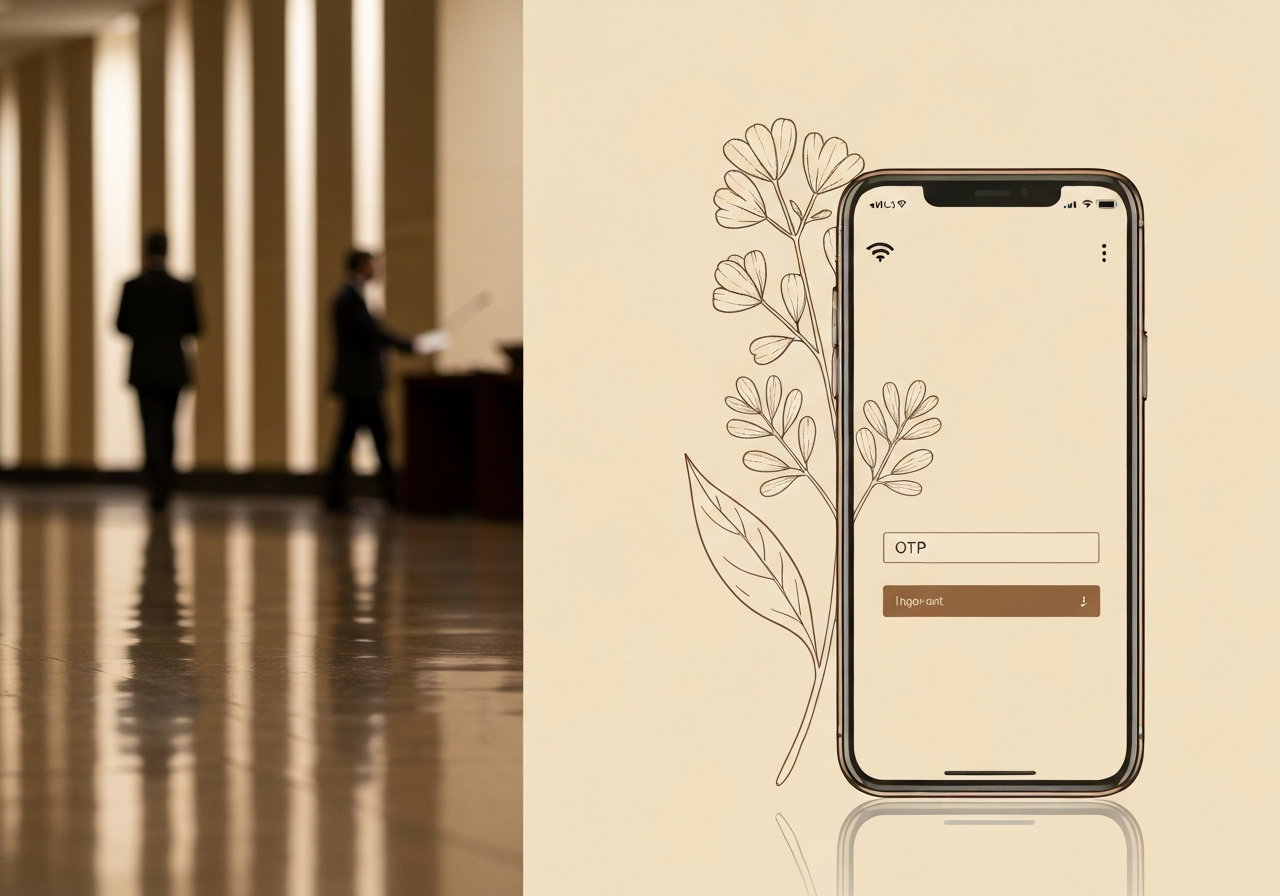
First, authentication is via mobile OTP. You walk in, select the NCLT Wi-Fi network, enter your mobile number, receive a one-time password, and you are in. No paperwork. No queue at a help desk.
Second, you must select a user type. The SOP does not list the categories, but the implication is clear: the system will distinguish between advocates, litigants, tribunal staff, and other stakeholders. This matters for bandwidth allocation and usage monitoring.
Third, the SOP mandates compliance with the Information Technology Act, 2000. All internet access will be logged and audited. The acceptable-use restrictions are standard — no illegal downloads, no malicious activity, no streaming of content that violates Indian law. But the audit trail is significant. Every website visited, every file downloaded, every session duration — logged.
This is not a surveillance measure, at least not in the traditional sense. It is a security requirement. Public Wi-Fi networks in government buildings are prime targets for cyberattacks. The audit log allows the NCLT to trace any misuse back to a specific user and a specific session. For advocates handling sensitive corporate insolvency data, this is actually reassuring.
Why this matters for advocates and litigants
The NCLT handles some of the most document-heavy litigation in the country. A typical insolvency application under the Insolvency and Bankruptcy Code involves hundreds of pages of financial statements, creditor lists, and resolution plans. Advocates routinely need to access the NCLT's e-filing portal, check case status, download orders, and communicate with clients — all from inside the tribunal premises.
Without free Wi-Fi, that meant relying on personal mobile data, which is expensive and unreliable inside large court complexes. Or worse, it meant not accessing documents at all until returning to the office. The free Wi-Fi changes that calculus.
For litigants — especially those appearing in person without a lawyer — the impact is even more direct. A small business owner fighting a winding-up petition can now check the NCLT's website for the next hearing date without spending money on a data pack. A creditor can download the resolution plan from the tribunal's portal while sitting in the waiting area.
The circular does not mention any data caps or speed limits. That will likely be clarified after the BSNL technical clearance. But even a basic connection — enough for browsing, email, and document downloads — is a significant upgrade from the status quo.
The BSNL factor: Why the launch is still conditional
The circular is careful to say that the actual launch will happen only after BSNL's technical team clears the network. This is not unusual. Government Wi-Fi projects in India have a history of delays — bandwidth issues, security audits, and vendor coordination all take time.
But the test mode is already operational at 15 benches. That means advocates and litigants walking into those benches today can connect and use the network. The feedback being collected — via email to secretary@nclt.gov.in — will presumably be used to fine-tune the SOP and address any technical glitches before the formal launch.
For practitioners, the message is simple: test the network now, report issues, and help shape the final version. Once BSNL clears it, the SOP becomes binding. Any changes after that will require a fresh circular.
What this means for other tribunals
The NCLT circular is issued in compliance with a Supreme Court order. That order applies to all courts and tribunals in India. The NCLT is one of the first to implement it with a detailed SOP and a concrete rollout plan.
Other tribunals — the National Company Law Appellate Tribunal, the Debt Recovery Tribunals, the Income Tax Appellate Tribunal, the Competition Appellate Tribunal — are watching. The NCLT's SOP could become a template. The authentication model (mobile OTP + user type selection), the IT Act compliance framework, the audit logging requirement — all of it is transferable.
For advocates who appear across multiple tribunals, the hope is that a single login or a uniform SOP emerges. That is not in this circular. But the NCLT has set a benchmark.
THE PLAY: If you appear at any NCLT bench, test the Wi-Fi now, send your feedback to secretary@nclt.gov.in, and document any connectivity issues — because once BSNL clears the network and the SOP is finalised, the window for input closes.
The bottom line for practitioners
Free Wi-Fi at NCLT benches is not a luxury. It is a compliance-driven administrative reform that directly affects how advocates and litigants access justice. The Supreme Court ordered it. The NCLT has implemented it in test mode. The SOP is clear, practical, and security-conscious.
Test the network. Send your feedback. And once BSNL gives the green light, expect this to become the new normal — not just at the NCLT, but across every tribunal in the country.