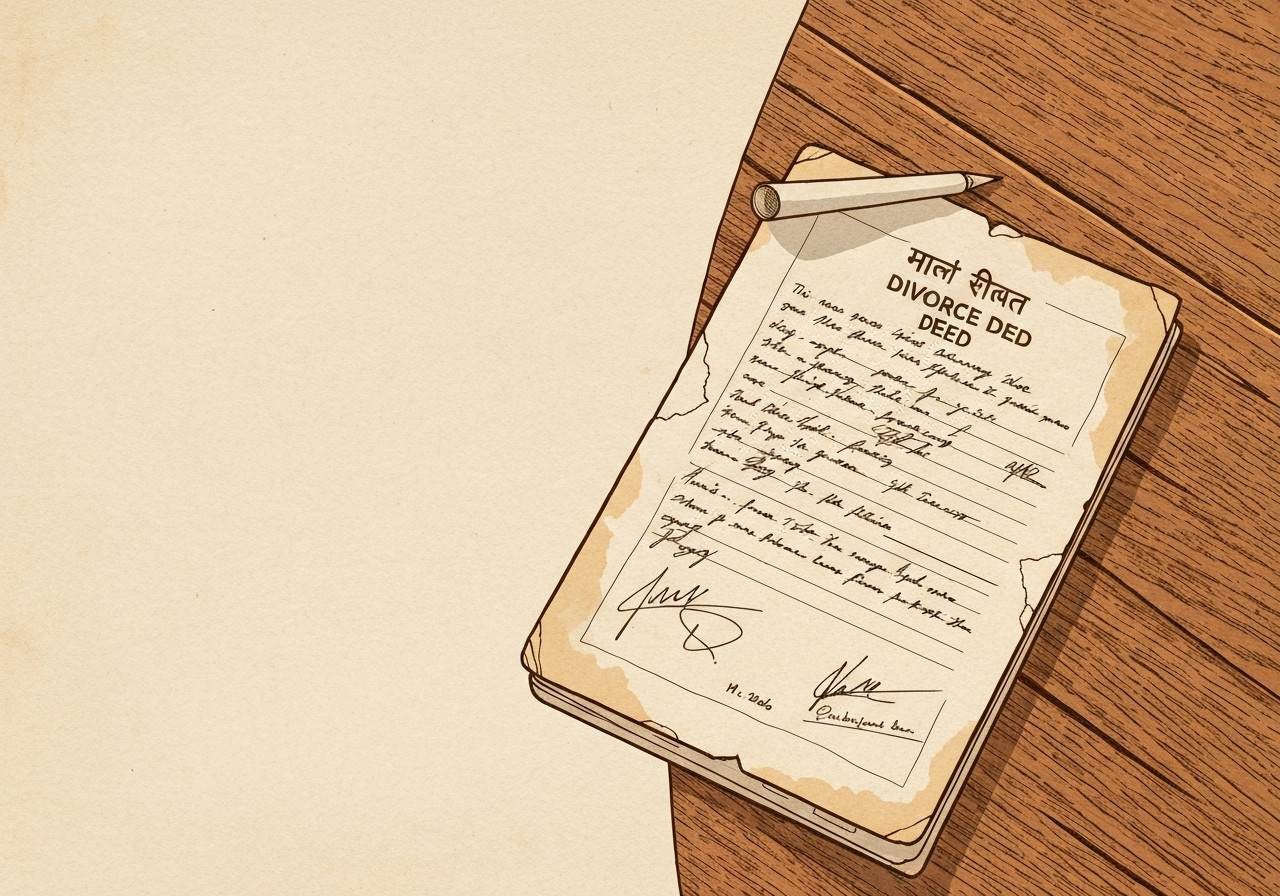
A divorce deed signed by panchayat. The Supreme Court just threw it out.
Husband claimed a 2014 customary divorce deed ended his marriage. He remarried in 2018. But the court said: you can't just assume a custom exists.
9
years.
Husband claimed a 2014 customary divorce deed ended his marriage. He remarried in 2018. But the court said: you can't just assume a custom exists.
He handed her a divorce deed signed by village elders. The Supreme Court said: that's not how it works.
The deed was dated January 5, 2014. The signatures belonged to the husband, the wife, their parents, and the panchayat members. No court. No judge. Just a piece of paper. The husband said it ended the marriage. The wife said it ended nothing. By the time the Supreme Court heard the case, nine years had passed, the husband had remarried, and the wife had been fighting for maintenance she never received.
The question before the court was simple: Can a panchayat's signature erase a Hindu marriage, without anyone ever proving the custom behind it actually exists?
The paper that the High Court accepted
A woman and a man married in 2011. The relationship soured. By 2014, the husband claimed, both parties and their panchayat signed a customary divorce deed. No legal proceeding. No judicial scrutiny. Just ink on paper.
In 2018, the husband remarried. That same year, the wife filed a complaint under the Protection of Women from Domestic Violence Act, 2005 (the DV Act — a law that lets a woman seek protection, maintenance, and housing from a magistrate when she faces domestic abuse).
The husband's response was immediate: dismiss the complaint. His argument was clean — the 2014 deed had ended the marriage. Without a valid marriage, the wife could claim no rights under the DV Act.
The magistrate who said no
The Judicial Magistrate First Class at Kandaghat, District Solan, Himachal Pradesh, was not convinced. In June 2018, the magistrate rejected the husband's application for dismissal and granted the wife interim maintenance of Rs. 3,000 per month — temporary financial support while the case was pending.
The husband then approached the High Court of Himachal Pradesh at Shimla under Section 482 of the Code of Criminal Procedure, 1973 (the High Court's inherent power to stop a case that should never have begun).
In August 2022, the High Court did something striking: it quashed the entire DV Act proceedings. It accepted the customary divorce deed as valid, without requiring any evidence about the custom it was based on. The interim maintenance was set aside. The wife was left with nothing.
The provision that changed everything
The wife appealed to the Supreme Court. The bench — Justice Surya Kant and Justice Dipankar Datta — heard the matter and delivered judgment on September 18, 2023.
The court's reasoning began with a single provision: Section 29(2) of the Hindu Marriage Act, 1955. This section says nothing in the Act affects any custom that allows divorce — but only if the custom is valid. And here, the Supreme Court said, is where the High Court went wrong.
A custom, the court explained, must be specifically pleaded and proved by cogent evidence (clear and convincing proof). The person relying on the custom — in this case, the husband — must show the practice has been uniformly observed for a long time, is not unreasonable, and is not opposed to public policy. This is not a formality. It is the entire foundation of a customary divorce.
The High Court had assumed the deed was valid without any such evidence. It had not asked the husband to prove the custom. It had not examined whether the panchayat's practice was longstanding or merely a one-time arrangement. It had simply looked at the paper and said: this is enough.
The presumption that survived
The Supreme Court held that until the validity of the customary divorce deed is established through proper evidence, a statutory presumption operates — the marriage is presumed to be subsisting (still legally in existence). Under this presumption, the DV Act complaint cannot be thrown out at the very beginning on the ground that it is not maintainable.
The court also noted that the validity of a customary divorce deed is essentially a question of fact — something that cannot be decided on a simple application for dismissal. It requires a proper foundation in the pleadings (the written statements filed by both sides) and impeccable evidence (evidence that cannot be doubted). Ordinarily, such a question should be decided by a civil court, not assumed away by a criminal court at the threshold.
The precedents that built the rule
The Supreme Court anchored its reasoning in three prior decisions, each reinforcing the same core principle: a custom must be proved, not presumed.
In Yamanaji H. Jadhav v. Nirmala (2002), the court had held that a party asserting a customary divorce must lead evidence to establish the custom's existence, its uniformity, and its long-standing nature. Without such evidence, the claim falls.
In Subramani v. M. Chandralekha (2005), the court went further, ruling that even where a custom is pleaded, the burden of proof remains heavy. The custom must not be unreasonable or opposed to public policy. A single instance of a divorce by deed, without a broader pattern, does not constitute a valid custom.
In Swapnanjali Sandeep Patil v. Sandeep Ananda Patil (2020), the court applied these principles to a case strikingly similar to the present one. There too, a husband had relied on a customary divorce deed to defeat a wife's claim for maintenance. The court rejected the deed, holding that the custom had not been proved, and restored the wife's rights under the DV Act.
These three decisions, taken together, form a clear line: a customary divorce deed is not a self-executing document. It is a claim that must be tested against evidence. The High Court in the present case had ignored this line entirely.
The procedural journey in detail
The case travelled through three tiers of the judiciary before reaching the Supreme Court.
First tier — the magistrate. On June 18, 2018, the wife filed her complaint under Section 12 of the DV Act before the Judicial Magistrate First Class, Kandaghat, District Solan, Himachal Pradesh. The husband immediately filed an application seeking dismissal of the complaint, relying on the customary divorce deed. The magistrate rejected that application and, on the same date, granted the wife interim maintenance of Rs. 3,000 per month. This was the wife's first victory — a small but significant sum to sustain herself while the case moved forward.
Second tier — the High Court. The husband challenged the magistrate's order before the High Court of Himachal Pradesh at Shimla, invoking Section 482 of the CrPC. On August 31, 2022, the High Court allowed his petition. It quashed not only the magistrate's order but the entire DV Act complaint. It held that the customary divorce deed was valid and that the wife had no subsisting marriage to support her claim. The interim maintenance was set aside. The wife was left without any financial support.
Third tier — the Supreme Court. The wife filed a Special Leave Petition before the Supreme Court, which was registered as Criminal Appeal No. 2905 of 2023. The bench of Justice Surya Kant and Justice Dipankar Datta heard the matter and delivered judgment on September 18, 2023. The court found that the High Court had erred fundamentally by assuming the validity of the customary divorce deed without any adjudication on the custom. It set aside the High Court's order and restored the magistrate's interim maintenance.
What the court ordered
The Supreme Court allowed the appeal in part. It set aside the High Court's order of August 31, 2022, and sent the case back to the High Court for a fresh decision — this time without relying on the customary divorce deed. The validity of that deed was left to be determined by a court of competent jurisdiction (a court with the authority to decide such questions, typically a civil court).
The interim maintenance of Rs. 3,000 per month was restored. The husband was directed to pay arrears (the amount that had accumulated since the High Court stopped it) within one month. Both parties were asked to appear before the High Court on October 30, 2023.
The court also clarified that its order did not disturb the provisions of Section 11 (void marriages) or Section 13 (divorce) of the Hindu Marriage Act, 1955. Those provisions remained available to the parties in appropriate proceedings. The only question decided was the procedural error committed by the High Court in assuming the validity of the customary divorce deed at the threshold.
Why this matters for every family lawyer
The judgment is a warning to every lawyer who thinks a panchayat deed is a shortcut. The Supreme Court has made it clear: a customary divorce deed is not a magic document. It is a claim that must be tested against evidence. Until that test is passed, the marriage stands, and the DV Act applies.
For practitioners, the takeaway is precise: if you are advising a client who relies on a customary divorce, you must be ready to plead the custom specifically — when it started, how long it has been observed, whether it is uniform, and why it is not unreasonable. A vague reference to "custom" will not survive scrutiny.
THE PLAY: Never advise a client to rely on a customary divorce deed without first gathering independent evidence — witness affidavits, prior instances, community records — that proves the custom has been uniformly observed for a long time.
The panchayat signed. The Supreme Court unsigned.