A fire in a warehouse. Two insurance policies. One said: not our problem.
Levi Strauss lost ₹12 crore goods in a fire. United India refused to pay, pointing to a global marine policy held by the parent company. The Supreme Court agreed — even though the fire never touched the sea.
12.2
crores.
Levi Strauss lost ₹12 crore goods in a fire. United India refused to pay, pointing to a global marine policy held by the parent company. The Supreme Court agreed — even though the fire never touched the sea.
Levi Strauss had fire insurance. Its parent had a global marine policy. A fire destroyed goods in a warehouse. United India said: 'That's marine's job.' The Supreme Court just agreed.
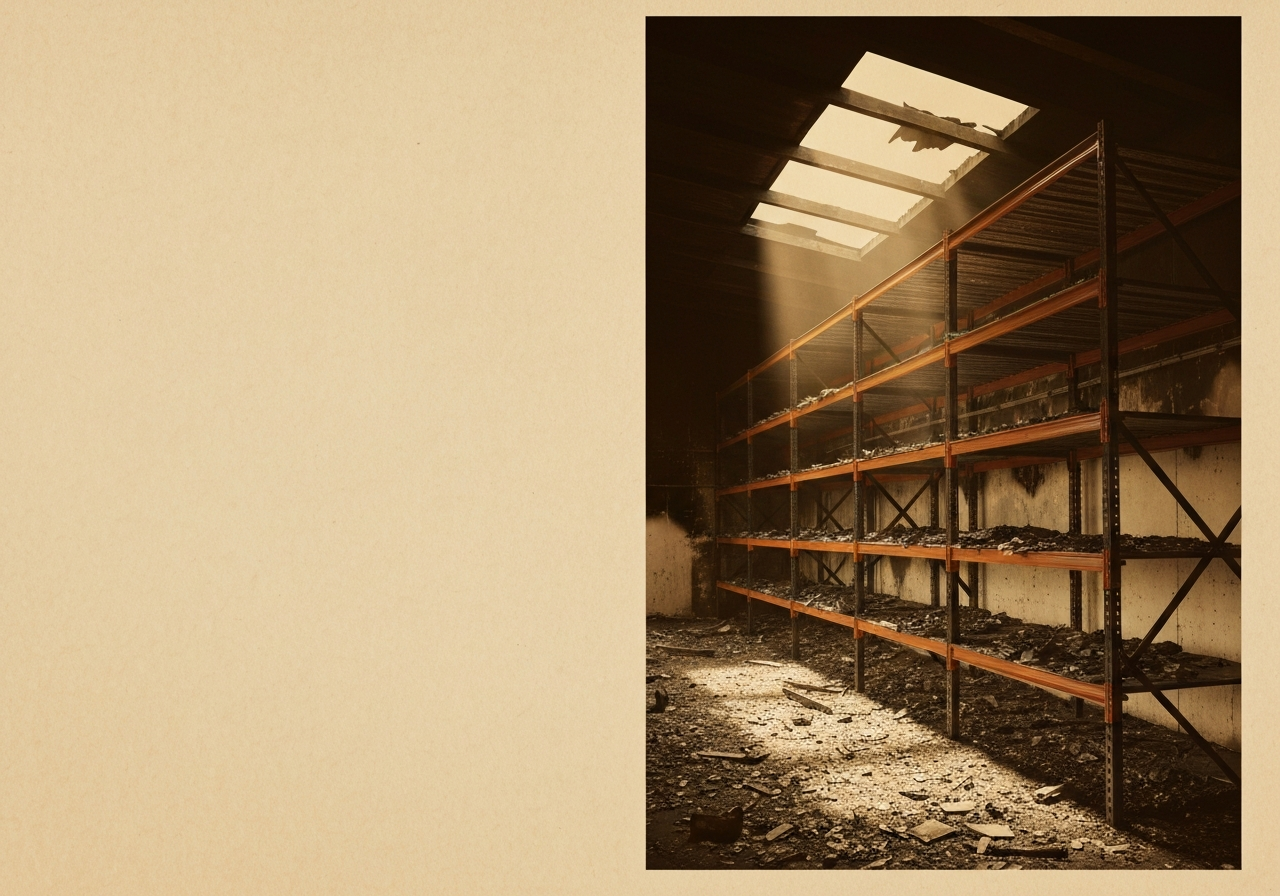
In July 2008, a fire tore through a warehouse holding Levi Strauss India's stock. The heat was intense, the smoke thick, and by the time the flames were doused, the goods inside were reduced to ash and twisted metal. The company had paid premiums for a domestic fire insurance policy from United India Insurance. It also had the backing of its global parent's marine policy from Allianz. When the smoke cleared and Levi claimed ₹12.2 crores, United India pointed to a single clause in the fire policy and refused to pay. The question that reached the Supreme Court was deceptively simple: when a fire destroys goods in a warehouse, can an insurer say the loss belongs to a marine policy — and get away with it?
When the fire policy had a catch
Levi Strauss India held a Standard Fire and Special Perils (SFSP) Policy from United India Insurance. Separately, its parent company had taken out two global policies from Allianz: a Stock Throughput Policy (STP) and an All Risks Policy (AR Policy). These covered Levi's stock worldwide, including the goods in the Indian warehouse.
After the fire, Levi claimed ₹12.2 crores from United India. The insurer repudiated the claim — formally rejected it — on 11 September 2009, invoking Condition No.4 of the fire policy. That condition excluded United India's liability for any loss already covered by a marine policy. The insurer argued that the parent's STP Policy was a marine policy, and since it covered the same goods, United India owed nothing. The crisp letterhead of the repudiation, dated that September day, carried the weight of a simple contractual refusal.
Levi had already received $4.54 million from Allianz under the STP Policy. It still sought ₹9.08 crores from United India, arguing that the domestic fire policy should pay the balance.
What the NCDRC decided
Levi approached the National Consumer Disputes Redressal Commission (NCDRC) — the top consumer court in India — with a complaint. In August 2019, the NCDRC allowed the claim partially, awarding ₹1.78 crores. The commission held that Clause 47 of the STP Policy entitled Levi to the benefits of a domestic policy. In the NCDRC's view, the global marine policy itself contemplated that local fire insurance would kick in.
United India appealed to the Supreme Court.
The core dispute: what counts as marine insurance
The Supreme Court had to decide whether the STP Policy was a marine policy under the Marine Insurance Act, 1963. If it was, Condition No.4 of the fire policy would apply, and United India could walk away.
Section 3 of the Marine Insurance Act defines marine insurance as a contract covering loss from marine perils — risks like storms, collisions, and sinking. Section 4 extends this to mixed sea and land risks, covering goods during transit that includes both sea and land legs. The STP Policy described itself as an "Open Marine Insurance Contract" and covered voyage, transit, transportation, and warehouse perils. It had a warehouse-to-warehouse clause — meaning it covered goods from the moment they left one warehouse until they reached another.
Levi argued that because the fire happened in a warehouse, not at sea, the STP Policy could not be a marine policy. The Supreme Court disagreed. The bench — Justices Uday Umesh Lalit, S. Ravindra Bhat, and Pamidighantam Sri Narasimha — held that a policy covering transit and warehousing as part of a continuous journey is a marine policy under Sections 3 and 4, regardless of where the specific loss occurred. The courtroom fell silent as the bench delivered its reading: "The STP Policy is a marine policy under Sections 3 and 4 of the Marine Insurance Act, 1963."
Why the exclusion clause worked
Condition No.4 of the SFSP Policy stated that United India would not be liable for loss covered by any marine policy. Since the STP Policy covered the same goods and the same fire risk during the warehousing period, the exclusion clause applied directly.
The court rejected Levi's argument that Clause 47 of the STP Policy created an obligation on the parent to obtain domestic fire insurance. Clause 47 said the insured was "obligated by legislation" to maintain local policies. Levi pointed to Section 25 of the General Insurance Business (Nationalization) Act, 1972, which prohibits insuring Indian property with foreign insurers. The court held that this was a prohibition on the foreign insurer, not a legislative mandate compelling the insured to buy domestic insurance. "Obligated by legislation" required an express command to insure — not a mere ban on foreign insurers.
Double insurance: you cannot profit from two policies
The court also applied the principle of double insurance — a situation where the same risk is covered by two policies. Once Allianz had paid complete indemnity under the STP Policy, United India was entitled to decline liability. The insured cannot recover more than the actual loss from overlapping policies. Allowing Levi to claim from United India after receiving full payment from Allianz would let it profit from the fire — which insurance law does not permit.
The court cited its own precedent in United India Insurance Co. Ltd. v. Great Eastern Shipping Co. Ltd. (2007) and Export Credit Guarantee Corporation of India Ltd. v. Garg Sons International (2014), both of which held that an insurer who has paid full indemnity is discharged, and the second insurer owes nothing. The court also drew on New India Assurance Co. Ltd. v. Hira Lal Ramesh Chand & Ors. (2008) and Vikram Greentech India Ltd. v. New India Assurance Co. (2009) to reinforce the principle that exclusion clauses in fire policies must be given their plain meaning.
What the Supreme Court finally held
The bench allowed United India's appeal and set aside the NCDRC order. The court held:
- The STP Policy was a marine policy under Sections 3 and 4 of the Marine Insurance Act, 1963.
- Condition No.4 of the SFSP Policy excluded United India's liability because the same risk was covered by a marine policy.
- Section 25 of the Nationalization Act did not create a legislative obligation on Levi to obtain domestic insurance.
- Since Allianz had paid complete indemnity, United India was entitled to decline the claim.
Levi's claim under the domestic fire policy was rejected entirely.
THE PLAY: When drafting a fire policy with an exclusion for marine coverage, ensure the exclusion clause is broad enough to cover any marine policy held by the insured or its parent — and verify whether the parent's global policy contains a warehouse-to-warehouse clause that triggers the exclusion.
The fire destroyed the goods. The marine policy paid. The fire insurer walked free.