A mother held a family deed. The court said: who better?
Three brothers fought over a document. The judge ruled it was in proper custody because no one is more neutral than the woman who raised them all.
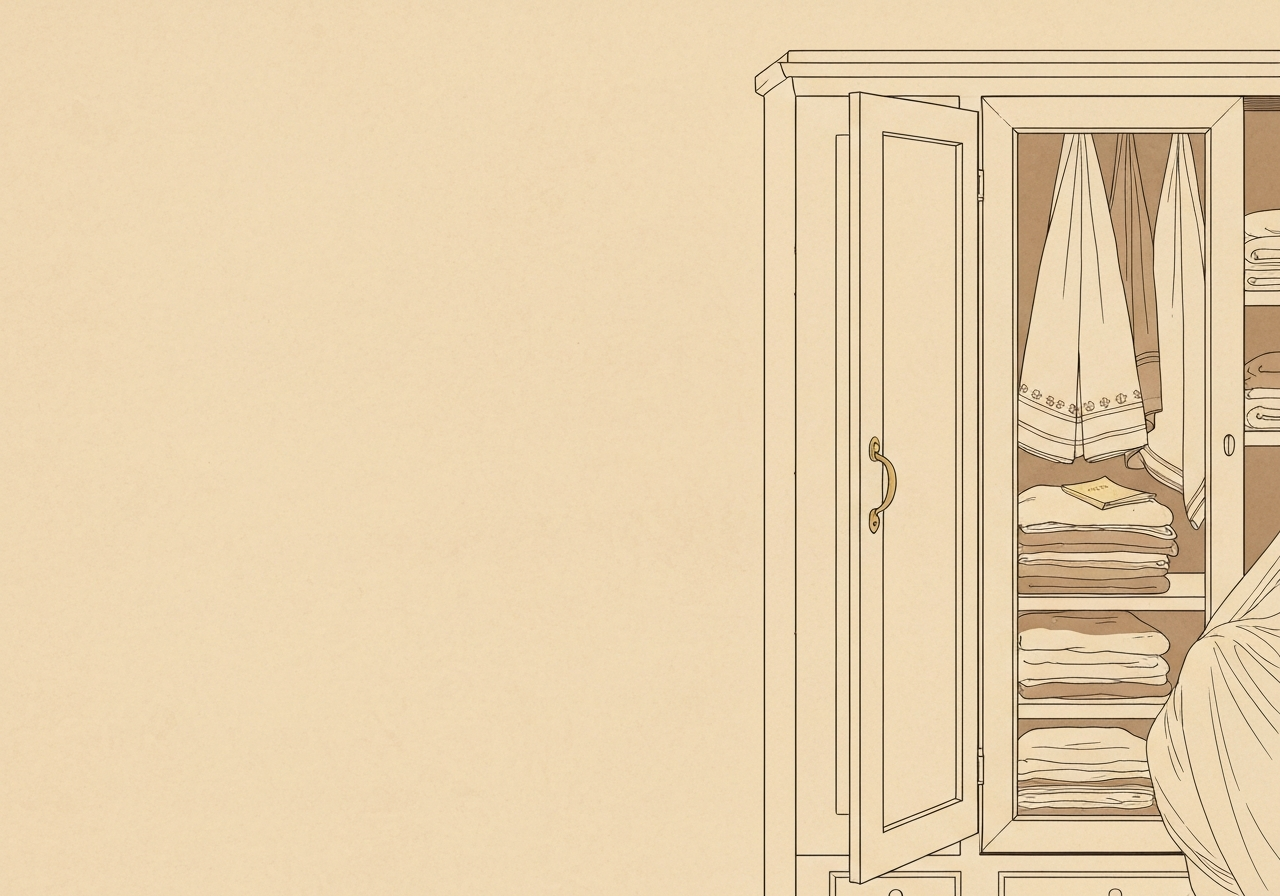
Held.
Mother's cupboard.
Proper custody.
Three brothers fought over a document. The judge ruled it was in proper custody because no one is more neutral than the woman who raised them all.
The deed was in the mother's cupboard. The court asked: who else would keep it safe?
The courtroom smelled of old paper and dust. A ceiling fan turned slowly overhead, its blades throwing long shadows across the wooden benches. Three brothers stood on opposite sides. One held a document — a yellowed sheet, folded four times, with Hindi script in fading blue ink. It was a deed that decided who owned what in a family that was now splitting apart. The other two said the document should not even be looked at. Their objection was not about what the deed said. It was about where it had been found.
The deed had come from their mother's steel almirah — a heavy cupboard with a brass handle, tucked in the corner of the kitchen, stacked alongside old saris and a tin of dried spices. And the question before the court was this: does a document lose its legal value simply because the person who kept it was not a party to the transaction?
When the mother held the paper
The case of Darshan Singh v. Prabhu Singh began like many family disputes in India — with a piece of paper that one brother had and the other two did not want him to have. The deed related to the affairs of three brothers. It recorded how the family's property was meant to be shared, or how it had been divided, or what each brother's rights were. The edges of the paper were frayed, as if it had been handled many times, and a faint thumbprint marked one corner.
One brother produced the deed in court. He said: this document proves my claim.
The other two brothers objected. They argued that the deed should not be admitted as evidence because it had not come from proper custody. The person who had kept it — their mother — was not a party to the transaction. She had not signed the deed. She had not been mentioned in it. She was, in their view, a stranger to the document. Their voices grew sharp as they pressed their point: how could a document kept by someone with no legal interest in it be trusted?
The court had to decide a narrow but critical question: what counts as proper custody of a document?
The objection that could have killed the case
Under the Indian Evidence Act, a document cannot simply be thrown into court by anyone who happens to have it. The law requires that a document be produced from what is called "proper custody" (a person who had a legitimate reason to keep it). This is not a technical trick. It is a rule designed to prevent forged or stolen documents from being used as evidence. If a deed suddenly appears from the pocket of a stranger, the court has reason to be suspicious.
But the rule is also flexible. Proper custody does not mean the document must always be with the person who signed it. It means the document must be with a person who had a legitimate reason to keep it — a reason that makes sense given the circumstances.
The two brothers argued that their mother had no such reason. She was not a party to the deed. She had no legal interest in it. Therefore, they said, the document should be rejected. Their lawyer gestured at the deed, its frayed edges, its faded ink: look at this paper, kept by a woman who never even touched the transaction. How can it be proper custody?
The courtroom fell silent. The ceiling fan continued its slow rotation. The judge looked at the deed, then at the brothers, then at the empty chair where the mother would have sat — had she been called to testify. She was not there. She had never been asked.
Why the mother was the right person
The court disagreed with the brothers. And the reasoning was as simple as it was powerful.
The court observed that "proper custody is custody proved to have had a legitimate origin or an origin the legitimacy of which the circumstances of the case render probable." In plain language: you do not need to prove exactly how the document reached the person who has it. You only need to show that it makes sense — given the situation — that the document ended up with that person.
And what situation could be more natural than a mother keeping the family papers? The deed had been in her steel almirah, next to her saris, in a house where three sons had grown up. She had not hidden it. She had not claimed ownership of it. She had simply kept it — as she had kept their school certificates, their old photographs, the receipts from their weddings.
The court concluded that the custody was proper. The reasoning was direct: "as there could be no better custodian than the mother to whom all the three sons are alike."
The mother was not a party to the transaction. She had no personal stake in which brother got what. But she was the one person in the family who was neutral — who loved all three sons equally. If the deed had to be kept somewhere safe, where no single brother could hide it or destroy it, the mother's cupboard was the most natural place in the world.
The judge's voice was calm as he read the finding. The brothers shifted on their feet. The deed lay on the table, its blue ink still legible, its thumbprint still visible — a silent witness to a transaction that had happened years ago, in a house that was now divided.
The natural condition test
This case is now a textbook example of what lawyers call the "natural condition test." The test asks a simple question: would a reasonable person, knowing the circumstances of the family and the nature of the document, expect the document to be with this person?
If the answer is yes, the custody is proper. The document can be admitted as evidence. The court will then look at the document itself — what it says, whether it is genuine, whether it has been tampered with — and decide how much weight to give it.
If the answer is no, the document may be rejected before anyone even reads it.
In this case, the answer was clearly yes. A deed about the affairs of three brothers, kept by the mother who raised them all — there was nothing suspicious about that. The court did not need to know exactly how the deed reached her hands. The circumstances made it probable that she was the right person to hold it.
The test is not about formal custody. It is about human reality. A mother's cupboard is not a bank vault. But for a family deed, it may be the safest place of all.
What this means for family disputes
For lawyers and litigants, this case offers a practical lesson. When you produce a document in court, you must be ready to explain why it is with you. But the explanation does not need to be a chain of custody with dates and signatures. It can be a simple, human explanation that any judge would accept.
If a document is with the family matriarch, with the family accountant, with the family lawyer — people who have no personal interest in the dispute but who naturally hold family papers — the court is likely to accept that as proper custody.
The key is legitimacy, not formality. A document does not become suspicious just because it was kept by someone who was not a party to it. It becomes suspicious only when it is kept by someone who had no reason to have it at all.
In this case, the mother had every reason. She was the one person who belonged to all three brothers equally. She was the natural custodian — not because the law said so, but because the family itself said so.
THE PLAY: When producing a family document in court, do not panic if it was kept by a neutral family member — the natural condition test treats a mother's cupboard as the most proper custody of all.
The deed stayed in evidence. The case moved forward. And the mother, who never spoke a word in court, had already said everything that mattered: she kept the paper because it belonged to all her sons.