A priest heard a thud at midnight. He peeped out and saw a murder. The Supreme Court just upheld the conviction — but flagged a key error in how the weapon was handled.
Two eyewitnesses saw the attack. But the court found serious flaws in the 'discovery' of the hammer. Here's why the conviction still stood — and what the judges want changed.
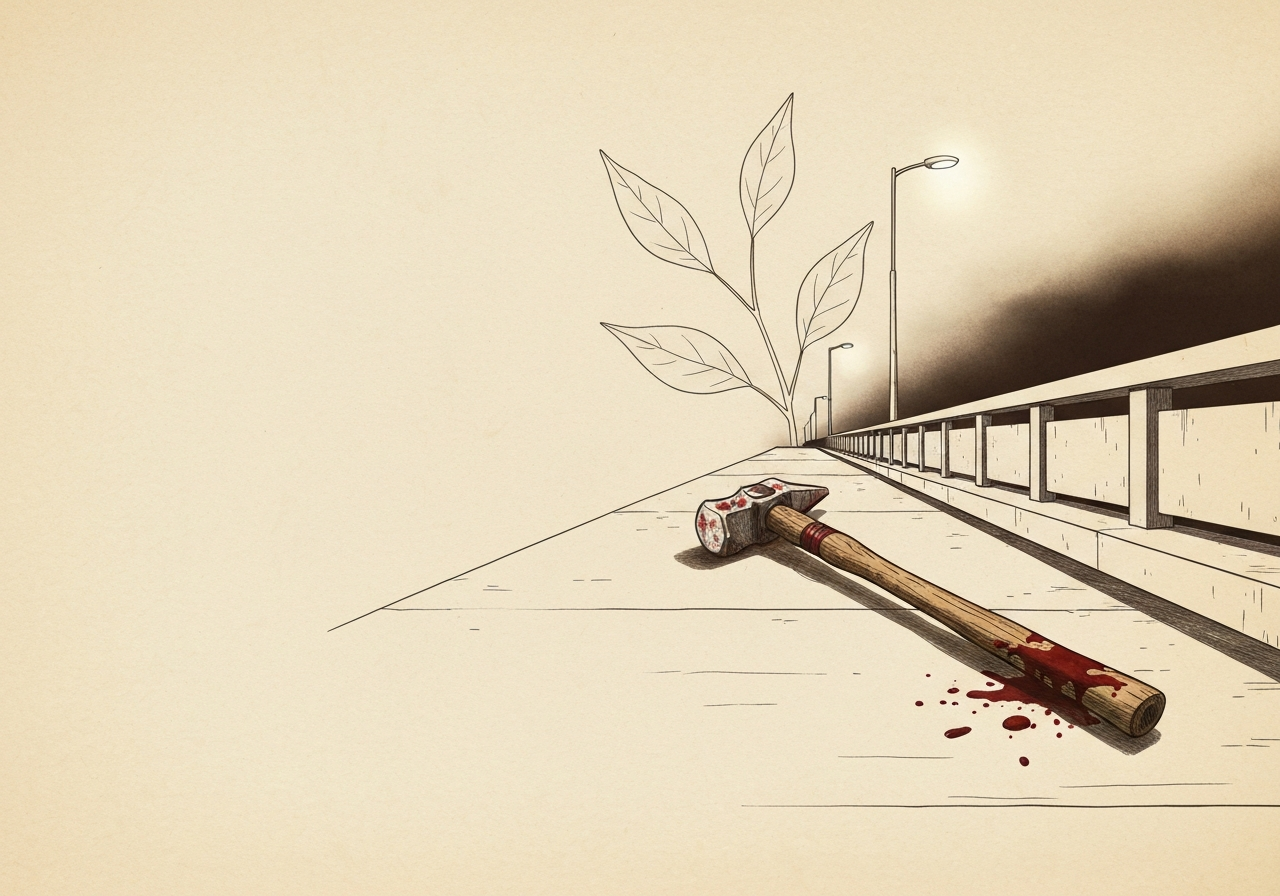
Upheld.
Life sentence
Flawed evidence.
Two eyewitnesses saw the attack. But the court found serious flaws in the 'discovery' of the hammer. Here's why the conviction still stood — and what the judges want changed.
A temple priest heard a thudding sound at midnight. He looked out and saw a man hitting a sleeping labourer with a hammer. The attacker walked away and admitted the crime. The Supreme Court upheld the life sentence — but slammed the way the weapon was handled.
The question was simple: could a man be sent to prison for life when the weapon used in the crime was recovered through a legally flawed procedure? The Supreme Court said yes — but only because two eyewitnesses had seen everything. The judges then spent a significant part of their judgment explaining why the way the hammer was discovered should never have been accepted as evidence at all.
The quarrel that ended on a bridge
Mahankal Jaiswal and Shahaja Ismail Mohd. Shaikh worked as labourers in Mumbai's Vile Parle area. On the night of December 10, 2006, the two men argued over money near the railway station. The dispute did not end there.
Around midnight, Jaiswal lay sleeping on a bridge near a Hanuman temple. Shaikh approached him with a hammer and struck him on the head. The blow was delivered while the victim was unconscious, defenceless.
A temple priest who lived nearby — recorded in court records as PW-1 — heard a thudding sound. He peeped out and saw the attack in progress. Another labourer sleeping on the same bridge, PW-8, also witnessed the assault. PW-1 confronted Shaikh as he walked away, still holding the hammer. Shaikh admitted to the priest that he had killed Jaiswal.
The next morning, an FIR (a written complaint that starts a police investigation) was lodged. Shaikh was arrested. A hammer stained with human blood matching Jaiswal's blood group was recovered at his instance.
When the trial court and High Court agreed
The trial court convicted Shaikh of murder under Section 302 of the Indian Penal Code (the provision that defines murder and prescribes punishment, including life imprisonment or death). He was sentenced to life imprisonment and a fine of Rs 1,000.
Shaikh appealed to the Bombay High Court. The High Court examined the evidence and dismissed the appeal, affirming the conviction. The case then reached the Supreme Court through a special leave petition under Article 136 of the Constitution (the Supreme Court's discretionary power to hear appeals against any judgment of any court or tribunal in India).
What the Supreme Court found wrong with the weapon
The Supreme Court bench — Justice Surya Kant and Justice J.B. Pardiwala — began by examining the evidence of the two eyewitnesses. They found it reliable. The priest and the fellow labourer had no reason to lie. Their presence at the scene was natural. Their testimony had what the court called "a ring of truth." Minor contradictions, the judges said, do not warrant discarding an entire testimony if the core of the evidence is credible.
But then the court turned to the discovery of the hammer. This is where the judgment took a sharp turn.
The prosecution had relied on Section 27 of the Indian Evidence Act (a provision that allows the court to admit as evidence a fact discovered in consequence of information received from an accused person in custody). The idea is simple: if an accused tells the police, "I hid the weapon behind a bush," and the police then find the weapon behind that bush, the fact of discovery can be used against the accused.
The Supreme Court found that the trial court and the High Court had both misunderstood how Section 27 works.
The problem with the panchnama
The discovery of the hammer was recorded in a document called a panchnama (a written record of a search or seizure, signed by independent witnesses called panchas). The Supreme Court pointed out two serious flaws.
First, the prosecution had failed to establish that Shaikh was the person who had concealed the hammer. The court clarified that mere discovery of a weapon at the instance of an accused does not automatically mean the accused hid it. The accused could have derived knowledge of the weapon's location through other sources — he might have seen someone else hide it, or he might have been told about it. Discovery proves at best that the accused knew where the weapon was. It does not prove that he concealed it or used it.
Second, the panchnama itself had procedural defects. The court explained that the contents of a panchnama are not substantive evidence in themselves. The real evidence is what the panch witnesses say in court, on the witness stand. The panchnama must be read over to the panch before it is exhibited in court. If there is any difference between what the panch says in court and what the panchnama records, the panch must be specifically asked whether the written portion is correct. None of this had been done properly.
Why the conviction still stood
Despite these serious flaws, the Supreme Court did not set aside the conviction. The reason was the eyewitnesses.
The two witnesses had seen the attack. The priest had confronted Shaikh immediately afterward. Shaikh had admitted the crime to the priest while still holding the hammer. The medical evidence — the post-mortem report showing a fatal head injury caused by a blunt object — corroborated the eyewitness accounts. The blood on the hammer matched the deceased's blood group.
The court applied the test laid down in the case of Bharwada Bhoginbhai Hirjibhai v. State of Gujarat: when assessing eyewitness evidence, the two principal considerations are whether it is possible to believe the witnesses' presence at the scene in circumstances that enabled them to witness the facts, and whether there is anything inherently improbable or unreliable in their evidence. The court found both conditions satisfied.
The conviction under Section 302 IPC was upheld. The appeal was dismissed.
The clarification on Section 27 and Section 8
But the court did not stop there. It used the case to clarify the law on two important provisions of the Evidence Act.
On Section 27, the court reiterated the principle from the Privy Council case of Phulukuri Kottaya v. Emperor: only that portion of the information given by the accused which distinctly relates to the fact discovered is admissible. The fact discovered must be the direct result of the information. The court also cited State of Uttar Pradesh v. Deoman Upadhyaya and Mohmed Inayatullah v. State of Maharashtra to reinforce that the prosecution must establish authorship of concealment — that the accused not only knew where the weapon was, but that he was the one who hid it there.
On Section 8 of the Evidence Act (which deals with motive, preparation, and previous or subsequent conduct of the accused), the court clarified that even if the discovery evidence under Section 27 is discarded, the conduct of the accused may still be relevant under Section 8. But the court added a crucial caveat: such conduct alone cannot form the basis of a conviction for a serious offence like murder. It can only be supporting material, never the main pillar.
What this means for criminal trials
For defence lawyers, this judgment is a powerful tool to challenge discovery evidence that has not been properly handled. If the prosecution cannot prove that the accused concealed the weapon, and if the panchnama has not been properly exhibited, the discovery evidence should be discarded.
For prosecutors, the message is clear: eyewitness testimony remains the gold standard, but discovery evidence must be handled with precision. A sloppy panchnama can be challenged — and should be.
THE PLAY: When challenging a discovery panchnama, demand that the prosecution prove not just that the accused knew where the weapon was, but that he was the one who hid it there — and ensure the panch witnesses confirm the panchnama contents on the stand.
The hammer was flawed evidence. But the eyes that saw the blow — those could not be undone.