A skeleton, a father's blood, and a DNA match that sealed a murder case
When no witness came forward, the Supreme Court turned to science—and convicted a man using a bone and a blood sample.
22
years.
When no witness came forward, the Supreme Court turned to science—and convicted a man using a bone and a blood sample.
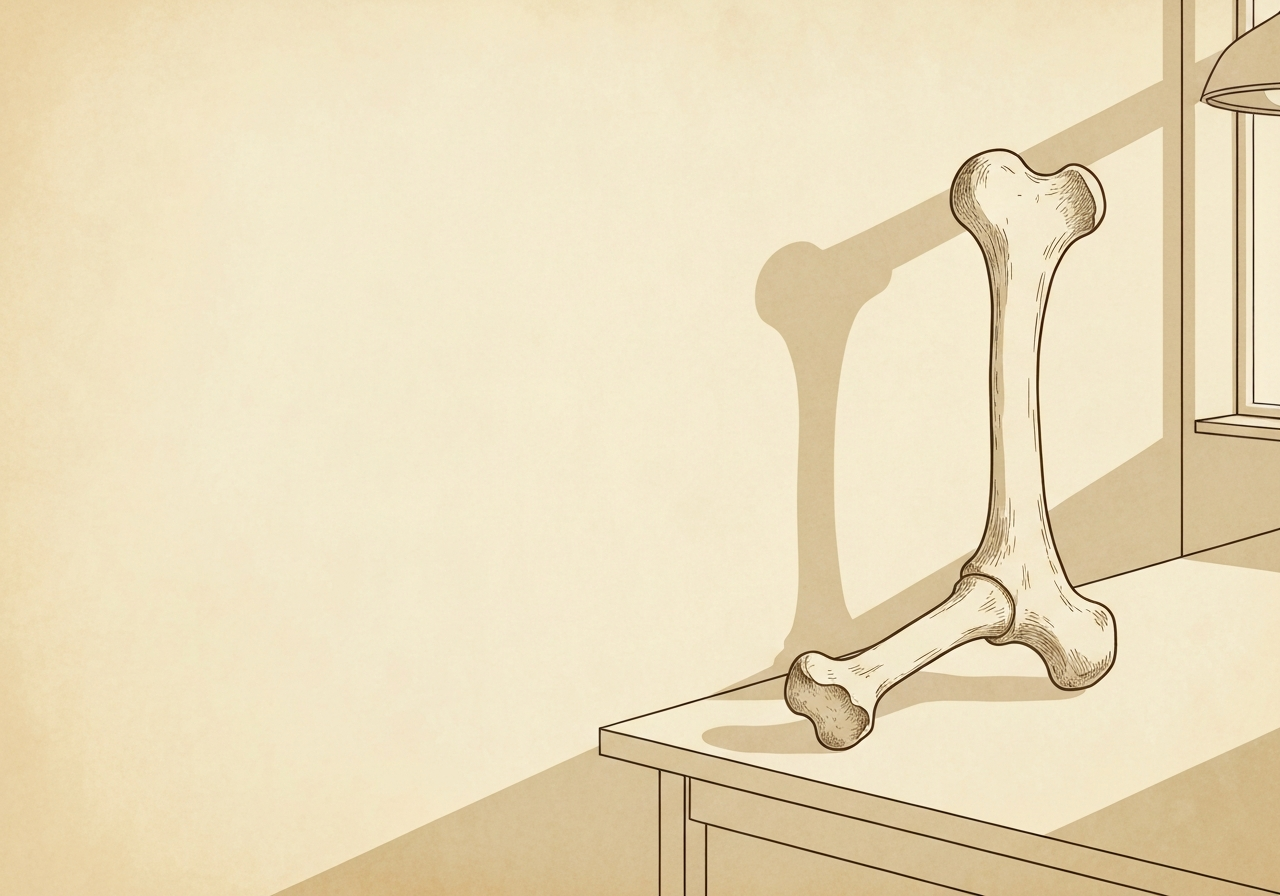
The skeleton was all they had. No eyewitness. No confession. Just a bone and a father's blood.
In a police station in Varanasi, a cardboard box sat on a metal table. The air in the room was stale, smelling of old paper and dust. Inside the box lay the remains of a young woman—a tourist named Diana, 22 years old, who had vanished months earlier. Her family had searched. The police had searched. And then, in a shallow grave outside the city, they found her bones.
The question that followed was brutal in its simplicity: How do you prove whose skeleton that is, when the flesh is gone and no one saw what happened?
The answer would reach the Supreme Court, and it would change how Indian courts think about science, evidence, and the weight of a single bone.
When the tourist never came home
Diana arrived in Varanasi in the year of the incident. She was 22, a tourist travelling alone. She checked into a guesthouse. Then she disappeared.
Her family filed a missing person report. The Uttar Pradesh Police searched for months. Eventually, a tip led them to a shallow grave outside the city. They dug. The smell of damp earth filled the air as they uncovered the bones. They found a skeleton.
The bones went for forensic examination. But the police knew a skeleton tells no name. They needed a way to link those bones to the missing woman—and to the man they suspected of killing her: Dharam Deo Yadav.
The problem with witnesses
This is where most murder cases hit a wall. In India, conviction rates in criminal trials remain low. The reason, as the Supreme Court would later note, is that witnesses are hard to find.
"Reliable, trustworthy, credible witnesses to the crime seldom come forward to depose before the court," the bench observed. People are afraid. They move away. They forget. Or they simply refuse to get involved.
In Dharam Deo Yadav's case, no one had seen the murder. No one had watched the body being buried. The prosecution had a skeleton, a suspect, and a theory. What it did not have was a single human being willing to say: "I saw what happened."
That left the police with one option: science.
A bone, a blood sample, and a match
The investigating agency sent the skeleton to a forensic laboratory for complex DNA testing (a method of identifying individuals by comparing unique genetic markers in their cells). They also obtained a blood sample from Diana's father.
The logic was straightforward. If the DNA extracted from the bone marrow matched the DNA in the father's blood, the skeleton belonged to his daughter. If it did not, the case would collapse.
The lab ran the tests. The results came back: a match.
But matching DNA in a laboratory is one thing. Convincing a court to accept that match as proof of identity—when the entire case hinges on it—is another.
What the defence argued
Dharam Deo Yadav's lawyers did not challenge the science of DNA testing itself. Instead, they questioned the process. Who had handled the bone? How was it stored? Could the sample have been contaminated? Were the technicians qualified to run the tests?
These are not frivolous questions. In any criminal trial, evidence is only as good as the chain that brings it to court. A bone dug from the ground, passed through multiple hands, stored in a police station, and then sent to a lab—every step creates an opportunity for error.
The defence argued that the prosecution had not proved that the bone they tested was the same bone they had recovered. Without that link, the DNA match meant nothing.
Why the Supreme Court looked at the experts
The Supreme Court did not dismiss these concerns. Instead, it examined the people who had done the testing.
The bench noted that the sampling and analysis had been carried out by experts whose scientific knowledge and experience were not questioned by the defence. No one had argued that the technicians were unqualified. No one had pointed to a specific error in the procedure.
What the defence had done, the Court found, was raise a general suspicion—without evidence to back it up. And a general suspicion, the Court said, is not enough to throw out a scientific result.
This is a crucial distinction. The law does not require that every conceivable doubt be eliminated. It requires that the evidence be reliable enough to convince a reasonable person. And when the experts are qualified, the process is documented, and the results are clear, a DNA match can carry that weight.
The judgment: science as a witness
The Supreme Court held that the prosecution had succeeded in proving that the skeleton recovered was that of Diana, based on the DNA match with her father's blood.
But the Court did not stop there. It used the case to make a broader point about the state of criminal justice in India—and about the low conviction rates that plague the system.
"Criminal Judicial System in this country is at cross-roads," the bench observed. "Many a times, reliable, trustworthy, credible witnesses to the crime seldom come forward to depose before the court... Investigating agency has, therefore, to look for other ways and means to improve the quality of investigation, which can only be through the collection of scientific evidence."
In other words: when witnesses vanish, science must step in. Not as a replacement for traditional evidence, but as a supplement—a way to fill the gaps that human fear and fallibility leave behind. The Court's emphasis on adopting scientific methods in crime detection was rooted in a stark reality: without such methods, conviction rates would remain low, and justice would remain elusive.
The trap the Court warned against
Yet the judgment also carried a warning. The Court stressed that while forensic science is powerful, it must be built on "legal foundations that are sound in science as well as in law."
This is the trap that many cases fall into. A DNA report arrives, and everyone—police, prosecutors, judges—treats it as infallible. But science is only as good as the people who perform it and the procedures they follow. A contaminated sample, a mislabelled tube, a technician who cuts corners—any of these can produce a match that is false.
The Court's message was clear: adopt science, but do not worship it. Test it. Question it. And only then, if it holds up, rely on it. The case illustrated the paramount need to adopt scientific methods in crime detection, but also the critical importance of ensuring that those methods rest on legal foundations that are sound in science as well as in law.
What this means for every criminal trial
For lawyers and investigators, Dharam Deo Yadav v. State of U.P. offers a practical lesson. When eyewitnesses are unavailable, scientific evidence can carry the case—but only if the chain of custody (the documented history of who handled the evidence, when, and under what conditions) is airtight, and only if the experts are beyond reproach.
For the rest of us—the doctors, the journalists, the college students reading this—the case answers a deeper question. How do you convict someone when no one saw the crime? You look at what the crime left behind. A bone. A drop of blood. A strand of hair. And you ask science to tell you whose they are.
THE PLAY: In any case where scientific evidence is the sole link between the accused and the crime, the prosecution must lead expert testimony establishing the qualifications of the analyst and the integrity of the sample—or the match is worthless.
The skeleton had a name. The father's blood had confirmed it. And the Court found that the prosecution had proved its case.