Can a witness read from a paper and call it memory?
A court said yes—but only if they swear the paper is right, even if they don't remember the facts themselves.
"I am sure the document is correct"
The one sentence that unlocks the doorSodhi Pindi Das v. Emperor
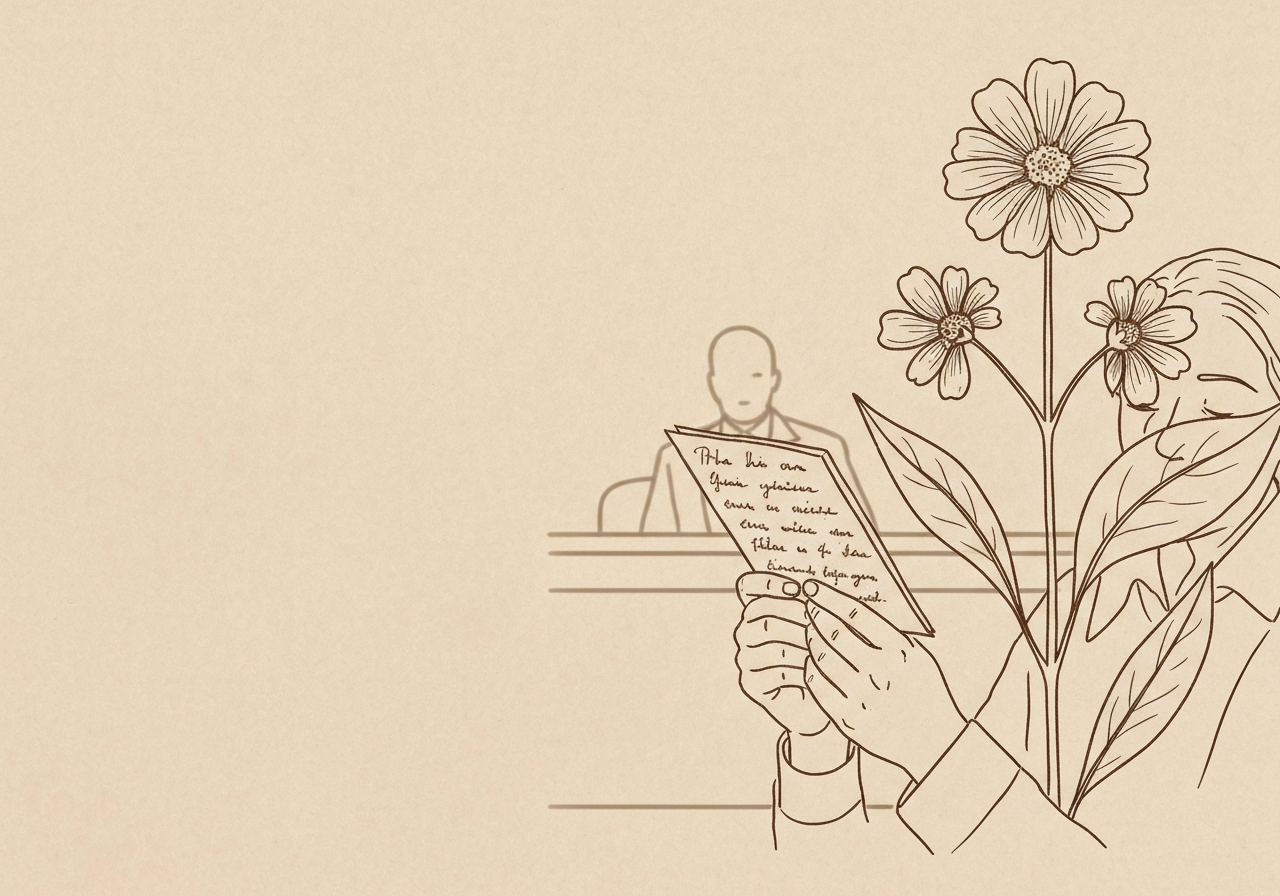
A court said yes—but only if they swear the paper is right, even if they don't remember the facts themselves.
A witness took the stand. He had no memory of what happened. But he had a document. The judge asked: can you swear this paper is true?
The courtroom went still. The witness looked at the paper in his hand. He had written it months ago. But his mind was blank. No date. No conversation. No face. Just the paper.
Is that testimony—or just reading aloud?
The answer, as the court in Sodhi Pindi Das v. Emperor made clear, depends on one sentence. One sentence spoken in open court. Without it, the paper is just paper. With it, the paper becomes evidence.
The witness who came with a note
Picture the scene. The witness takes the oath. The lawyer begins. "What happened on that day?"
The witness pauses. Nothing comes. Not the time. Not the person. Not what was said.
But he has a note. A diary entry. A receipt he wrote when it happened. He looks at it. Suddenly, he can answer every question.
But is he remembering—or just reading?
This is the exact problem the court faced. A witness using a document to refresh their memory (a process where a witness looks at a written record to recall facts they have forgotten). The court had to decide: what makes this legal?
The one sentence that unlocks the door
The court's ruling was precise. A witness can use a document to refresh their memory—but only if they state orally before the court that although they have no specific recollection of the facts themselves, they are sure that the facts were correctly recorded in the document.
That sentence is the key. Without it, the witness is just reading. With it, the witness is testifying.
Think about what this means. The witness must say: "I do not remember the meeting itself, but I wrote this note immediately after it happened, and I am certain that what I wrote is accurate." The court does not require the witness to magically recover the memory. It only requires the witness to vouch for the document's reliability.
Why this matters in every trial
This ruling has a practical consequence. If a witness cannot personally swear that the document is correct, the testimony is vulnerable. The opposing counsel can stand up and argue: "This witness is not testifying from memory. They are reading from a piece of paper they never verified. How do we know the paper is right?"
The court's requirement closes that attack. When the witness says, "I am sure the document is correct," the testimony becomes credible. It can withstand cross-examination. It can be relied upon by the judge.
For legal teams, the lesson is strategic. Before putting a witness on the stand who will rely on a document to refresh their memory, the team must ensure the witness can honestly make that statement. The witness must be able to say: "I do not remember the facts, but I trust this document."
The trap that catches careless lawyers
Here is where many cases go wrong. A lawyer hands a witness a document during trial. The witness looks at it and starts answering questions. The lawyer assumes the testimony is valid. But the opposing counsel objects: "The witness is reading, not testifying."
The judge looks at the witness. "Can you swear this document is correct?"
If the witness hesitates—if they say, "I think so" or "It seems right" or "I wrote it but I am not sure"—the testimony collapses. The document cannot be used. The evidence is lost.
The court in Sodhi Pindi Das v. Emperor made clear that the standard is not "I think the document is correct." It is "I am sure the document is correct." That is a higher bar. And it must be met orally, in open court, before the testimony can proceed.
A hypothetical: the shopkeeper who kept a ledger
Imagine a shopkeeper who sold goods on credit three years ago. He is now in court to recover the money. The buyer denies the debt. The shopkeeper takes the stand. The lawyer asks: "Do you remember the sale?"
The shopkeeper shakes his head. Three years. Hundreds of customers. He does not remember that particular sale. But he has his ledger. He wrote the entry the same evening, when the transaction was fresh. He looks at the page. He sees the buyer's name, the date, the amount, the goods delivered.
Now the critical moment. The lawyer asks: "Can you swear that this entry is correct?"
The shopkeeper must answer clearly. He must say: "I do not recall the sale itself, but I wrote this entry the same day, and I am certain that what I wrote is accurate." If he says that, the ledger entry becomes his testimony. The judge can rely on it.
But if the shopkeeper says, "I think it is correct" or "It looks like my handwriting," the testimony fails. The buyer's lawyer will tear it apart. The debt may be lost.
This is the practical reality of the Sodhi Pindi Das v. Emperor standard. It is not a technicality. It is the difference between evidence that holds and evidence that crumbles.
Another hypothetical: the clerk who kept minutes
Consider a different scenario. A company secretary took minutes of a board meeting two years ago. A shareholder now disputes what was decided. The secretary is called as a witness. She does not remember the meeting. She attends dozens every year. But she has the minutes she typed the next morning.
She takes the stand. The lawyer shows her the minutes. "Do you recall this meeting?" She says no. "But you wrote these minutes?" She says yes. "Can you swear they are correct?"
She must pause. She must think. She must answer: "I do not remember the meeting, but I wrote these minutes immediately after it, and I am sure they accurately record what was decided." That is the magic sentence. That is what the court requires.
Without that sentence, the minutes are just paper. The shareholder's lawyer can argue that the secretary is reading, not testifying. The evidence is excluded. The case may collapse.
This is why every legal team must prepare witnesses for this moment. The witness must understand that they are not being asked to remember. They are being asked to vouch. They are being asked to stake their credibility on the document's accuracy.
What this means for trial preparation
The strategic implication is clear. When a legal team plans to use a document to refresh a witness's memory, they must do three things.
First, they must confirm that the witness wrote the document or verified it at the time. The witness must have personal knowledge that the document is accurate. A document written by someone else and handed to the witness later will not work. The witness cannot vouch for it.
Second, they must rehearse the oral statement. The witness must be ready to say, in clear words: "I do not recall the facts, but I am certain this document correctly records them." The witness must not hesitate. The witness must not qualify. The statement must be firm.
Third, they must anticipate the cross-examination. The opposing counsel will try to shake the witness's confidence. "How can you be sure? You said you do not remember. Are you guessing?" The witness must hold firm. The answer must be: "I am not guessing. I am relying on the document I wrote at the time, and I am certain it is correct."
If the legal team does this preparation, the testimony will withstand scrutiny. If they do not, the evidence is at risk.
The deeper principle: trust in the record
At its heart, the ruling in Sodhi Pindi Das v. Emperor is about trust. The court trusts the witness's word that the document is reliable. But that trust is not automatic. It must be earned. The witness must speak it aloud, under oath, in open court.
This is why the oral statement is so important. It is not a formality. It is the moment when the witness takes responsibility for the document. It is the moment when the paper becomes evidence. Without that moment, the document is just a piece of paper that someone wrote once. With that moment, it becomes a record that the court can rely on.
For judges, this ruling provides a clear test. When a witness uses a document, the judge can ask: "Did you swear that the document is correct?" If the answer is yes, the testimony can proceed. If the answer is no, the document cannot be used. The test is simple, but it protects the integrity of the trial.
For lawyers, the ruling provides a clear checklist. Before the witness takes the stand, the lawyer must ensure the witness can make the oral statement. If the witness cannot, the lawyer must find another way to prove the facts. Perhaps another witness remembers. Perhaps the document can be admitted through a different witness. But the lawyer must not assume that the document speaks for itself. It does not. The witness must speak for it.
THE PLAY: Before a witness uses any document to refresh their memory, have them state in open court: "I do not recall the facts, but I am certain this document correctly records them."
The witness took the stand. He had no memory. But he had a document. And he swore it was true. That was enough.