COVID-19 extension applies even to commercial suit's 120-day deadline
Supreme Court says the pandemic limitation orders override the non-extendable period for filing a written statement in commercial cases.
19
months.
Supreme Court says the pandemic limitation orders override the non-extendable period for filing a written statement in commercial cases.
A company missed the 120-day deadline to file its written statement in a commercial suit. The court said — the clock stopped during COVID.
The defendant had already lost once in the trial court and again in the High Court. The Commercial Court judge had looked at the calendar, counted 120 days from 6 January 2021, and declared the right to file a written statement forfeited. The High Court agreed. But the Supreme Court saw something the lower courts missed — a set of extraordinary orders that had, in effect, frozen the legal calendar for nearly 19 months.
The question was deceptively simple: Could a company that missed the rigid 120-day deadline for filing a written statement in a commercial suit blame the pandemic and get a second chance?
When the summons arrived during a pandemic
Two companies — Prakash Corporates and Dee Vee Projects Limited — had been business partners on public road construction projects in Chhattisgarh. Dee Vee had sub-contracted portions of the work to Prakash Corporates. Then the money stopped flowing smoothly. Disputes erupted over payments. Prakash Corporates sent an insolvency demand notice — a formal warning that it would drag Dee Vee to bankruptcy court if dues weren't cleared.
Dee Vee struck first. On 21 December 2020, it filed a commercial suit in the Commercial Court at Nava Raipur, Chhattisgarh, seeking recovery of what it claimed were excess payments made to Prakash Corporates. The summons document — a crisp, typed sheet bearing the court's seal — was served on Prakash Corporates on 6 January 2021.
Under the Commercial Courts Act, 2015, the clock started ticking. The defendant had 120 days — no more, no less — to file its written statement (the formal reply to the plaintiff's claims). Unlike ordinary civil suits where courts have discretion to extend the deadline, commercial suits are merciless: the proviso to Order VIII Rule 1 of the Code of Civil Procedure (as amended by the Commercial Courts Act) says the 120-day period is non-extendable. Miss it, and you forfeit your right to file a written statement entirely.
Prakash Corporates appeared in court but kept seeking adjournments. Then the second wave of COVID-19 hit India.
Why the second wave changed everything
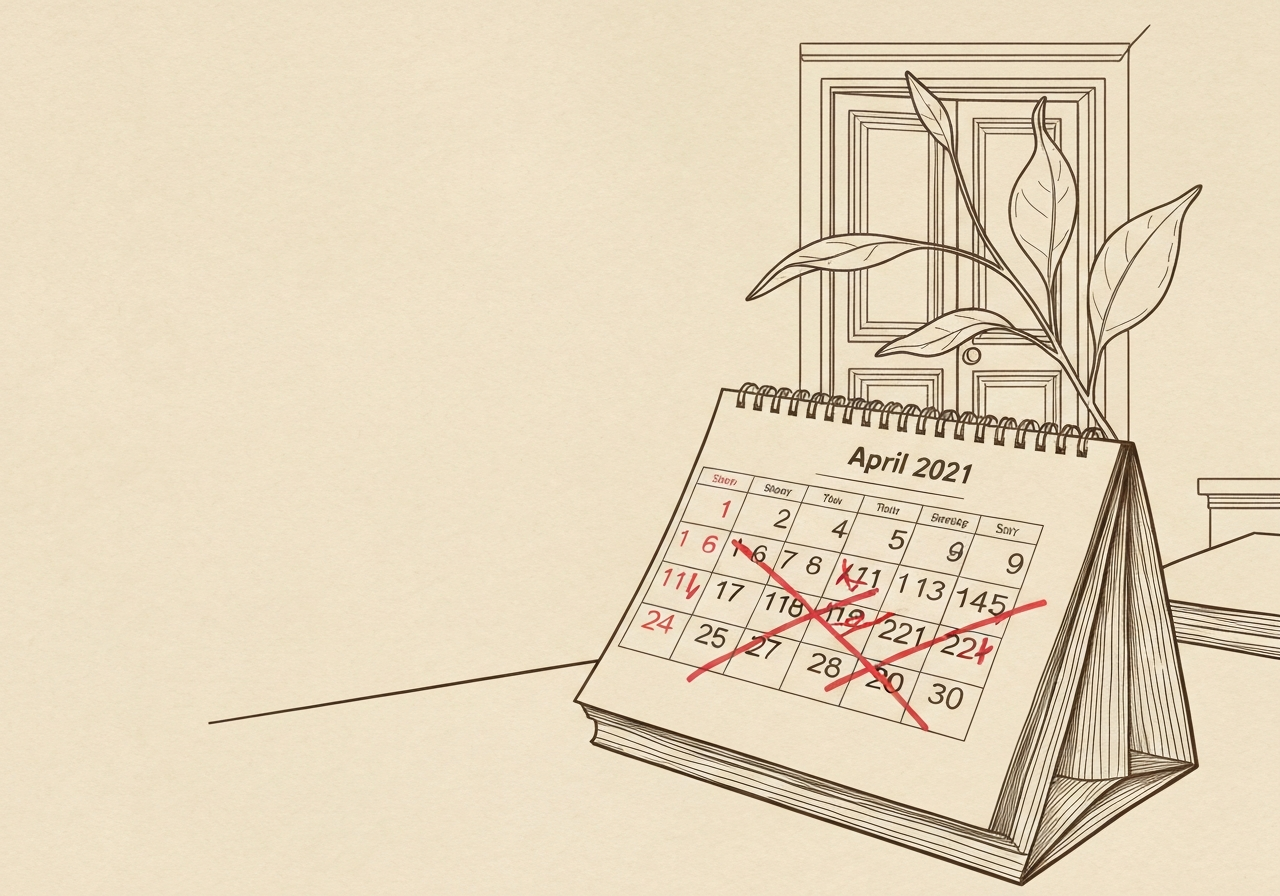
By April 2021, India was drowning. Hospitals overflowed. Courts across the country functioned in curtailed mode — limited benches, restricted hearings, skeleton staff. The Commercial Court in Nava Raipur was no exception. The court registry, usually a hive of shuffling papers and murmured consultations, fell into an eerie silence. For weeks, the court barely operated, its corridors empty, the smell of disinfectant replacing the familiar scent of old case files. The judge's calendar, marked with red ink, showed the deadline had passed — a stark reminder of the procedural machinery grinding to a halt.
When the court finally reopened on 22 June 2021, the judge counted the days. Summons served on 6 January. One hundred and twenty days had passed by early May. The defendant had missed the deadline. The court held that the right to file a written statement was forfeited. No exceptions.
Prakash Corporates rushed to the High Court of Chhattisgarh at Bilaspur with a writ petition under Article 227 (a constitutional power that allows the High Court to supervise lower courts). The High Court dismissed it on 9 July 2021. The defendant was out of options — or so it seemed.
The argument the lower courts missed
Before the Supreme Court, Prakash Corporates raised an argument that had not found favour with the courts below. The Supreme Court, it said, had passed a series of extraordinary orders in a case called SMWP No. 3 of 2020 — a suo motu (on its own motion) proceeding where the court had taken cognisance of the pandemic's impact on the justice system.
Starting from 23 March 2020, and continuing through multiple orders on 6 May 2020, 10 July 2020, 27 April 2021, and 23 September 2021, the Supreme Court had directed that the period of limitation for all legal proceedings — whether in courts, tribunals, or before any authority — would stand extended. The period from 15 March 2020 to 2 October 2021 was to be excluded entirely from the computation of limitation.
These orders, Prakash Corporates argued, were not limited to the Limitation Act, 1963 (the law that sets time limits for filing cases). They applied to all time limits prescribed under any law — including the 120-day deadline for filing a written statement in a commercial suit.
For litigants caught in similar binds, this ruling clarifies that the COVID-19 extension orders are not confined to limitation statutes. Any party that missed a procedural deadline during the pandemic's peak — even in fast-track commercial litigation — can now argue that the clock was frozen by the Supreme Court's own directive.
The plaintiff's counter: a non-extendable deadline is non-extendable
Dee Vee Projects Limited pushed back hard. The Commercial Courts Act, it argued, was designed for speed. The 120-day deadline under Order VIII Rule 1 was deliberately made non-extendable — no court could grant even a single day beyond 120. The Supreme Court's COVID-19 orders could not override a specific statutory command that Parliament had intentionally made inflexible.
The plaintiff pointed to the scheme of the Commercial Courts Act: Section 16 says the court shall follow the provisions of the Code of Civil Procedure as amended by the Act. Order VIII Rule 10 says that if a defendant fails to file a written statement within the prescribed period, the court can pronounce judgment against them. These were mandatory, not discretionary. The COVID-19 orders, the plaintiff said, dealt with limitation under the Limitation Act — not with procedural deadlines that carried their own penal consequences.
What the Supreme Court saw in its own orders
The bench of Justice Dinesh Maheshwari and Justice Vikram Nath examined the text of the suo motu orders. The Supreme Court's order sheet, a single page with the court's seal, listed the dates of its own orders — each one a lifeline for parties caught in the pandemic's grip. The orders were sweeping in their language. They extended limitation in all proceedings — "whether civil or criminal, including commercial matters." The court had used its power under Article 142 of the Constitution (the Supreme Court's extraordinary power to pass orders necessary for complete justice) to override ordinary legal provisions.
The Supreme Court held that these orders were "extraordinary measures in extraordinary circumstances." Their operation could not be curtailed by pointing to the ordinary operation of law — including mandatory statutory timelines. If the court's own orders said the period from 15 March 2020 to 2 October 2021 was to be excluded from computing any limitation period, that applied to the 120-day window for written statements too.
The court also noted a practical reality: from April 2021, courts were functioning in curtailed mode. The defendant could not have filed its written statement even if it wanted to — the court was barely open. "Rules of procedure are intended to subserve the cause of justice and not for punishment of parties," the bench observed, giving the piece a moment of direct judicial voice. Provisions like Order VIII Rules 1 and 10 provide consequences for omission but are not intended to override all other provisions or extraordinary judicial orders.
The court cited its own precedents — SCG Contracts (India) Pvt. Ltd. v. K.S. Chamankar Infrastructure Pvt. Ltd., SS Group Pvt. Ltd. v. Aaditiya J. Garg, Sagufa Ahmed v. Upper Assam Polywood Products Pvt. Ltd., S. Kasi v. State, and New India Assurance Co. Ltd. v. Hill Multipurpose Cold Storage (P) Ltd. — all cases where the court had held that procedural rules must yield to the overriding objective of doing substantial justice.
When the clock restarted
The Supreme Court allowed the appeal on 14 February 2022. It set aside the orders of the Commercial Court dated 22 June 2021 and the High Court dated 9 July 2021. Prakash Corporates was permitted to file its written statement. The 120-day clock, the court held, had stopped on 15 March 2020 and restarted only on 3 October 2021. The period in between did not count.
The court did not stop there. It also noted that Prakash Corporates had filed an application under Section 10 of the Code of Civil Procedure (a provision that stays a suit when another suit on the same matter is pending between the same parties). Such an application, the court said, requires immediate consideration before any other step in the suit — because if granted, the trial cannot proceed at all. The bench emphasised that an application under Section 10 CPC, by its very nature, requires immediate consideration before any other steps in the suit, because if granted, the trial is not to proceed at all.
THE PLAY: If you missed a procedural deadline in a commercial suit between 15 March 2020 and 2 October 2021, the Supreme Court's suo motu orders exclude that entire period — even for deadlines that are otherwise non-extendable.
The clock had stopped. But it had started again. The defendant got its day in court — not because the rules were bent, but because the Supreme Court remembered that it had, for a time, suspended time itself.