He got bail by hiding his pending Supreme Court case. The top court found out.
Kusha Duruka filed a second bail application without disclosing his earlier rejection or the pending SLP. The High Court granted bail, but the Supreme Court called it a fraud on the court.
23.8
kg.
Kusha Duruka filed a second bail application without disclosing his earlier rejection or the pending SLP. The High Court granted bail, but the Supreme Court called it a fraud on the court.
He had a bail case pending in the Supreme Court. So he filed a fresh one in the High Court—and didn't mention the first. On October 11, 2023, a judge in Cuttack signed an order setting Kusha Duruka free. The judge believed his case was identical to a co-accused who had already been granted bail. What the judge did not know—because Duruka had carefully not told him—was that the Supreme Court was already examining the exact same question.
The 23.8 kg that started everything
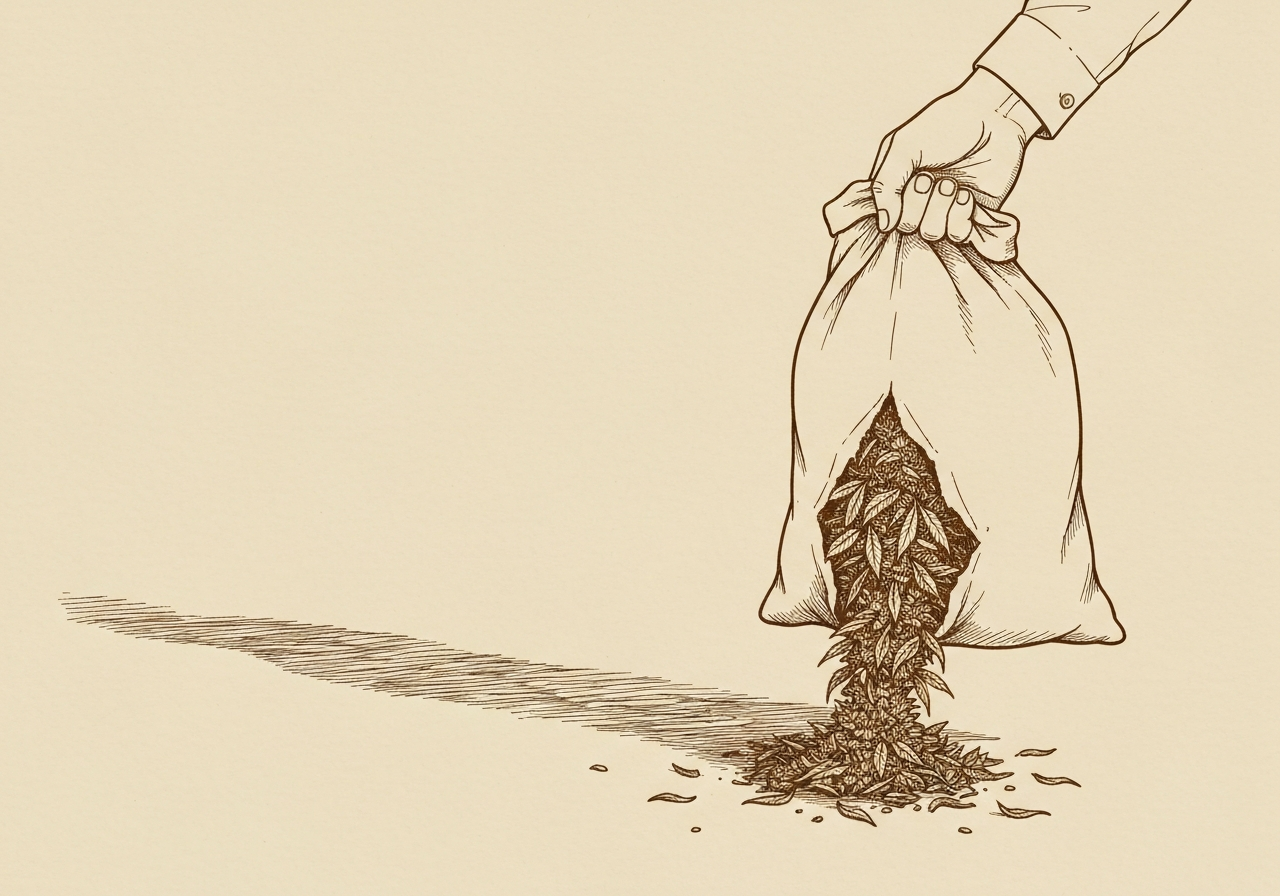
On February 3, 2022, police in Odisha's Malkangiri district stopped two men. In their possession: 23.8 kilograms of ganja, packed in gunny sacks. The smell of the contraband hung in the air as the seizure was documented. Kusha Duruka and Gangesh Kumar Thakur were arrested the same day and charged under Section 20(b)(ii)(C) of the NDPS Act, 1985—the provision that punishes commercial quantities of cannabis with a minimum ten-year sentence.
Both men applied for bail the very next day, on February 4, 2022. The Sessions Judge-cum-Special Judge in Malkangiri rejected them both. So they went higher.
One got out. One didn't.
Thakur approached the Orissa High Court and secured bail on January 17, 2023. Duruka tried the same route. On March 6, 2023, the High Court rejected his bail application. The reasoning: the quantity was commercial, the investigation was ongoing, and there was nothing yet to show that Duruka deserved the same treatment as Thakur.
Duruka did not give up. In July 2023—specifically, on July 21—he filed a Special Leave Petition (SLP)—an appeal to the Supreme Court against a High Court order—challenging the rejection. On September 22, 2023, the Supreme Court issued notice on his SLP. That meant the top court was actively considering his case. The matter was alive.
The second application that hid everything
While the Supreme Court had his file open, Duruka went back to the Orissa High Court. On September 15, 2023, he filed a second bail application before the trial court in Malkangiri. It was rejected. So he went straight to the High Court again.
This time, his application contained three critical omissions. He did not disclose that his first bail application had been rejected by the same High Court. He did not disclose that he had an SLP pending before the Supreme Court. He did not disclose that this was his second bail application—not his first.
The High Court, seeing only what Duruka chose to show, granted him bail on October 11, 2023. The judge's pen signed the bail order, setting a man free on the basis of an incomplete record. The order cited parity with the co-accused Thakur, who had been released nine months earlier.
How the Supreme Court found out
Back in the Supreme Court, the record showed something strange. Duruka's SLP was pending—but he was walking free. The bench noticed the discrepancy. The courtroom fell silent as the judges reviewed the papers. It called for the original records from the High Court. It asked the High Court and the State Government for reports. What came back was a clear picture: Duruka had suppressed material facts.
The Supreme Court framed the question bluntly: could a litigant who hides the existence of a pending appeal before a higher court, and the rejection of an earlier bail application, still claim the relief of bail from a lower court?
The fraud on the court
The bench—Justice Vikram Nath and Justice Rajesh Bindal—held that this was not a mere procedural slip. It was an attempt to pollute the stream of justice. The court cited its own precedents: Chandra Shashi v. Anil Kumar Verma (1995), K.D. Sharma v. Steel Authority of India Limited (2008), Dalip Singh v. State of Uttar Pradesh (2010), Moti Lal Songara v. Prem Prakash @ Pappu (2013), Saumya Chaurasia v. Directorate of Enforcement (2023), Pradip Sahu v. State of Assam (2022), and Pradhani Jani v. State of Odisha (2023)—all of which stand for the same principle: a litigant who approaches the court with unclean hands, suppressing facts, forfeits the right to be heard.
The court observed that suppression of material facts—including the prior rejection of bail, the pendency of proceedings before a higher court, or the sequential nature of the bail application—is equivalent to fraud on the court. The judgment stated that such suppression "pollutes the stream of justice" and that a person who does this is disentitled to any relief. The court's language was unequivocal: this conduct is "equivalent to fraud on the court."
What the court ordered
The Supreme Court dismissed Duruka's appeal as infructuous—meaning the question of bail was now moot since he had already been released. But it did not let him walk away clean. It imposed token costs of ₹10,000, to be deposited with the Mediation and Conciliation Centre attached to the Orissa High Court within eight weeks. Proof of deposit must be furnished within two weeks thereafter.
More importantly, the court issued systemic directions that apply to every bail application in every High Court across India.
The new rules for every bail application
The Supreme Court laid down three mandatory disclosures for every bail application filed in any court:
- The applicant must provide details and copies of orders passed in all earlier bail applications that have already been decided.
- The applicant must disclose details of any bail application pending in any court below or above, or state clearly that no such application is pending.
- The application must state whether it is the first, second, or subsequent bail application.
The court also directed that the registry of every court must annex a system-generated report about all decided or pending bail applications in the same crime case. The investigating officer or the officer assisting the State's counsel must inform the counsel about any orders passed in different bail applications or proceedings in the same case. And all bail applications arising from the same FIR should be listed before the same judge.
THE PLAY: Every bail application must now carry a sworn disclosure of all prior bail orders and pending proceedings in the same case—or risk being treated as a fraud on the court.
Why this matters beyond Kusha Duruka
For practitioners, the direction is simple: the days of filing a fresh bail application in a lower court while a higher court is still considering the same case—without disclosure—are over. The court has made it clear that suppression is not a strategic advantage. It is a disqualification.
For litigants, the message is equally sharp: the court's mercy depends on the court's trust. Break that trust, and the door closes.
The Supreme Court sent a copy of its order to the Registrars General of all High Courts, to be placed before the Chief Justices. The original record from the Orissa High Court was sent back.
Kusha Duruka got his bail. But the court that gave it to him never knew the full story. The court that did know the full story made sure no one would be able to hide that story again.