He led cops to 6.6 lakh drug tablets. Court still granted bail — until today.
Mohit Aggarwal’s own disclosures helped NCB recover a massive haul from a co-accused’s godown. The Delhi High Court said that wasn’t enough to hold him. The Supreme Court disagreed.
6.6
lakh.
Mohit Aggarwal’s own disclosures helped NCB recover a massive haul from a co-accused’s godown. The Delhi High Court said that wasn’t enough to hold him. The Supreme Court disagreed.
He told the NCB where to find over 6.6 lakh narcotic tablets. Then he asked for bail — and got it.
The Delhi High Court had looked at the case and seen a man whose own shop yielded nothing incriminating. No drugs. No scales. No cash piles. Just a statement he had made to investigators — a statement the Supreme Court had already ruled could not be used as evidence. So the High Court let him walk. The Narcotics Control Bureau, watching its largest seizure in that operation walk out of custody, went to the Supreme Court. And the Supreme Court asked a different question entirely: not what the police found on him, but what he helped the police find on someone else.
When the godown door opened
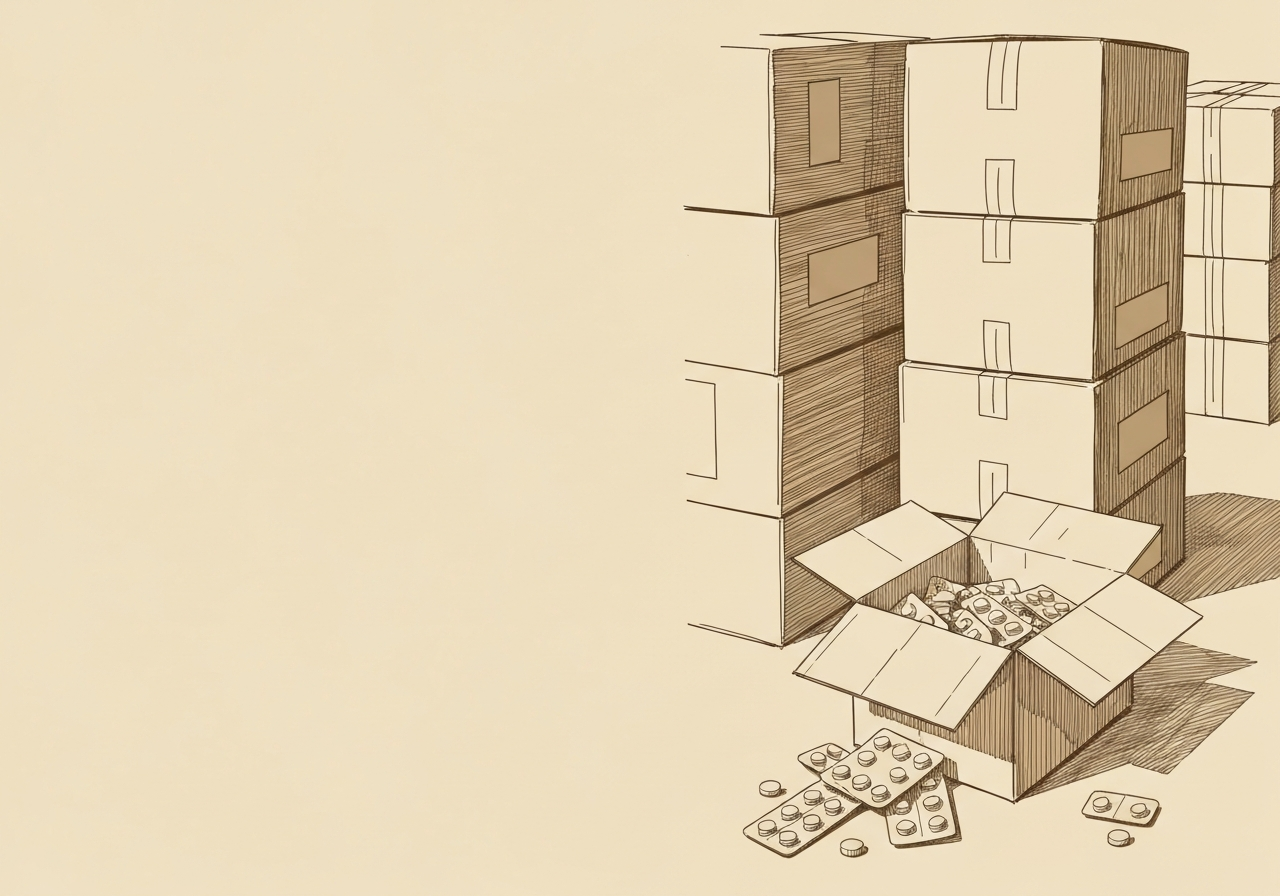
It began with a parcel. The NCB received a tip that a package containing narcotic tablets had been booked by one Gaurav Kumar Aggarwal from Agra to Ludhiana. When officials raided a courier godown in New Delhi, they found 50,000 Tramadol tablets — a psychotropic substance — mislabeled as "surgical items." The boxes were ordinary cardboard, stamped with surgical supply labels, but inside lay rows of blister-packed tablets. The air in the godown was thick with dust and the smell of old cardboard. An officer tore open a box, expecting surgical gloves or bandages. Instead, tablet strips spilled onto the concrete floor.
During questioning, Gaurav stated he had purchased the tablets from Mohit Aggarwal (the respondent), a shopkeeper in Agra. Based on that disclosure, the NCB raided a godown belonging to another co-accused, Promod Jaipuria. Inside, they recovered over 6.6 lakh tablets of various psychotropic substances — a haul large enough to qualify as a "commercial quantity" under the NDPS Act (the law that governs narcotic drugs and psychotropic substances, which imposes stricter bail conditions for commercial quantities). The godown door swung open to reveal stacks of cartons, each containing thousands of tablets. Officers worked through the night, counting and cataloguing. The seizure list ran to several pages.
Mohit Aggarwal was arrested on January 11, 2020. He applied for bail. The trial court — a special NDPS court — rejected his application. He applied again. That court rejected him again on July 21, 2020. Two bail applications, two rejections. Each time, the judge looked at the scale of the recovery — over 6.6 lakh tablets — and concluded that the twin conditions of Section 37 NDPS Act could not be satisfied.
The High Court's logic
Mohit then approached the Delhi High Court under Section 439 of the CrPC (the provision that gives High Courts and Sessions Courts special powers to grant bail). The High Court saw things differently.
Nothing incriminating had been recovered from Mohit's own premises. The only evidence linking him to the drugs was his own statement to NCB officials under Section 67 of the NDPS Act (a provision that allows officers to call for information and record statements). But the Supreme Court's decision in Tofan Singh v. State of Tamil Nadu (2020) had held that such statements were inadmissible as evidence — they were treated like confessions to police officers, which cannot be used against an accused person.
With that statement removed, the High Court reasoned, what remained? No physical recovery from Mohit. No direct evidence. He had been in custody for over a year. The trial had begun. The High Court granted him bail on March 16, 2021. The order was brief. It noted the absence of recovery from Mohit's premises, the passage of time, and the fact that the charge-sheet had been filed. In the High Court's view, these factors together created reasonable grounds to believe Mohit was not guilty.
Outside the courtroom, NCB officers exchanged glances. They had seized over 6.6 lakh tablets based on this man's information. Now he was walking free.
What the NCB argued
The NCB appealed to the Supreme Court. Its argument was simple: the High Court had misunderstood what Section 37 of the NDPS Act requires.
Section 37(1)(b) imposes twin conditions for granting bail in cases involving commercial quantities of drugs. First, the court must have reasonable grounds to believe that the accused is not guilty of the offence. Second, the court must believe that the accused is unlikely to commit any offence while on bail. These are not discretionary factors — they are mandatory barriers. A court cannot grant bail unless both conditions are satisfied. The NCB's petition was filed promptly. The case was assigned to a bench led by the Chief Justice.
The NCB said the High Court had treated the absence of physical recovery from Mohit's premises as enough to create reasonable grounds for believing he was not guilty. But the circumstantial evidence told a different story: Mohit's own disclosures had led directly to the recovery of over 6.6 lakh tablets from Promod Jaipuria's godown. Call detail records — CDR evidence — linked Mohit to the network. This was not a man who happened to be named in a statement. This was a man whose information had unlocked a massive drug cache. The NCB argued that the High Court had ignored the chain of causation: the parcel led to Gaurav, Gaurav led to Mohit, Mohit led to the godown, and the godown yielded lakhs of tablets. Each link in the chain was circumstantial, but together they formed a coherent picture.
Why the Supreme Court reversed
The Supreme Court bench — Justice N.V. Ramana, Justice Krishna Murari, and Justice Hima Kohli — agreed with the NCB. It allowed the appeal on July 19, 2022, and cancelled Mohit's bail. The courtroom fell silent as the order was read aloud. The bench had reserved judgment after hearing both sides. When the order was pronounced, the packed courtroom — lawyers, officers, accused — waited for the operative part. "The present appeals are allowed," the bench said. "The bail bonds of the respondent are cancelled and he is directed to be taken into custody forthwith."
The Court held that the High Court had erred in two fundamental ways. First, it had treated the absence of physical recovery from Mohit's premises as a ground for bail. But at the bail stage under Section 37, the Court said, the assumption that "since nothing was found from the possession of the accused, he is not guilty" would be premature. The concept of constructive or conscious possession — where a person may control drugs even if they are not physically on his person — remains relevant. The Court noted that the NDPS Act was designed to combat a network of drug trafficking, not merely isolated possession. A person who directs others to store drugs, who arranges shipments, who provides the financial backing — such a person may never touch a single tablet, yet he is central to the operation.
Second, the High Court had relied on the length of Mohit's custody and the fact that the charge-sheet had been filed. The Supreme Court was categorical: "The length of the period of custody or the fact that the charge-sheet has been filed and trial has commenced are by themselves not considerations that can be treated as persuasive grounds for granting bail under Section 37 NDPS Act." The Court explained that the stringent conditions of Section 37 override ordinary bail considerations. Even if an accused has been in custody for a long period, even if the trial has begun, the court must still find reasonable grounds to believe the accused is not guilty. Those grounds must be substantive, not procedural.
What 'reasonable grounds' actually means
The Court clarified the key phrase in Section 37(1)(b). The expression "reasonable grounds," it said, means "credible, plausible grounds for the Court to believe that the accused person is not guilty of the alleged offence." Such facts and circumstances must exist in a case that can persuade the Court to believe the accused would not have committed the offence. The Court drew on its earlier decisions in Collector of Customs, New Delhi v. Ahmadalieva Nodira (2004) and State of Kerala v. Rajesh (2020) to explain the standard. "Reasonable grounds" is not a low threshold. It requires the court to be satisfied, not merely to entertain a possibility.
Importantly, the Court noted that even after excluding the confessional statements under Section 67 (following Tofan Singh), circumstantial evidence such as disclosures leading to recovery, CDR details, and involvement in an organized network can constitute sufficient material to deny bail under Section 37. The Court was not required to record a finding of not guilty or weigh evidence for a final determination at the bail stage. The exercise was limited to examining whether reasonable grounds existed for believing the accused was not guilty. The Court emphasized that the bail stage is not a mini-trial. The judge does not decide who is right and who is wrong. The judge only decides whether there are credible, plausible grounds to believe the accused is innocent. If those grounds do not exist, bail must be refused — regardless of how long the accused has been in custody.
They did not exist here. Mohit Aggarwal had led the NCB to 6.6 lakh tablets. That fact, by itself, was enough to keep him in custody. The Court noted that Mohit's disclosures were not a mere mention of a name. They were specific, detailed, and actionable. He told the NCB where to go, whom to look for, and what to expect. The godown raid was not a stroke of luck — it was the direct result of his cooperation. And yet, the Court observed, that same cooperation could not be used to argue that he was innocent. If anything, it showed his involvement in the network.
THE PLAY: When opposing bail under Section 37 NDPS Act, lead with the circumstantial chain your client's disclosures triggered — not just the statement itself.
THE TEST: The "reasonable grounds" test under Section 37(1)(b) is satisfied not by the absence of physical recovery from the accused, but by the absence of credible, plausible grounds to believe they are not guilty — a standard that circumstantial evidence can meet.
WHAT THIS MEANS: For trial courts and High Courts across India, this judgment serves as a reminder that the twin conditions of Section 37 NDPS Act are not formalities. The length of custody, the filing of the charge-sheet, and the absence of physical recovery from the accused are not, by themselves, grounds for bail. The court must examine the circumstantial evidence — disclosures leading to recovery, CDR records, links to co-accused — and ask whether reasonable grounds exist to believe the accused is not guilty. If the circumstantial chain points to involvement, bail must be denied. The judgment also clarifies that the exclusion of Section 67 statements under Tofan Singh does not automatically open the door to bail. The prosecution can still rely on other evidence. The key is to build a case that does not depend solely on the accused's own statement.
The Supreme Court quashed the bail order, cancelled Mohit's bail bonds, and directed that he be taken into custody forthwith. The order was a single page, but its implications were far-reaching. For the NCB, it was a vindication of their strategy — to argue not from what they found on the accused, but from what the accused helped them find. For the accused, it was a return to custody after months of freedom. For the legal system, it was a reaffirmation that the NDPS Act's stringent bail provisions mean what they say.