He signed a deal to sell land, then sold it to others. The buyers sued. Then one buyer switched sides.
The Supreme Court says oral evidence can prove a written agreement was fake. But a registered deal still gives notice to later buyers.
7,000
rupees.
The Supreme Court says oral evidence can prove a written agreement was fake. But a registered deal still gives notice to later buyers.
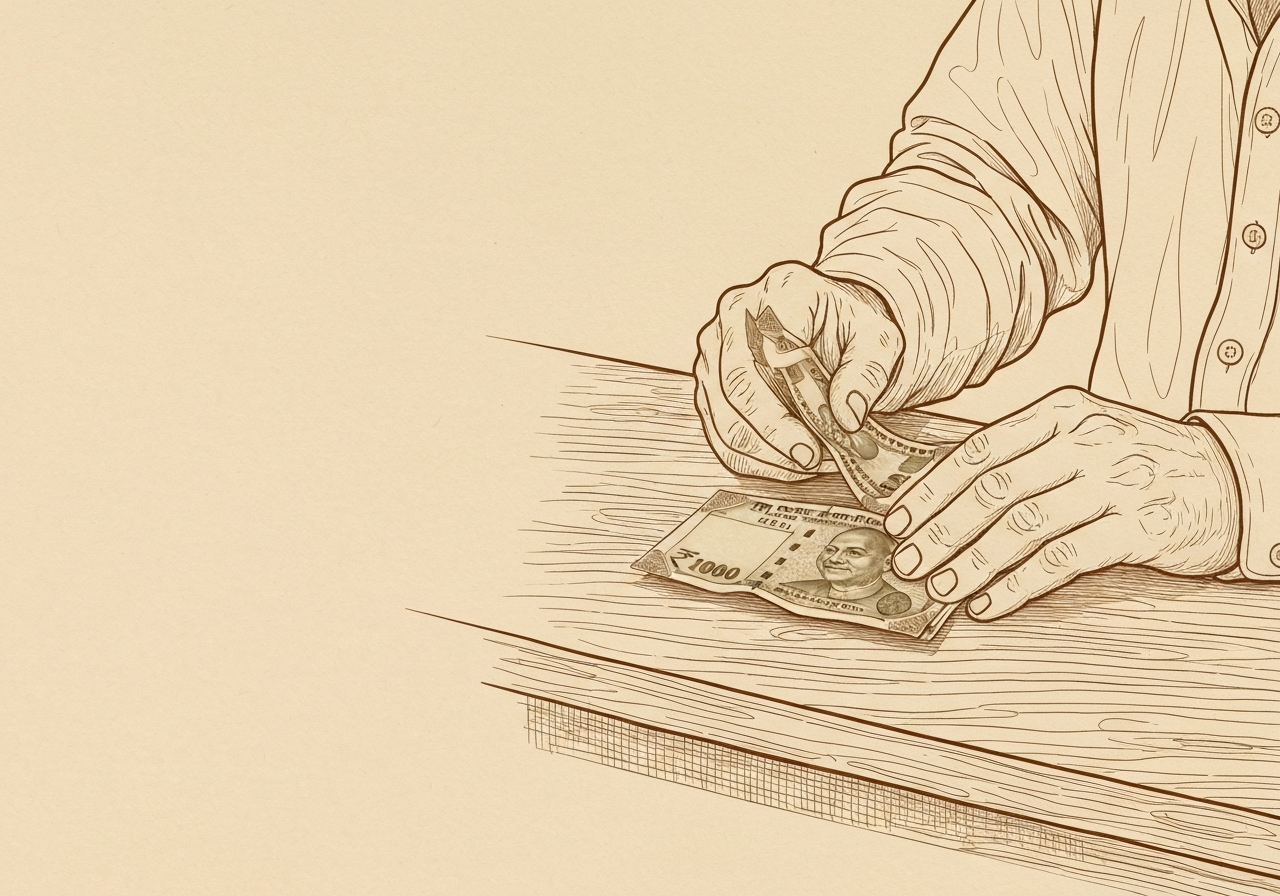
Two men paid ₹7,000 advance for 2.9 acres. The seller sold the land to someone else. Then one of the buyers told the court: the deal was never real.
It was December 1981. A landowner signed a registered agreement — the pages stamped and bound — to sell nearly three acres of agricultural land in Uttarakhand to two buyers for ₹20,300. He took ₹7,000 as advance. The deal was simple: execute the sale deed within three years. But the landowner never did. Instead, in 1983, he sold the same land to other people through two separate registered sale deeds.
The two original buyers sued. They wanted the court to force the sale — a legal remedy called specific performance (a court order compelling someone to honour a contract). The defendants fought back, claiming the agreement was a sham, created only to scare the landowner into not selling because of his bad habits. Then came the twist: one of the two plaintiffs switched sides. The courtroom fell silent as he told the court the agreement was never meant to be acted upon.
The Supreme Court of India had to untangle a knot of questions. Could oral evidence prove a written, registered agreement was fake? Did later buyers have legal notice of the earlier deal? And what happens when one buyer turns hostile?
When the registered agreement became a weapon
The first plaintiff and the second plaintiff — the two original buyers — had signed a registered agreement for sale with the landowner on December 7, 1981. The land was Bhumidhari land, a type of agricultural holding in Uttar Pradesh (now Uttarakhand). The agreement was compulsorily registrable under law. They registered it.
Before the three-year window closed, the landowner sold the property to the second, third, and fourth defendants through two registered sale deeds in 1983. The plaintiffs filed a suit for specific performance in the Trial Court at Nainital.
The defendants raised a classic defence: the agreement was a sham transaction. They argued that under Sections 91 and 92 of the Indian Evidence Act, 1872, no oral evidence could be admitted to contradict the terms of a written document. Section 91 says that when the terms of a contract have been reduced to a document, that document is the only evidence of those terms. Section 92 says oral evidence cannot be used to contradict, vary, or add to the terms of a written document.
But the defendants themselves wanted to introduce oral evidence to show the document was never intended to be acted upon. The plaintiffs, of course, wanted the document enforced as written.
One buyer flips. The court watches.
During the trial, something unusual happened. The second plaintiff — one of the two men who had signed the agreement — turned hostile. The trial court's dusty file recorded his testimony as he began supporting the defendants' case. He testified that the agreement was never meant to be a real sale. It was, he said, a device to scare the landowner into not selling his land because of his bad habits.
The Trial Court didn't buy it. It decreed specific performance in favour of both plaintiffs. The Additional District Judge, Nainital, dismissed the appeal. The Uttarakhand High Court dismissed the second appeal. All three courts below ruled for the plaintiffs.
The defendants appealed to the Supreme Court.
The legal puzzle: can oral evidence prove a document is fake?
The Supreme Court bench — Justice Abhay S. Oka and Justice Sanjay Karol — had to decide a threshold question. Sections 91 and 92 of the Evidence Act bar oral evidence that contradicts a written document. But do they bar evidence that the document itself was a sham — that it was never intended to create any legal rights or obligations?
The court held they do not. "Evidence that a document was sham or bogus," the court held, "goes to the very question of whether the parties agreed to contract at all." If the document was never intended to be acted upon, there was no contract to begin with. Sections 91 and 92 do not prevent a party from showing that the document was a mere pretence.
This is a crucial distinction. The sections exclude evidence that contradicts the terms of a written contract. They do not exclude evidence that challenges the existence of the contract itself.
Why the later buyers couldn't claim ignorance
The defendants who bought the land in 1983 argued they were bona fide purchasers for value without notice — innocent buyers who had no idea about the earlier agreement. But the court rejected this claim.
Under Explanation 1 to Section 3 of the Transfer of Property Act, 1882, a person is deemed to have constructive notice (legal knowledge, even without actual knowledge) of any fact that would come to light if they made reasonable inquiries. Since the 1981 agreement was compulsorily registrable and had been duly registered, the later buyers were deemed to have constructive notice of it. They could not claim to be innocent purchasers.
This is a powerful rule. Registration is not just a formality — it puts the entire world on notice.
The strange case of the missing prayer
The defendants raised another argument. They said the plaintiffs should have asked the court to cancel the subsequent sale deeds — a separate legal prayer — before seeking specific performance. They relied on a 2018 Supreme Court decision, B. Vijaya Bharathi v. P. Savitri, which seemed to require exactly that.
But the bench found that B. Vijaya Bharathi had been decided by a two-judge bench and had failed to consider a binding three-judge bench decision from 1953: Lala Durga Prasad v. Lala Deep Chand. In that earlier case, the Supreme Court had held that where subsequent purchasers are not bona fide purchasers without notice, no separate prayer for cancellation is necessary. The court can simply direct the subsequent purchasers to join in the conveyance.
The bench followed Lala Durga Prasad. It held that since the later buyers had constructive notice of the earlier agreement, they could not claim to be innocent. The plaintiffs did not need a separate prayer for cancellation of the subsequent sale deeds.
This is a reminder that precedent matters — but not all precedents are equal. A smaller bench cannot overrule a larger bench, even implicitly.
The land was agricultural. The buyers were not farmers.
There was one more complication. The land was agricultural. Section 154-B of the Zamindari Abolition Act (as amended by the Uttaranchal Amendment Act, 2003) prohibits the sale of agricultural land to a non-agriculturist — someone who is not a farmer. The plaintiffs were not agriculturists.
The court held that Section 154-B bars the sale of agricultural land to non-agriculturists, but does not bar an agreement for sale. Under Section 54 of the Transfer of Property Act, an agreement for sale does not create any interest in the land itself — it only creates a personal right to demand performance. So the agreement was valid.
But the decree for specific performance — the actual transfer of land — could not be executed without government permission. The court made the decree conditional: the plaintiffs could get the land only if they obtained government approval under Section 154-B. The court also noted an implied covenant on the vendor to apply for such permission.
This is a practical solution. The court did not strike down the agreement. It simply said: you can enforce it, but only if the law allows the transfer.
What happens when one buyer walks away
The second plaintiff had turned hostile. He had supported the defendants. The court had to decide what to do with his share.
Under Section 45 of the Transfer of Property Act, when property is transferred to two or more persons jointly and their shares are not specified, they are presumed to hold equal shares. The two plaintiffs had not specified their shares in the agreement. So each was entitled to an undivided half-share.
Since the second plaintiff had not proved his readiness and willingness to perform the contract — in fact, he had actively opposed it — the court restricted the decree to the first plaintiff's undivided half-share. The suit was dismissed against the second plaintiff.
The Supreme Court partly allowed the appeal. It modified the decree to grant specific performance only for the first plaintiff's half-share, conditional on obtaining government permission under Section 154-B.
THE PLAY: When a written agreement is registered, later buyers cannot claim ignorance — registration gives constructive notice to the entire world.
The agreement was signed in 1981. The Supreme Court decided the appeal in 2024. Forty-three years later, the first plaintiff got his half-share — if he could get the government's permission. The second plaintiff got nothing. And the landowner, who had tried to sell the same land twice, learned that a registered agreement is not just a piece of paper. It is a public declaration.