He was convicted of murder. The Supreme Court said: not so fast.
The prosecution said he was last seen with the victim, fled, and confessed. But the Court found the chain of clues had a missing link.
3
links.
The prosecution said he was last seen with the victim, fled, and confessed. But the Court found the chain of clues had a missing link.
He was convicted of murdering a girl and burying her body. But the Supreme Court just broke the chain of evidence.
The trial court looked at the pieces—an extrajudicial confession, the fact that he fled, that he was seen at the spot—and decided they fit together like a lock and key. The man was guilty. But the Supreme Court looked at the same pieces and saw gaps. Spaces where the prosecution had assumed a connection that simply was not there.
The question that hung over the case was deceptively simple: When all the evidence against a person is circumstantial (indirect clues that require the court to infer guilt, rather than a direct eyewitness or confession), how tightly must those clues link together before a man can be sent to prison for life?
When the body was found
The facts began the way many such cases do—with a disappearance. A girl went missing. A search followed. Eventually, her body was discovered, buried in the ground. The mud-caked earth around the grave still bore the marks of a hurried dig. The police investigation pointed to one man: SK. Yusuf.
Against him, the prosecution assembled three main pieces of evidence. First, an extrajudicial confession—meaning he had allegedly confessed to someone outside a courtroom, not to a magistrate or police officer. The handwritten note of that confession, scrawled on a crumpled sheet, sat in the case file. Second, the fact that he had absconded (fled and gone into hiding) after the incident. Third, that he had been last seen at the location where the crime likely occurred.
To a trial court, this looked like enough. The man had admitted guilt, run away, and been spotted at the scene. The pieces seemed to click. The trial court convicted him of murder.
Why the confession did not hold
But when the case reached the Supreme Court, the bench began pulling at the threads. The first thread came loose almost immediately.
The extrajudicial confession, the Court noted, contained "substantial discrepancies." What the accused had allegedly said to one person did not match what he had allegedly said to another. The story shifted. Details changed. A confession that contradicts itself is not a confession—it is a collection of inconsistent statements that cannot be relied upon to convict anyone. The silence in the courtroom seemed to thicken as the judges read the conflicting accounts aloud.
The Court did not stop there. It examined the second piece of evidence: the fact that the accused had absconded. In common understanding, a man who runs must have something to hide. But the law does not work that way. The Supreme Court has repeatedly held that absconding, by itself, does not prove guilt. A person may flee for many reasons—fear of a false case, panic, even the simple instinct to avoid a hostile police station. Running is not the same as confessing.
When "last seen" is not enough
The third piece of evidence was the most critical. The prosecution argued that the accused was last seen at the place of occurrence (the location where the crime happened) around the time of the murder. This, they said, placed him at the scene. The appellant argued that being last seen at the location and absconding "would not raise any presumption of guilt", and that the extrajudicial confession could not be fully trusted.
But the Supreme Court drew a sharp distinction. Being present at a location is not the same as being seen with the victim right before her death. The Court noted that the prosecution had failed to establish that "the deceased was last seen with the accused right before her death." There was no witness who could say: I saw them together, and then she was gone.
Without that link, "sheer presence at the place of occurrence at the likely time of occurrence would not raise any adverse presumption" (a legal assumption that something is true unless proven otherwise). A person can be in a place without committing a crime. The law does not allow a court to infer guilt simply from proximity.
The chain that had a missing link
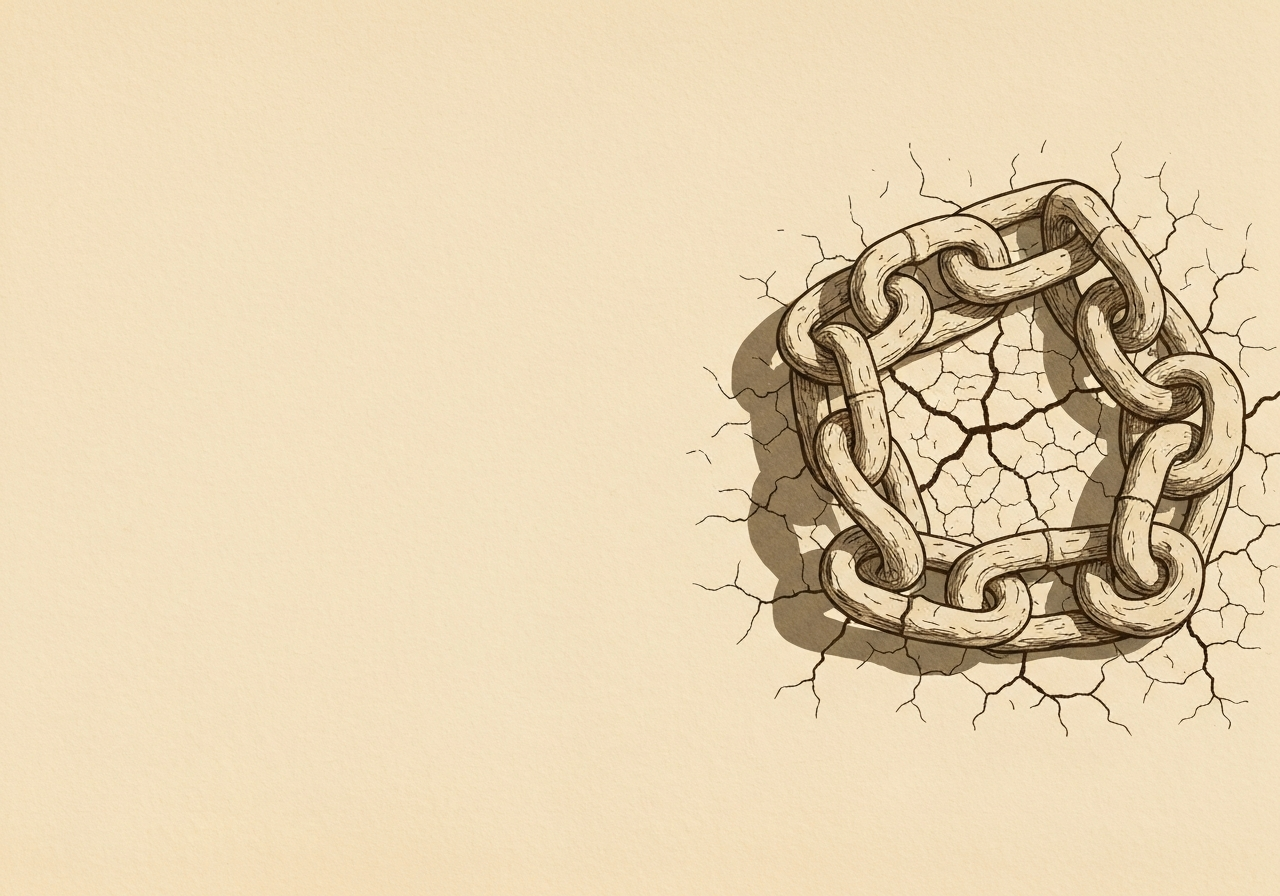
This is the heart of the law on circumstantial evidence. When a case rests entirely on indirect clues, those clues must form a complete chain—every link must connect to the next, with no gaps. The prosecution cannot ask the court to fill in the missing pieces with guesswork. If there is a single link missing, the entire chain collapses. The Court meticulously examined the evidence, noting that there was a failure to establish that "the deceased was last seen with the accused right before her death."
The Supreme Court found that the chain here was broken. The extrajudicial confession was unreliable. The absconding proved nothing by itself. And the "last seen" evidence did not place the accused with the victim at the critical moment. The pieces did not fit together into a picture of guilt beyond a reasonable doubt (the standard of proof required for a criminal conviction, meaning no other logical explanation is possible). The judicial process in this instance centered on whether the individual pieces, when linked together, formed an unbreakable, conclusive chain of facts.
The Court determined that the chain of circumstantial evidence was not complete. Because the prosecution failed to construct the necessary link beyond a reasonable doubt, the appellant was acquitted. The Court acquitted SK. Yusuf. The conviction was set aside. A man who had been sentenced to prison walked free—not because the Court believed he was innocent, but because the prosecution had not done its job of proving guilt. The courtroom fell silent as the judge read the acquittal, the file on the desk feeling suddenly thin.
The precise legal standard
The Court's reasoning turned on a specific, exacting standard. It held that if the constructive link between the existing evidence and the inference is not "completely beyond any reasonable doubt then the court can establish any fact", the link fails, and the case collapses. This is not a vague caution—it is a binding rule. Every piece of circumstantial evidence must point unerringly to guilt, leaving no room for any other hypothesis. The prosecution cannot ask the court to guess, to assume, or to fill in blanks with suspicion.
In this case, the prosecution's chain had three links. The first—the extrajudicial confession—was cracked by "substantial discrepancies." The second—absconding—was legally inert on its own. The third—last seen—failed because it did not place the accused with the victim at the moment of death. The Court examined each link separately, found each wanting, and concluded that the chain could not hold.
What this means for every criminal case
This case reinforces that if the constructive link between the existing evidence and the inference is not "completely beyond any reasonable doubt then the court can establish any fact", the link fails, and the case collapses. For lawyers and judges, this judgment is a reminder of a fundamental rule: circumstantial evidence is not weaker than direct evidence, but it demands stricter discipline. Each piece must be proved independently. Each inference must be the only reasonable one. And the chain must be unbroken.
For the rest of us—the journalists, the founders, the doctors, the students who read this magazine—the lesson is simpler. A conviction based on "he was there" and "he ran" and "someone said he confessed" is not a safe conviction. The law demands more. And when the law demands more, the Supreme Court enforces it.
THE PLAY: In any case built on circumstantial evidence, test every link separately—if one breaks, the entire case breaks with it.
The chain held at trial. At the Supreme Court, it fell apart.