He wrote a Will at 80. Died 15 days later. The Court said: that's not suspicious.
The Supreme Court ruled that old age and quick death don't automatically mean incapacity—if witnesses confirm the testator knew what he was signing.
15
days.
The Supreme Court ruled that old age and quick death don't automatically mean incapacity—if witnesses confirm the testator knew what he was signing.
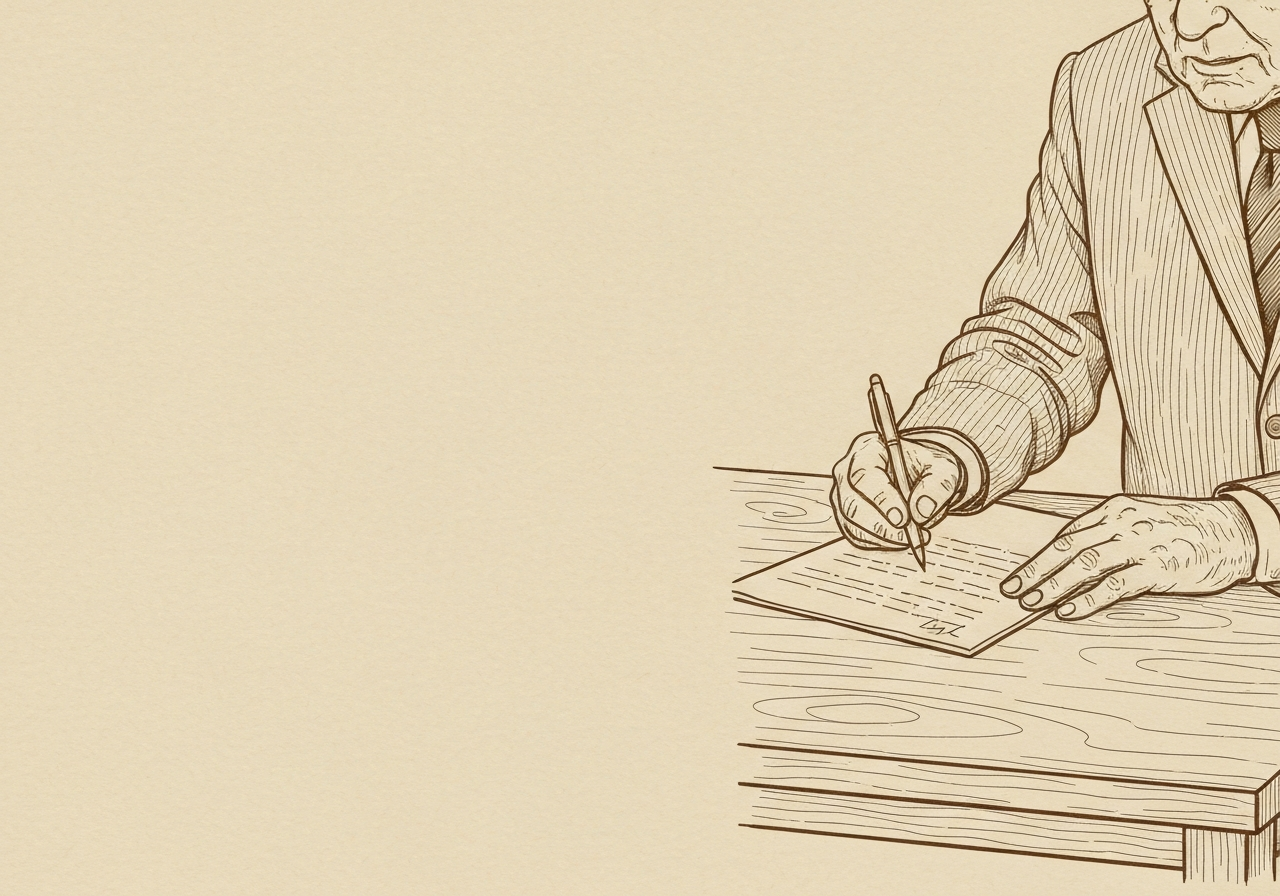
An 80-year-old man signs a Will. 15 days later, he dies. The family cries foul. But the Court saw it differently.
The Supreme Court did not call it suspicious. It called it valid.
One group of heirs—Sridevi and others—had argued that the timing itself was proof of foul play. The testator was 80. He died almost immediately after signing. And the Will "deprived the other heirs of his property." But the other side—Jayaraja Shetty and others, the propounders (the people trying to prove the Will is real)—insisted the testator knew exactly what he was doing. He signed in front of witnesses. He understood every word.
The trial court and the High Court had both upheld the Will. The Supreme Court now had to decide—in the case of Sridevi & Ors v. Jayaraja Shetty & Ors.
When the witnesses spoke
Two attesting witnesses (people who watched the testator sign the Will and then signed it themselves to confirm they saw it happen) and the scribe (the person who wrote the Will) all gave the same account. They said the 80-year-old was in sound health. He had full physical and mental faculties. He signed after understanding the nature and effect of the dispositions—meaning he knew exactly which property was going to which child and why.
The courtroom fell silent as each witness took the stand. The physical Will document lay on the table—its edges worn, the testator's signature visible at the bottom, a firm, steady hand for a man of 80. The scribe pointed to the page, confirming he had written every word at the testator's dictation. The attesting witnesses identified their own signatures alongside the testator's.
The challengers, led by Sridevi, cross-examined these witnesses. They tried to find a crack. They asked about the testator's health, his daily routine, whether he had been confused or forgetful in his final weeks. The witnesses did not waver. No suggestion of confusion emerged. No hint of illness affecting his mind. No evidence that he was pressured or manipulated.
The Court noted this silence carefully—the appellants had failed to bring on record anything in cross-examination that could cast doubt regarding the physical or mental incapacity of the testator.
One witness was pressed repeatedly on whether the testator had seemed weak or disoriented on the day of signing. The witness replied that the testator had sat upright, read the document slowly, and asked a question about one clause before nodding his approval. The scribe confirmed that the testator had dictated the terms himself, pausing to correct a minor error in the draft. These small details, accumulated across the testimony, painted a picture of a man in command of his faculties.
The cross-examination stretched over two sessions. The challengers tried every angle—suggesting that the witnesses were biased, that they were relatives of Jayaraja Shetty, that they had not actually been present. But the witnesses held firm. The witness did not flinch. One attesting witness, when asked how he could be sure the testator understood the document, replied simply: "He told me what it said before he signed. He explained it to me in his own words."
The "deprivation" argument that collapsed
The challengers argued that the Will was suspicious because it "deprived the other heirs of his property." This is a common argument in Will disputes—the idea that a fair distribution should treat all children equally, and any deviation must be a sign of coercion.
But the Court looked at the Will itself. It found reasons. The testator had structured the Will to "balance the equitable distribution of the properties in favour of all his children" after a prior family partition. The Will was not an arbitrary snub. It was a considered attempt to correct an earlier imbalance—perhaps one where an older sibling had received a larger share in a previous settlement, leaving the testator feeling that the scales had tipped unfairly. The document explained itself. The Court accepted that explanation.
The smell of old paper filled the courtroom as the judges examined the document. The Will was not a rushed scrawl on a scrap of paper—it was a carefully drafted instrument, with clear reasoning for each disposition. The testator had not simply cut out certain heirs; he had created a new balance after an earlier division of property had left some children with more than others.
The challengers, during their arguments, insisted that the very act of "depriving" heirs was itself evidence of suspicious conduct. But the Court noted that the Will gave reasons for the distribution. The document did not hide its intent. It stated plainly that the testator was seeking to equalise what an earlier partition had left uneven. This transparency, the Court implied, was the opposite of suspicious behaviour.
The heart of the judgment: what old age and quick death do not prove
Indian law places a specific burden on anyone trying to prove a Will. The propounder must show three things: that the testator signed the document, that he was in a "sound disposing state of mind" (meaning he understood what he was doing and what the consequences would be), and that he signed it of his own free will, not under pressure or fraud.
But when a Will has "unusual features," the court must apply closer scrutiny. The Supreme Court has repeatedly said that the propounder must then "dispel the suspicious circumstances" by providing clear and convincing evidence.
The question in this case was simple: had the propounders done enough?
The Court held that mere advanced age and proximity of death do not automatically negate testamentary capacity. A person can be 80, frail, even close to death, and still possess the mental clarity to decide how to distribute his assets. The key is whether the propounder can produce clear and convincing evidence—usually from the attesting witnesses—that the testator was of sound disposing mind and understood the document.
In this case, the propounders had done exactly that. The witnesses were credible. Their testimony was consistent. The challengers had failed to shake it. The Court concluded that the propounders had discharged the burden of proof. The Will was genuine.
The Supreme Court's reasoning was clear: the law mandates close scrutiny when a Will presents unusual features or unnatural circumstances surrounding its execution. The onus was on the propounder to prove testamentary capacity and due execution.
The Court observed that the two attesting witnesses and the scribe categorically stated that the testator was in a sound state of health and possessed his full physical and mental faculties. They deposed that the testator had signed the Will in their presence after understanding the nature and effect of dispositions made by him. Crucially, the Court noted that the appellants failed to bring on record anything in cross-examination that could cast doubt regarding the physical or mental incapacity of the testator.
The Court held that the propounders had successfully proved the Will was a true and genuine document.
This case also echoes an earlier principle: that a Will is not invalid simply because it disappoints some heirs. The law protects the right of a testator to dispose of his property as he sees fit, provided he has the mental capacity to do so. The Court's judgment in Sridevi & Ors v. Jayaraja Shetty & Ors reaffirms that the burden on the challenger is not light—suspicion alone is not enough. There must be evidence.
The challengers had argued that the 15-day gap between execution and death was inherently suspicious. But the Court did not agree. The law does not presume that a person loses mental capacity simply because death is near. If the witnesses testify credibly that the testator was alert and understanding, and if the challengers fail to produce contrary evidence, the Will stands.
The file in this case was thin on the challengers' side—no medical records showing dementia, no testimony from a doctor about confusion, no witness who saw the testator being coerced. The propounders, by contrast, had brought forward living witnesses who had seen the testator sign and who remembered his clarity. That asymmetry decided the case.
THE PLAY: When challenging a Will, attacking the testator's age or the timing of death is not enough—you must present specific evidence of mental incapacity, not just suspicion.
For families, the lesson is practical. If you are helping an elderly relative make a Will, ensure the process is witnessed by independent, credible people who can later testify that the testator was alert, understood the document, and signed freely. A Will made in a hospital bed, witnessed by a doctor and a nurse, with clear notes about the testator's mental state, is far harder to challenge than one signed in a hurry with family members as the only witnesses.
This case reinforces that mere advanced age or proximity of death does not automatically negate capacity, provided the propounder furnishes clear and convincing evidence, often from attesting witnesses, that the testator was of sound disposing mind and understood the document.
The testator signed. The witnesses saw. The Court believed them.