High Court can order fresh probe, but not name the target
Supreme Court partly allowed a District Manager's appeal against a Patna HC order that directed further investigation into his role in a foodgrain theft — without hearing him first.
17
lakh.
Supreme Court partly allowed a District Manager's appeal against a Patna HC order that directed further investigation into his role in a foodgrain theft — without hearing him first.
A Class IV employee was charged with stealing Rs. 17 lakh worth of foodgrains. The High Court said he was a scapegoat — and ordered a fresh probe into his boss. The boss wasn't even in court.
The District Manager learned about the investigation into his own role from a newspaper report. By then, the Patna High Court had already declared him the real target of a criminal probe — without hearing a single word from his side.
Could a High Court order a fresh investigation into a specific person, by name, without giving that person a chance to be heard? The Supreme Court would have to answer that question — and in doing so, draw a line between the High Court's power to correct injustice and its duty to follow basic fairness.
When a low-level employee took the fall
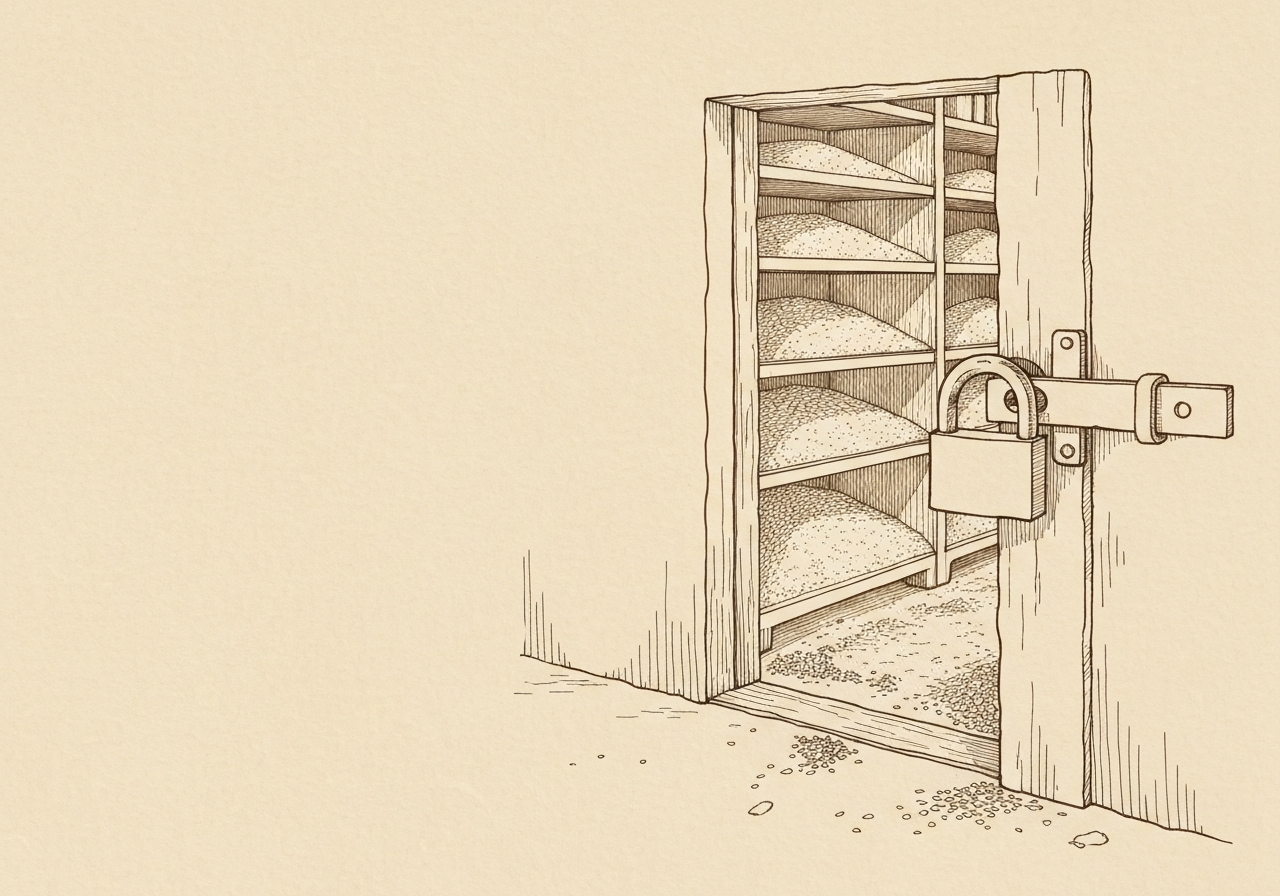
In 2012, foodgrains worth Rs. 16.99 lakh went missing from a godown in Barh, Patna district, run by the Bihar State Food and Civil Supplies Corporation. The godown's rusted lock had long been a formality; the real security lay in the chain of command. The police filed an FIR (a written complaint that starts a police investigation) and later a chargesheet — but only against a single person: a Class IV employee, the lowest-ranking worker at the godown.
The employee was charged with criminal breach of trust, forgery, and cheating under Sections 409, 467, 468, and 420 of the Indian Penal Code. But he had a defence that would change the course of the case: he wasn't the real thief. He was, he argued, a scapegoat.
His argument was simple. The District Manager had appointed him irregularly. The real control over the godown — and the real opportunity to steal — lay with the District Manager. The employee approached the Patna High Court under Section 482 of the CrPC (the High Court's inherent power to prevent abuse of its own process), asking the court to throw out the charges against him.
When the High Court named a target
The Patna High Court agreed with the employee — and went much further than he had asked. The court expressed surprise that the District Manager had received a "clean chit" while the low-level employee was being prosecuted. It called the employee a "scapegoat."
Then, in September 2018, the High Court passed an order directing the Magistrate to order further investigation under Section 173(8) of the CrPC (a provision that allows police to investigate further even after filing a chargesheet) — specifically into the role of the District Manager.
The District Manager was not a party to the case. He was not named in the FIR. He was not chargesheeted. He was not even present in court. The High Court had, in effect, named a target for a criminal investigation without hearing him. The courtroom's silence that day was absolute — no one spoke for the man whose name had just been written into the order.
The boss fights back
The District Manager learned of the order — perhaps over his morning newspaper, the headline catching his eye — and appealed to the Supreme Court. His challenge had two parts. First, the High Court had no power to direct an investigation against a specific person by name. Second, even if it had such power, it could not exercise it without giving him a hearing.
The State of Bihar and the employee defended the High Court's order. The investigation, they argued, was clearly incomplete — the real culprit had been left out. The High Court was merely doing what the Magistrate should have done: ensuring that justice was done.
The question before the Supreme Court was narrow but consequential. Could the High Court, using its inherent powers under Section 482 CrPC, direct a fresh investigation targeted at a specific individual — and do so without hearing that individual?
What the Supreme Court said
The Supreme Court partly allowed the appeal. It upheld the High Court's power to direct further investigation — but struck down the specific targeting of the District Manager and the lack of hearing.
The bench, comprising Justice Dinesh Maheshwari and Justice Aniruddha Bose, held that the High Court's inherent powers under Section 482 CrPC are wide enough to include the power to direct further investigation or even reinvestigation where the original investigation was not in the proper direction. The provisions of Section 173(8) CrPC, the court said, do not limit or affect these powers.
But the court drew a clear boundary. While the High Court can order further investigation, it cannot dictate the specific direction of that investigation. It cannot order the police to investigate only from a particular angle. It cannot direct that a particular person must be prosecuted as a result of the further investigation. And it certainly cannot pass such orders without hearing the person who is specifically targeted.
"The question of opportunity of hearing," the court observed, "depends upon the given set of facts and circumstances of the case. However, where the direction specifically targets a named individual's role, hearing is required."
The precedents that guided the court
The Supreme Court's judgment drew on a line of earlier decisions that shaped its reasoning. In Vinay Tyagi v. Irshad Ali & Ors. (2013), the court had held that the High Court's inherent powers under Section 482 CrPC are not curtailed by the procedural framework of Section 173(8). In Vinubhai Haribhai Malaviya & Ors. v. State of Gujarat & Anr. (2019), the court had affirmed that the power to order further investigation is broad and can be exercised at any stage. But in Popular Muthiah v. State (2006) and State of Punjab v. Central Bureau of Investigation & Ors. (2011), the court had cautioned against the High Court stepping into the role of the investigating agency.
The court also relied on Manharibhai Muljibhai Kakadia & Anr. v. Shaileshbhai Mohanbhai Patel & Ors. (2012) and Union of India & Anr. v. W.N. Chadha (1993) for the proposition that natural justice requires a hearing before any adverse order is passed against a person who is not a party to the proceedings. The procedural journey of the case — from the FIR at Barh Police Station on 1 January 2012, to the cognizance order by the ACJM, Barh on 21 June 2014, to the High Court's order on 10 September 2018, and finally to the Supreme Court's judgment on 12 October 2022 — showed how a single missing hearing could unravel an entire investigation.
Why the hearing matters
The District Manager was not merely a person who might be incidentally affected by a general order for further investigation. The High Court had specifically named him as the target. It had called the existing investigation incomplete precisely because it had not examined his role. Any further investigation would, by the High Court's own design, be directed at him.
In such a situation, the court held, basic principles of natural justice (the legal requirement that no one be judged without a fair hearing) demanded that the District Manager be heard before the order was passed. The High Court could not, in a proceeding between two other parties, unilaterally declare a third person a target of a criminal investigation.
The Supreme Court modified the High Court's order. The direction for further investigation was upheld in principle — the investigation could continue. But the specific directions regarding investigating the District Manager's role and the manner of investigation were set aside. The matter was sent back to the High Court for fresh consideration, this time after hearing the District Manager. The file, thin as it was, would now grow heavier with the District Manager's response.
THE PLAY: If you are named as a target in a court-ordered investigation without being heard, your first argument is not about the merits — it is about the denial of natural justice, and the Supreme Court will strike down the targeting part of the order.
The balance the court struck
The judgment is a careful balancing act. On one hand, the Supreme Court affirmed that the High Court has the power to step in when an investigation is going wrong. The inherent powers under Section 482 CrPC exist precisely for such situations — to prevent injustice and to ensure that the criminal justice system does not become a tool for protecting the powerful while punishing the weak.
On the other hand, the court refused to let the High Court become an investigator itself. The High Court can order further investigation. It cannot direct how that investigation should proceed or who it should target. Those decisions belong to the police and the Magistrate, not to the High Court acting on a petition between two other parties. The court also left open the possibility of proceeding against other persons under Section 319 CrPC (the power to add new accused during trial), but only through the proper procedural channels.
The District Manager's appeal was partly allowed. He would get his hearing. The investigation into the foodgrain theft would continue — but without a pre-written script naming him as the villain.
The Class IV employee remained chargesheeted. The stolen foodgrains remained unaccounted for. And the District Manager, who had never been in court when the order was passed, finally got his day before the law.