Highway dispute: Court says no to second-guessing arbitrators on technical contract terms
Supreme Court restores arbitral awards after Delhi High Court substituted its own interpretation of measurement clauses for embankment construction, ruling that courts cannot act as appellate forums under arbitration law.
Restored.
After the High Court
Supreme Court restores.
Supreme Court restores arbitral awards after Delhi High Court substituted its own interpretation of measurement clauses for embankment construction, ruling that courts cannot act as appellate forums under arbitration law.
The arbitral tribunal had technical experts. The High Court still overturned their reading of a contract clause. The Supreme Court just reversed that—and sent a message.
The question was simple: how do you measure a mound of earth and ash? On a highway bypass project, the embankment rose in a grey-brown wedge of compacted soil and pond ash, a single structure built to a technical specification. Yet, when payment time came, the measurement itself became the battlefield.
The National Highways Authority of India (NHAI) awarded contracts for embankment construction using both soil and pond ash. The contractors built the embankments as a single composite structure. But NHAI's supervising engineer split the measurement—paying separately for soil portions and pond ash portions at different rates. The contractors said the entire cross-section should be measured as one unit. That disagreement travelled from a dispute resolution board all the way to the Supreme Court.
When the engineers disagreed on measurement
The dispute turned on two Bill of Quantities (BOQ) items—2.02(a) and 2.02(b)—read with Clause 305.8 of the Ministry of Road Transport and Highways (MoRTH) technical specifications. These clauses governed how embankment work was measured and paid for. The contractors argued: for pond ash embankments, you measure the entire embankment as one unit and pay at a single rate. NHAI's engineer insisted on splitting—soil at one rate, pond ash at another.
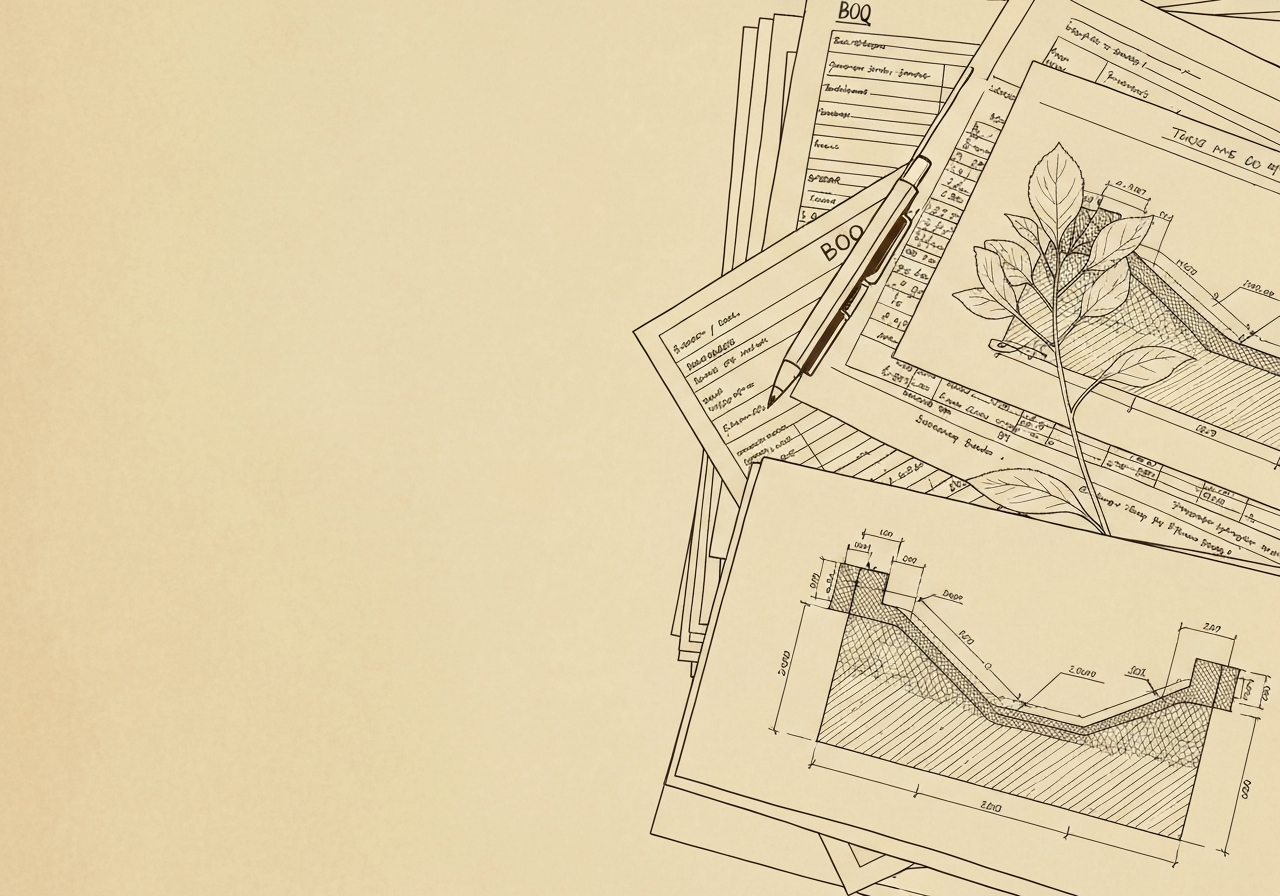
Before the matter reached arbitration, the dispute first went to NHAI's internal Dispute Resolution Board (DRB/DRP), which predominantly favoured the contractors' interpretation. That finding, however, did not settle the matter. Three separate arbitral tribunals, each comprising technical experts in construction and engineering, then heard the disputes. The hearing rooms were filled with the rustle of thick contract documents and the low murmur of engineers debating cross-sections. On the tables lay a stack of BOQ sheets with handwritten annotations, and the tribunal's engineering drawings, spread across the surface, showed cross-sections of the embankment marked in pencil. The tribunals predominantly sided with the contractors, finding that the contract documents, read as a whole, contemplated composite measurement for pond ash embankments. These were not generalist judges second-guessing a contract—they were domain specialists applying their technical knowledge to a technical contract.
The High Court's intervention
NHAI challenged the awards before a Single Judge of the Delhi High Court under Section 34 of the Arbitration and Conciliation Act, 1996 (the provision that allows a court to set aside an arbitral award on limited grounds like patent illegality or public policy). The Single Judge, after hearing arguments, rejected the challenge and upheld the awards.
NHAI appealed to a Division Bench under Section 37 of the Act (which governs appeals against orders under Section 34). The Division Bench reversed course. It held that the tribunals' interpretation of the measurement clauses was implausible. In effect, the High Court substituted its own reading of the contract for the tribunals' reading. It set aside the awards and elevated a dissenting opinion from one of the arbitral tribunals—treating it as though it were the correct interpretation.
Why the Supreme Court stepped in
Under Sections 34 and 37 of the Arbitration Act, how much room does a court have to overturn an arbitral tribunal's interpretation of a contract? The Supreme Court answered with a clear boundary. The Court held that a court cannot substitute its own interpretation of contractual terms for that of the arbitral tribunal, so long as the tribunal's interpretation is plausible and reasonable. "The court cannot create pathways to appellate review through primary contract interpretation," the judgment stated. In other words, the High Court cannot act as though it were hearing a regular appeal—arbitration law deliberately restricts judicial intervention.
The Court relied on a line of precedents including Associate Builders v. Delhi Development Corporation (2014), Delhi Airport Metro Express (P) Ltd v. DMRC (2021), and Ssangyong Engg. & Construction Co. Ltd. v. NHAI (2019), all of which reinforce the narrow scope of judicial interference under the Arbitration Act. These cases, their pages well-thumbed by counsel, form the backbone of the doctrine that an arbitral award is not a first appeal.
The deference due to technical experts
The Supreme Court added a second layer. Where arbitral tribunals comprise technical experts with domain knowledge—here, engineers familiar with highway construction and measurement methodologies—courts should accord greater deference to their interpretation of technical contractual terms. The Division Bench had failed to do this. It had treated the tribunals' reading as just another opinion, no different from what a generalist judge might produce.
The Court also addressed a procedural anomaly. When the Division Bench set aside the majority award, it effectively treated the dissenting arbitrator's opinion as the correct interpretation. The Supreme Court held this was improper. A dissenting opinion does not receive the same level of scrutiny as the majority award during challenge proceedings. The dissenting opinion cannot be elevated to an award upon setting aside of the majority award. The dissenting opinion, which the Division Bench had elevated to an award, was held by the Supreme Court to be improper. It remains just that—an opinion, not a competing award.
What the court restored
The Supreme Court allowed all five civil appeals (Civil Appeal No. 4658 of 2023 with CA 4659-4662/2023). It set aside the Delhi High Court's judgments and restored the arbitral awards to the extent they had been overturned. The only modification concerned interest: the awards had directed compounded monthly interest, which the Supreme Court changed to uniform simple interest at 12% from the date of the award to the date of payment, payable within eight weeks. No costs were imposed.
Why this matters for every arbitration
For parties to commercial contracts—particularly infrastructure and construction contracts with technical specifications—this judgment is a shield. If your contract dispute goes to an arbitral tribunal composed of domain experts, and the tribunal gives a plausible interpretation of the contract terms, a court cannot overturn it simply because the judge would have read the clause differently. The boundary between arbitration and litigation has been redrawn.
THE PLAY: When drafting arbitration clauses for technical contracts, ensure the tribunal includes domain experts—their interpretation of technical terms will receive greater deference from courts, making the award harder to challenge.
The arbitral tribunal had technical experts. The High Court still overturned their reading. The Supreme Court just restored it—and drew the line.