Hotel had CCTV. Prosecution didn't use it. Court drew a sharp conclusion.
Supreme Court says when best evidence exists but is withheld, the case gets a serious doubt — even if witnesses say otherwise.
114
(g).
Supreme Court says when best evidence exists but is withheld, the case gets a serious doubt — even if witnesses say otherwise.
The hotel manager said CCTV covered every floor. The prosecution never showed the footage. The judge asked: why?
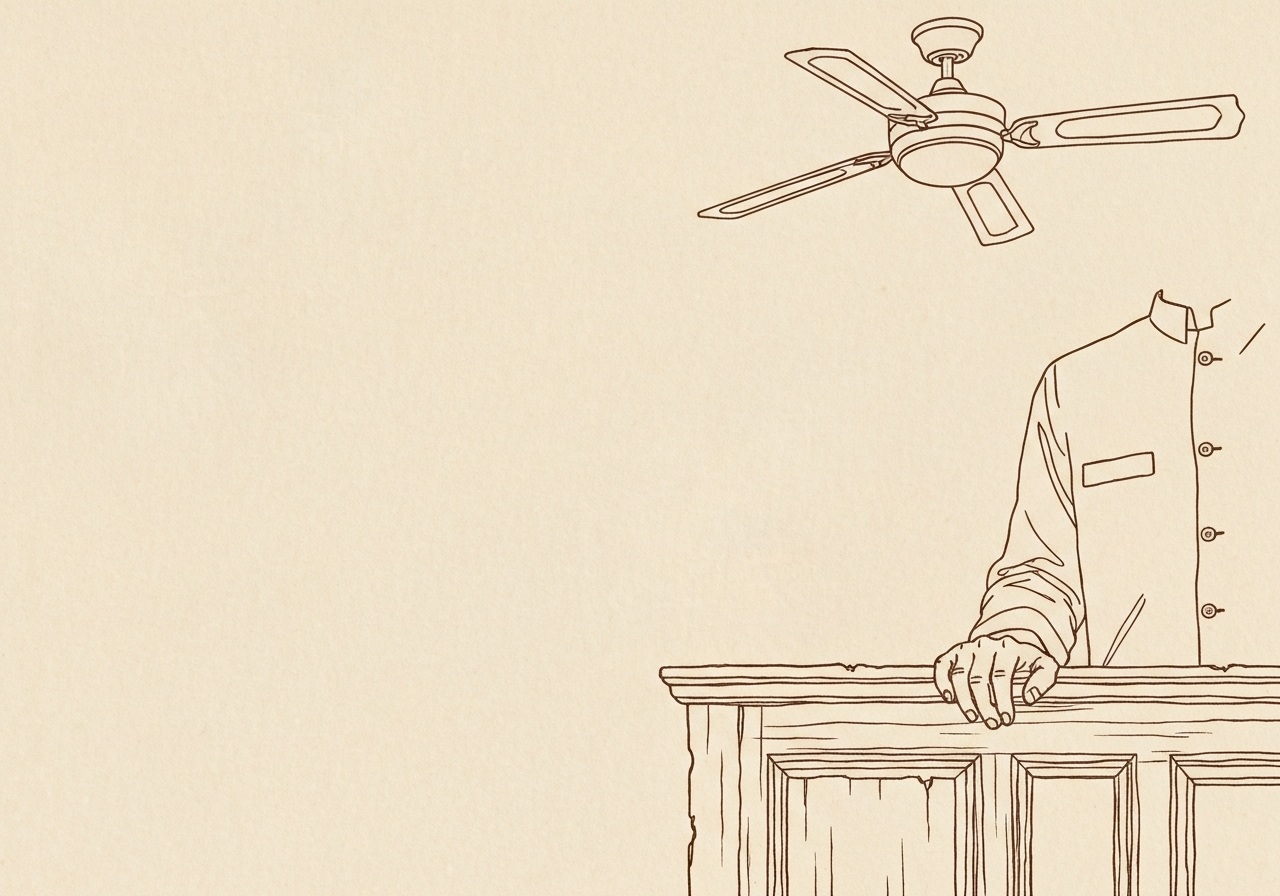
On a quiet afternoon in a hotel, a man stood accused of a crime that would turn on a single question: was he in that room, or wasn't he? The prosecution brought witnesses. The hotel manager took the stand. He said the cameras were working — reception, all three floors, every corner. As he spoke, the manager gestured toward the ceiling, where a camera lens blinked a steady red. But the footage never arrived in court. The Supreme Court had to decide what happens when the state holds the best proof of guilt and chooses not to show it.
The question was brutal: If the police had CCTV footage that could confirm or destroy their own case, and they didn't produce it — could the accused still be convicted on oral testimony alone?
When the hotel manager took the stand
The case, Tomaso Bruno v. State of U.P., reached the Supreme Court after the trial court and the High Court had both convicted the accused. The central fact was the accused's presence in a hotel room — a fact the prosecution needed to prove beyond reasonable doubt.
PW-1, the hotel manager, was the prosecution's own witness. He told the court that CCTV cameras were installed across the hotel — the reception area and all three floors. He described the cameras as positioned in "prominent places," and he did not say the cameras were broken, or that the footage was lost, or that the system was down that day. He said they were working. In the courtroom, the manager's voice was steady as he confirmed the system's coverage, but the prosecution never asked him to retrieve the tapes. The judge's pen paused mid-stroke. The manager's hand rested on the witness box rail, the wood grain worn smooth by decades of hands before his. He had come prepared to testify — but no one had asked him to bring the hard drive.
Yet the prosecution never called for the footage. They never asked the manager to produce it. They never explained why the tapes — if they existed — were missing from the evidence. Instead, they relied entirely on oral testimony: what witnesses said they saw.
Why the best evidence rule matters
The Supreme Court looked at this gap and found it impossible to ignore. The bench observed that the CCTV footage would have been the best evidence to prove whether the accused remained inside the room or had gone out. It was, in the court's words, a "crucial piece of evidence." The judgment itself felt thin in the hand — the omission was so stark that the reasoning unfolded almost silently, the courtroom still as the bench read out its observations. The accused, seated in the dock, gripped the wooden edge, his knuckles pale. The silence stretched long enough for the ceiling fan's rhythmic hum to fill the room.
This is where Section 114(g) of the Indian Evidence Act (which allows a court to assume that withheld evidence would have hurt the case of the party that kept it back) comes in. The section allows a court to draw an "adverse inference" — meaning the court can assume that if a party had evidence and chose not to show it, that evidence would have hurt their case. It is a legal shortcut based on common sense: if you have a photograph that proves you are innocent, you show it. If you don't, the court can guess why.
The prosecution, the court noted, was in possession of the best evidence that would "throw light on the controversy." They withheld it. The logical conclusion, the court said, was that the footage would not have supported their case.
The omission that broke the case
The court did not stop at noting the absence. It went further: the omission by the prosecution to produce this best evidence was deemed to raise "serious doubts about the prosecution case." Not mild doubts. Not technical doubts. Serious doubts — the kind that undo a conviction. The judge's voice hardened as he said the words, the silence in the room deepening. A clerk shuffled papers, the rustle loud in the quiet. The accused's lawyer exhaled slowly, the breath audible in the stillness.
The reasoning was sharp. If the CCTV footage existed and showed the accused inside the room, the prosecution would have played it. It would have been the strongest piece of evidence in their arsenal. The fact that they did not meant either that the footage did not exist — in which case the manager's testimony about working cameras was false or misleading — or that the footage showed something that contradicted the prosecution's story.
Either way, the accused got the benefit of the doubt.
What the court actually decided
The Supreme Court reiterated the principle that Section 114(g) permits the drawing of an adverse inference when a party in possession of the best evidence withholds it. The court did not say that oral testimony is always insufficient. It said that when the best evidence exists and is deliberately withheld, the oral testimony cannot fill that gap on its own.
The conviction was set aside. The accused walked free — not because the witnesses were lying, but because the prosecution chose to keep the truth under lock and key. As the order was read, the accused's shoulders dropped, the tension of years draining in a single breath. The courtroom's fluorescent lights hummed overhead, indifferent to the weight of the moment.
Why this matters for every trial
For practitioners, the takeaway is sharp and practical. If the prosecution has CCTV footage, call for it. If they don't produce it, ask the court to draw an adverse inference. The same logic applies to any form of best evidence — call records, photographs, forensic reports, written documents. If the state holds it and hides it, the case against the accused weakens.
The principle in Tomaso Bruno v. State of U.P. is not novel — Section 114(g) has been part of the Indian Evidence Act for over a century. But the case is a reminder that the rule is not a technicality; it is a shield against incomplete prosecutions. The trial court and the High Court had both convicted the accused despite the missing footage, perhaps relying on the oral testimony of the hotel manager and other witnesses. The Supreme Court corrected that error, holding that when the best evidence is deliberately withheld, the prosecution case cannot stand on oral testimony alone.
The implications extend beyond CCTV footage. In an era where electronic evidence — from phone location data to ATM logs to surveillance video — is routinely available, the failure to produce it can be fatal to the prosecution. Defence counsel must be vigilant: if the police seized a hard drive, if the hotel had a DVR system, if the bank had CCTV at the counter, demand its production. If it is not produced, invoke Section 114(g).
The hotel manager said the cameras were working. The prosecution never showed what they saw. The court ended where it began: with a question that had no good answer.
THE PLAY: When the prosecution withholds the best available evidence — especially electronic or documentary proof — move the court to invoke Section 114(g) and argue that the missing evidence would have favoured the accused.