Insurer tried to add new reasons to deny fire claim after rejecting it. Court said: too late.
A warehouse owner's Rs 6.57 crore claim was rejected on two grounds. At trial, the insurer raised a third. The Supreme Court shut it down—and held the insurer liable.
44
lakhs.
A warehouse owner's Rs 6.57 crore claim was rejected on two grounds. At trial, the insurer raised a third. The Supreme Court shut it down—and held the insurer liable.
The insurance company said the fire wasn't covered. Then in court, it added a new excuse. The judge stopped them cold.
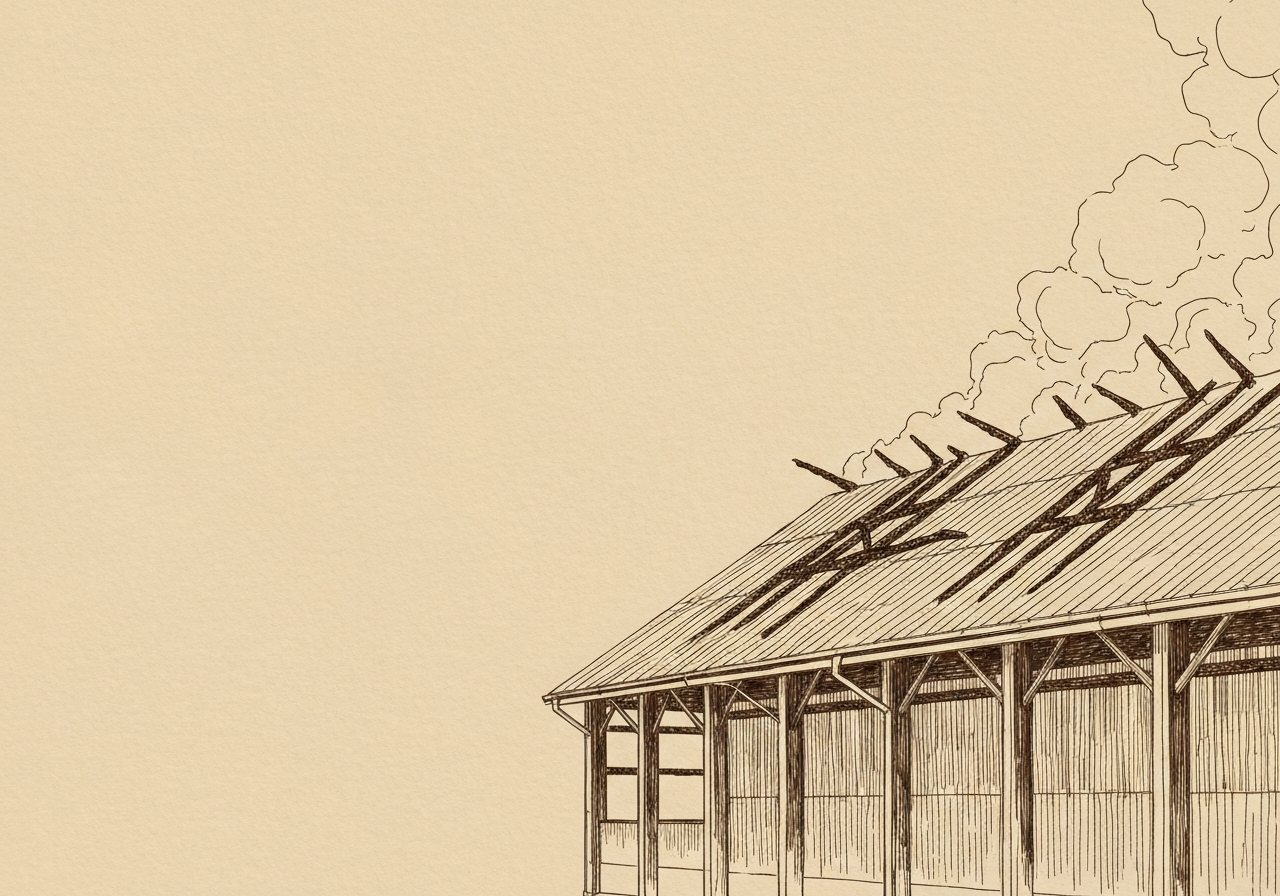
On 14 March 2018, a warehouse in Raigad, Maharashtra, went up in flames. Mudit Roadways, the company that leased the building to store imported goods, had paid nearly Rs 44 lakh in fire insurance premiums to New India Assurance. When they filed a claim for Rs 6.57 crore, the insurer said no—on two specific grounds, penned in a letter that would later become the centrepiece of the dispute. The warehouse owner went to consumer court and won. Then the insurer appealed to the Supreme Court, where it tried to slip in a third reason for denying the claim. The bench, seated in a silent courtroom where the only sound was the rustle of paper, didn't let it.
The question that drove the case: Can an insurance company reject a claim on two grounds, then show up in court with a completely new reason to avoid paying?
When the fire broke out in Veshvi
Mudit Roadways leased a warehouse at Survey No. 9/3 in Village Veshvi, Raigad district, to store custom bonded goods—imported items that haven't cleared customs yet. The company took out fire insurance policies from New India Assurance, paying premiums totalling about Rs 44 lakh. On 14 March 2018, a fire ripped through the warehouse. Mudit Roadways filed a claim for Rs 6.57 crore, covering the destroyed goods plus customs duties the company was legally obligated to pay even on burnt imports.
The insurance company sent its surveyor to inspect the site. The surveyor returned with a smoke-stained report that would later be scrutinised in court. Then the insurer sent a letter rejecting the claim. The letter gave two reasons, laid out like bullet points: first, the fire-affected warehouse was not covered under the policy because it allegedly fell outside the insured survey number; second, the fire was caused by the insured's own negligence during roof repair work, which violated a policy condition about alterations that increase risk. Those two points were all the letter contained.
What the repudiation letter said—and didn't say
Mudit Roadways filed a consumer complaint before the National Consumer Disputes Redressal Commission (NCDRC—the top consumer court that hears disputes between consumers and service providers). The NCDRC ruled in favour of the warehouse owner, holding that the warehouse was indeed insured and that the fire was likely caused by an electrical short circuit, not negligence. The commission ordered the insurer to pay the claim.
New India Assurance appealed to the Supreme Court. And here's where the case took its sharp turn. In court, the insurer argued that even if the warehouse was covered and even if the fire wasn't caused by negligence, the claim should still fail because the goods stored were custom bonded—imported goods not yet cleared—and the policy didn't cover such goods. This was a third ground, never mentioned in the original repudiation letter. The bench, comprising Justice Hrishikesh Roy and Justice Sanjay Karol, fell silent as the new argument was raised. Then the judges spoke.
The Supreme Court shut that argument down immediately. The court held that an insurance company cannot introduce additional grounds for rejection during a hearing beyond what it specifically wrote in its letter of repudiation. The repudiation letter is the insurer's final word. If the insurer had a problem with custom bonded goods, it should have said so when it first rejected the claim. The judgment stated this principle with clarity: the insurer cannot urge grounds beyond the repudiation letter. That single sentence, drawn from the court's reasoning, became the legal anchor for the entire dispute.
Why the warehouse was covered
The court then examined the two grounds the insurer actually raised. On the first—whether the fire-affected premises were inside the insured survey number—the court looked at the totality of documents. The leave and license agreement, the statutory licenses from customs authorities, the electricity and water connections, and communications from various government bodies all pointed to Survey No. 9/3. The warehouse was covered. The court found that the location of insured premises is determined by the whole set of documents, not merely a survey number interpretation.
On the second ground—that roof repair work constituted an alteration increasing risk under General Condition 3(a) of the fire insurance policy (a clause that voids coverage if the insured makes changes that raise the chance of loss or damage)—the court found no merit. Essential repair work on a rooftop to prevent water leakage cannot be reasonably called an alteration that increases the risk of fire. The court noted that seven of nine reports, including the insurer's own surveyor's report, supported electrical short circuit as the cause of the fire, not negligence during roof work.
The surveyor's report isn't gospel
The insurer tried to rely heavily on its surveyor's report, arguing that under Section 64-UM(4) of the Insurance Act, 1938 (a provision requiring an approved surveyor's assessment for claims above Rs 20,000, making it a mandatory step before payment), the report was binding. The court disagreed. It held that while the surveyor's report is a prerequisite for processing a claim, it is not conclusive or sacrosanct. Courts can depart from it based on contrary evidence—and here, the evidence pointed away from the insurer's theory.
The court also addressed a deeper principle: when the exact cause of a fire is indeterminable or disputed, the insurance company cannot escape liability as long as the insured is not the person who caused the fire. Even if the precise cause remains unknown, the insurer remains liable if the insured didn't start the blaze. This principle, drawn from precedents like Galada Power & Telecommunication Ltd. v. United India Insurance Co. Ltd. and Khatema Fibres Ltd. v. New India Assurance Co. Ltd., reinforces that insurers cannot hide behind uncertainty when the insured is blameless.
What the customs duty ruling means
A significant part of the claim involved customs duties on the destroyed imported goods. Mudit Roadways, as a warehouse custodian, was duty-bound under the Public Warehouse Licensing Regulations, 2016 (rules that govern how licensed warehouses operate and what obligations they carry) to pay customs duties on goods destroyed in its custody, even though the company wasn't the importer. The court held that this customs duty liability was a legitimate part of the insurance claim. However, to prevent double recovery (unjust enrichment—getting paid twice for the same loss by both the insurer and the customs authorities), the court ordered that the customs duty component be paid directly to the Customs Department, not to Mudit Roadways.
The court also examined related provisions of the Customs Act, 1962, including Sections 12 and 46 (which impose the duty and the procedure for clearance), Section 23 (which allows remission of duty on lost or destroyed goods), and Section 22 (which provides for abatement of duty in certain cases). The court interpreted these provisions to confirm that the warehouse custodian's liability to pay duty survived the fire, making it a legitimate claim item.
Why this case matters for every policyholder
For advocates, CFOs, and business owners, this judgment delivers a clear message: an insurer's repudiation letter is its only shot. It cannot hold back reasons, then spring new ones during litigation. The letter must contain every ground the insurer intends to rely on. If it doesn't, the court will not entertain them.
The case also clarifies several other points that practitioners should note. The surveyor's report, while required by law, is not the final word—courts can and do reject it when other evidence contradicts it. Essential repairs to an insured property do not automatically void coverage under an "alteration" clause. And when the cause of a fire is disputed or unknown, the insurer bears the loss unless it can prove the insured started the fire.
For businesses that store imported goods in bonded warehouses, the judgment offers specific relief: the customs duty component of a claim is recoverable, provided it is paid directly to the government to prevent double recovery. This ensures that the insured is made whole without profiting from the loss.
THE PLAY: When you receive a claim rejection letter, preserve it. If the insurer later raises a reason not in that letter, you can ask the court to strike it out—the Supreme Court has now said that's the rule.
The court dismissed the appeal, upheld the NCDRC's order, and directed the insurer to pay. The customs duty portion goes straight to the government. The rest goes to the warehouse owner who paid his premiums and trusted the policy.
The insurer's new excuse arrived too late—and the court locked the door behind it.