Judge granted bail, High Court ordered his arrest. Supreme Court steps in.
A trial judge gave bail to an accused after charge-sheet was filed. The High Court cancelled it, ordered the judge to explain—and the Supreme Court called it a 'chilling effect'.
Reversed.
Bail restored.
Judge protected.
A trial judge gave bail to an accused after charge-sheet was filed. The High Court cancelled it, ordered the judge to explain—and the Supreme Court called it a 'chilling effect'.
A trial judge granted bail. The High Court ordered the judge's arrest. The Supreme Court just reversed it.
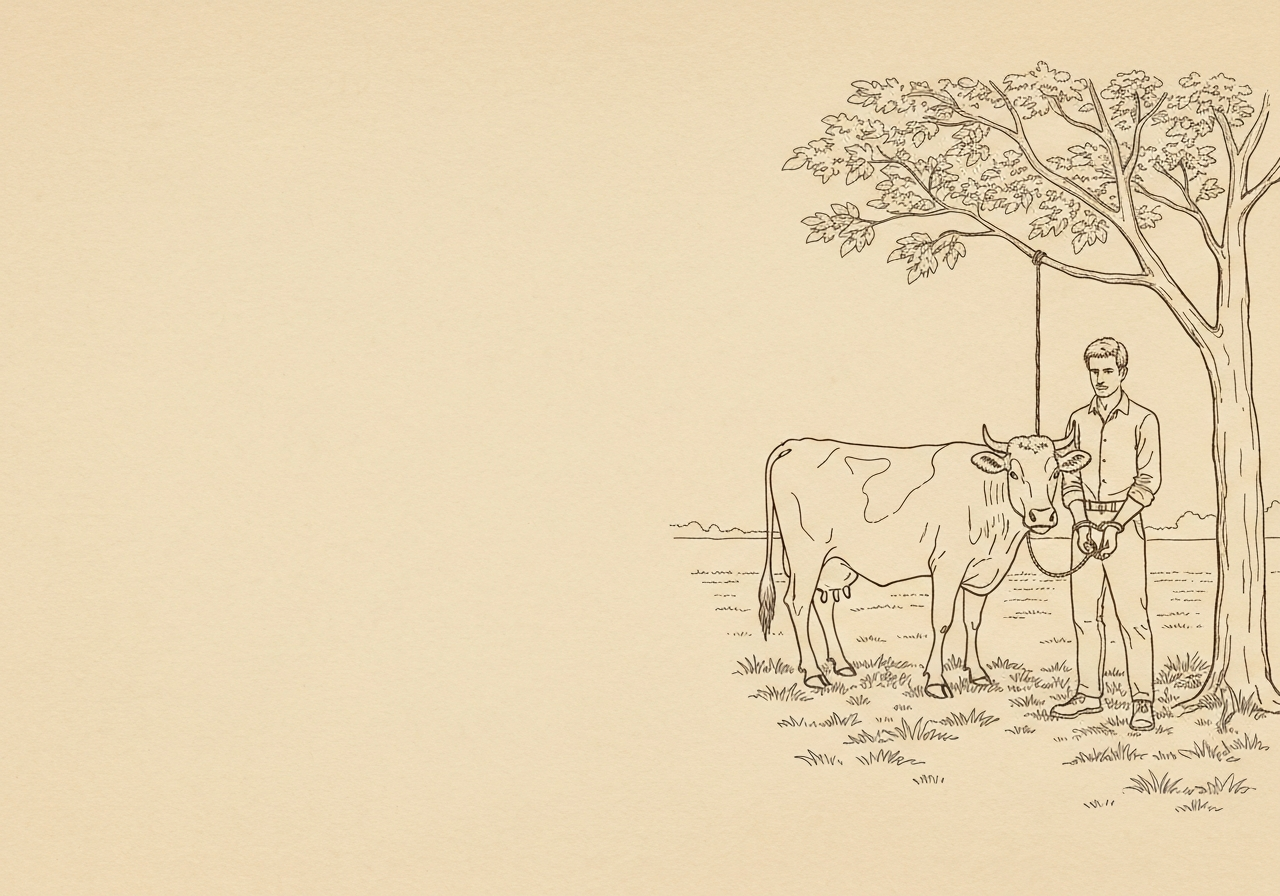
Totaram and the complainant are closely related. On a June morning in 2022, an FIR (a written complaint that starts a police investigation) was filed. It alleged that Totaram and another man had stopped the complainant while he was tending his cattle, stripped him, tied him to a tree, and assaulted him. Totaram was arrested. His first attempt at bail failed—both the Trial Court and the High Court said no. But the High Court gave him one small opening: he could apply again after a reasonable time.
That reasonable time came on 5 August 2022, when the police filed a charge-sheet (a formal list of charges against the accused, submitted after investigation). Totaram applied for bail again. On 16 August 2022, the Trial Court said yes. The judge noted two things: the charge-sheet was now on record, and the co-accused were already out on bail. It seemed like a routine decision—the kind district judges make every day.
It was not routine for the complainant. He challenged the bail order before the High Court of Madhya Pradesh. And the High Court did something that made the legal world stop and stare.
When the High Court ordered the judge's arrest
The High Court cancelled Totaram's bail. It ordered his immediate arrest. And then it directed the Trial Judge—the man who had granted the bail—to explain why he had done so. A show-cause notice was issued to the Sessions Judge himself.
Totaram, now facing arrest again, approached the Supreme Court. The case was Totaram v. State of Madhya Pradesh & Anr. The bench consisted of Chief Justice Dr. Dhananjaya Y. Chandrachud and Justice J.B. Pardiwala. The date was 6 April 2023.
The Supreme Court did not just reverse the High Court's order. It tore into the reasoning behind it.
Why the Trial Judge's decision was 'eminently fair'
The Supreme Court began with a simple question: was the Trial Judge wrong to grant bail? The answer was no.
The court pointed out that when a prior bail application is dismissed with liberty to apply afresh after a reasonable time, the filing of a charge-sheet under Section 173 CrPC (the police officer's report on completion of investigation) constitutes a changed circumstance. This is a well-established principle. An accused person is entitled to move a fresh bail application on this basis. The Trial Judge had done exactly that—he had noted the charge-sheet and the fact that the co-accused were already on bail. That, the Supreme Court said, was "eminently fair and reasonable."
The High Court's cancellation of bail, coupled with a direction for immediate arrest and a show-cause notice to the Trial Judge, was described as "wholly disproportionate." The Supreme Court said such orders produce a "chilling effect" on the independence of the district judiciary in exercising its lawful bail jurisdiction.
The 'chilling effect' that worried the Supreme Court
This was the heart of the judgment. The Supreme Court was not just correcting a procedural error. It was sending a message about judicial independence.
"Members of the district judiciary cannot be placed in a sense of fear for exercising the jurisdiction lawfully entrusted to them for granting bail in appropriate cases," the bench observed. High Court oversight, the court said, must not produce a chilling effect on legitimate judicial discretion.
The message was clear: district judges are not clerks who rubber-stamp High Court preferences. They are independent judicial officers who must be free to apply the law without fear of personal consequences. A High Court that punishes a judge for making a reasonable decision—even if the High Court would have decided differently—undermines the entire structure of judicial hierarchy.
What the Supreme Court actually did
The Supreme Court set aside the High Court's order dated 2 December 2022. It dismissed the application for cancellation of bail. It confirmed the bail granted to Totaram, subject to the terms and conditions imposed by the Trial Court.
The High Court's direction for the Trial Judge to explain himself was effectively nullified. The Supreme Court did not say the High Court could never question a bail order. It said the High Court could not do so by threatening the judge who made it.
THE PLAY: A trial judge who grants bail after a charge-sheet is filed, following a prior dismissal with liberty to reapply, is acting within lawful discretion—and a High Court that punishes that judge for it will be reversed.
Why this case matters for every lawyer and judge
For practitioners, the ratio (the court's central reasoning) is straightforward: a changed circumstance—such as the filing of a charge-sheet—is sufficient ground for a fresh bail application, even after an earlier rejection. Parity with co-accused on bail is a valid consideration. And a Trial Judge who applies these principles correctly is not acting arbitrarily.
But the deeper message is institutional. The Supreme Court has drawn a line. High Courts can correct errors. They cannot intimidate the judges who make them.
The chilling effect the court warned about is real. If district judges fear personal consequences every time they grant bail, they will stop granting bail. And if they stop granting bail, the presumption of innocence—the bedrock of criminal law—becomes meaningless for thousands of undertrial prisoners who have not been convicted of anything.
The Supreme Court ended where it began: with a trial judge who did his job, a High Court that overreacted, and a bench that restored the balance.