Levi's jeans burned in a fire. Two insurers paid up. The Supreme Court said one didn't have to.
The fire insurer said its policy excluded losses already covered by a marine policy. The marine policy covered the warehouse fire too. Who pays?
12
crores.
The fire insurer said its policy excluded losses already covered by a marine policy. The marine policy covered the warehouse fire too. Who pays?
Levi Strauss had two insurance policies for its warehouse stocks. A fire broke out. Both insurers paid. Then the Supreme Court stepped in.
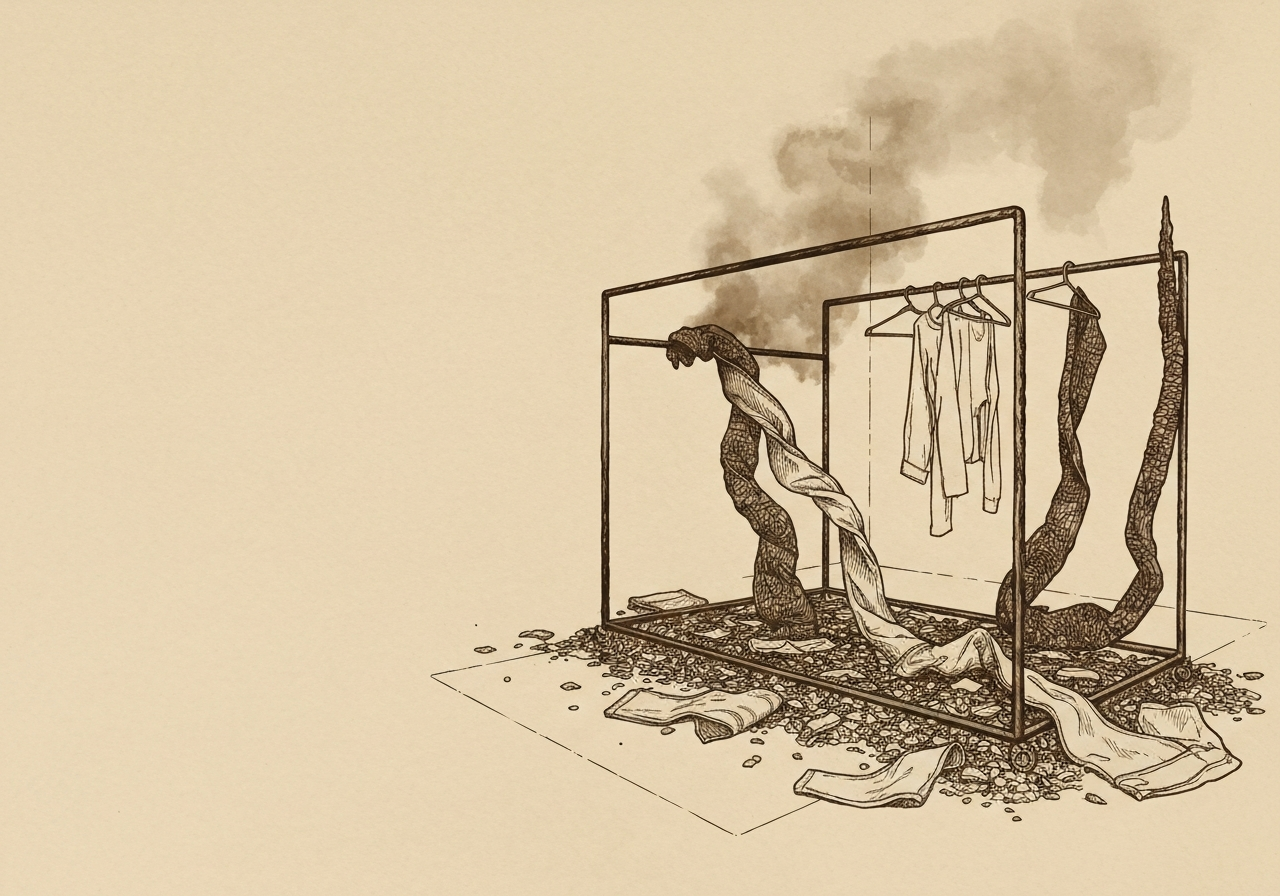
In July 2008, a fire ripped through a warehouse in India. Inside were stocks of Levi's jeans — thousands of pairs, now ash and melted rivets. The heat warped metal racks into twisted sculptures. The acrid smell of burnt denim hung in the air for days. Levi Strauss India had a fire insurance policy with United India Insurance. Its parent company also held a global marine policy from Allianz. Both policies covered the same warehouse. Both policies covered fire. When the smoke cleared, Allianz paid $4.54 million (about ₹19.52 crores). United India refused to pay a single rupee. Levi went to court demanding ₹12 crores more. The question: could a company collect twice for the same burnt jeans?
When the warehouse went up in flames
Levi Strauss India Pvt. Ltd. ran its Indian operations with a standard fire insurance policy from United India Insurance Co. Ltd. — the kind of policy any factory or warehouse buys to cover loss from fire, lightning, explosion, and similar perils. Separately, Levi's global parent company had arranged a "Stock Throughput Policy" from Allianz, a German insurer. That policy covered Levi's goods everywhere in the world — during ocean transit, land transport, and while sitting in warehouses.
On July 18, 2008, a fire destroyed Levi's warehouse stocks. Levi filed a claim with United India for approximately ₹12 crores. United India investigated, then sent a letter on September 11, 2009: claim rejected. The insurer pointed to Condition No. 4 of the fire policy, which said the company would not pay for any loss already covered by a marine policy. Since Allianz's policy covered the warehouse, United India argued it owed nothing. The letter itself was a thin, official sheet — the weight of a single page carrying the refusal of a twelve-crore claim. Levi's executives, expecting a routine payout, were stunned. The company's legal team began reviewing the policy language, searching for a way around the exclusion.
Meanwhile, Allianz paid out $4.54 million — about ₹19.52 crores at the time. Levi accepted the money but argued it was entitled to more from United India. The two policies, Levi said, covered different types of losses. The fire policy covered the warehouse fire. The marine policy covered transit risks. The fact that Allianz paid did not erase United India's obligation. The company's internal memos noted that the fire had caused total destruction — the stocks were a complete loss, and the ₹12 crore claim reflected the full value of the inventory. The Allianz payout, though larger, was under a different contract, Levi insisted.
The consumer court rules: pay up
Levi took its case to the National Consumer Disputes Redressal Commission (NCDRC — the top consumer court in India). In August 2019, the NCDRC ruled in Levi's favour. It ordered United India to pay ₹1.78 crores. The commission reasoned that the marine policy and the fire policy were different contracts covering different risks. The exclusion clause in the fire policy, the NCDRC said, could not apply because the Allianz policy was not a "marine policy" in the strict legal sense — it covered warehouse storage too, which went beyond traditional marine insurance. The courtroom fell silent as the order was read out; the file on the judge's desk felt thin, almost dismissive of the complex dispute it contained. Levi's legal team exchanged relieved glances. United India's representatives sat motionless, already planning their appeal.
The NCDRC's order was a significant victory for Levi. The commission had rejected United India's core argument — that Condition No. 4 excluded liability — by holding that the Allianz policy was not a marine policy. The commission focused on the fact that the STP covered warehouse storage, which it considered outside the scope of marine insurance. For Levi, this meant the fire policy's exclusion clause was inapplicable, and United India had to pay. But United India was not done. It filed a civil appeal in the Supreme Court, arguing that the NCDRC had misinterpreted both the policy language and the law.
What the policies actually said
The case turned on three documents. First, the Standard Fire and Special Perils (SFSP) Policy from United India. Condition No. 4 of that policy stated: "This policy does not cover any loss or damage to property which at the time of the happening of such loss or damage is insured by or would be insured by any Marine Policy." In plain English: if a marine policy covers the same goods, the fire policy won't pay.
Second, the Allianz Stock Throughput Policy (STP). This policy described itself as an "Open Marine Insurance Contract." It covered goods "whilst anywhere in the world" — during ocean voyages, land transit, and while in warehouses. The policy explicitly included fire among the perils covered. The document itself was thick, a global contract with fine print that smelled faintly of old paper. Its scope was vast: it covered Levi's inventory from the moment it left a factory anywhere in the world until it reached its final destination, including any stops along the way.
Third, the question of Section 25 of the General Insurance Business (Nationalization) Act, 1972. That section says properties in India cannot be insured with foreign insurers without government permission. Levi had not obtained such permission. United India argued that this meant the Allianz policy was illegal, and therefore Condition No. 4 could not apply — because you cannot exclude liability for a policy that doesn't legally exist. Levi, on the other hand, argued that Section 25 created a mandatory obligation to insure locally, and since the Allianz policy was illegal, the fire policy should pay. This argument was a double-edged sword: Levi was simultaneously relying on the Allianz policy to claim it had coverage, while also arguing that the policy was illegal to defeat the exclusion clause.
The Supreme Court's reasoning
A three-judge bench — Justice Uday Umesh Lalit, Justice S. Ravindra Bhat, and Justice Pamidighantam Sri Narasimha — delivered the judgment on May 2, 2022. The court allowed United India's appeal and set aside the NCDRC order. The bench, known for its careful reading of commercial contracts, took just over a year to decide the case after hearing arguments. The courtroom was packed with insurance lawyers and corporate counsel, all watching to see how the court would resolve the tension between a local fire policy and a global marine policy.
The court first held that the Allianz Stock Throughput Policy was indeed a "marine policy" under Sections 3 and 4 of the Marine Insurance Act, 1963. Section 3 defines marine insurance as a contract where the insurer undertakes to indemnify the insured against losses incident to a "marine adventure." Section 4 extends this to cover mixed sea and land risks — goods that travel partly by sea and partly by land. The court noted that the STP policy described itself as an "Open Marine Insurance Contract," covered marine risks, and included warehouse storage as part of the transit chain. It was, therefore, a marine policy within the meaning of the Act. The court rejected the NCDRC's view that warehouse storage somehow removed the policy from the marine insurance framework.
Since the Allianz policy was a marine policy, Condition No. 4 of the United India fire policy applied directly. The fire policy excluded losses already covered by a marine policy. Levi's warehouse stocks were covered by the Allianz marine policy. The exclusion clause was valid on its plain language. The court emphasized that insurance contracts must be interpreted according to their terms — not rewritten by courts to create coverage where none existed.
On Section 25 of the Nationalization Act, the court delivered a crucial clarification. Section 25 prohibits insuring property in India with foreign insurers without government permission. But a prohibition, the court said, is not the same as a positive obligation. Section 25 does not say "you must insure locally." It says "you cannot insure with foreign insurers without permission." If Levi violated that prohibition by taking the Allianz policy without permission, that was a separate regulatory issue — but it did not create a mandatory duty to buy domestic insurance. The fire policy's exclusion clause remained enforceable. This distinction — between a prohibition and an obligation — was the key to the court's reasoning on this point.
Finally, the court addressed the principle of double insurance. Levi had already received full indemnity from Allianz — $4.54 million, which exceeded the ₹12 crores it claimed from United India. The court held that an insured cannot profit from having two policies covering the same risk. Once fully compensated, the insured has no remaining loss to claim from the second insurer. United India was entitled to decline liability. The court cited several precedents, including New India Assurance Co. Ltd. v. Hira Lal Ramesh Chand & Ors. and Vikram Greentech India Ltd. v. New India Assurance Co., to support the principle that insurance is a contract of indemnity, not a source of profit.
The aftermath: what the judgment meant for Levi's business
The Supreme Court's decision was a final blow to Levi's hopes of recovering additional funds from United India. The company had already received $4.54 million from Allianz — a sum that covered the full value of the destroyed stocks. But the legal battle had cost time and legal fees, and the company's Indian operations had to absorb those costs. For Levi's finance team, the judgment meant closing the books on the fire loss and moving on. The warehouse itself was rebuilt, and new stocks arrived under the same global marine policy. But the company's risk managers now had a clear lesson: when a global policy covers warehouse risks, the local fire insurer may validly refuse to pay. Levi's procurement of domestic insurance for future warehouse stocks would need to be carefully coordinated with its global coverage to avoid similar disputes.
The judgment also sent ripples through the insurance industry in India. Insurers began reviewing their policy wordings, particularly exclusion clauses like Condition No. 4. Corporate policyholders, meanwhile, started auditing their insurance portfolios to identify overlapping coverage and potential gaps. The case became a standard reference for insurance lawyers arguing about the scope of marine policies and the enforceability of exclusion clauses.
Why this matters for every business with multiple policies
For corporate counsel and CFOs, this judgment is a sharp reminder: exclusion clauses in insurance policies are not boilerplate. Condition No. 4 — or any clause excluding coverage for losses already covered by another policy — will be enforced on its plain terms. If your company has a local fire policy and a global marine policy that both cover the same warehouse, check which one pays first. The fire insurer may validly walk away.
The judgment also clarifies that Section 25 of the Nationalization Act is a regulatory prohibition, not a mandate to buy domestic insurance. Companies that obtain global policies from foreign insurers without government permission face regulatory risk — but that risk does not help them claim under a local policy that excludes marine-covered losses. The lesson is simple: know what your policies cover, and know which exclusions apply, before a fire forces you to find out.
THE PLAY: When your company holds both a local fire policy and a global marine policy covering the same warehouse, the marine policy pays first — and the fire policy's exclusion clause will likely let it off the hook entirely.
The jeans burned. Allianz paid. United India walked free. The Supreme Court ended where it began: with two policies and a fire.