Police watched a murder and did nothing. 4 men were convicted anyway.
The Supreme Court acquitted them after 34 years, finding that the cops themselves may have killed the victim and framed the accused.
34
years.
The Supreme Court acquitted them after 34 years, finding that the cops themselves may have killed the victim and framed the accused.
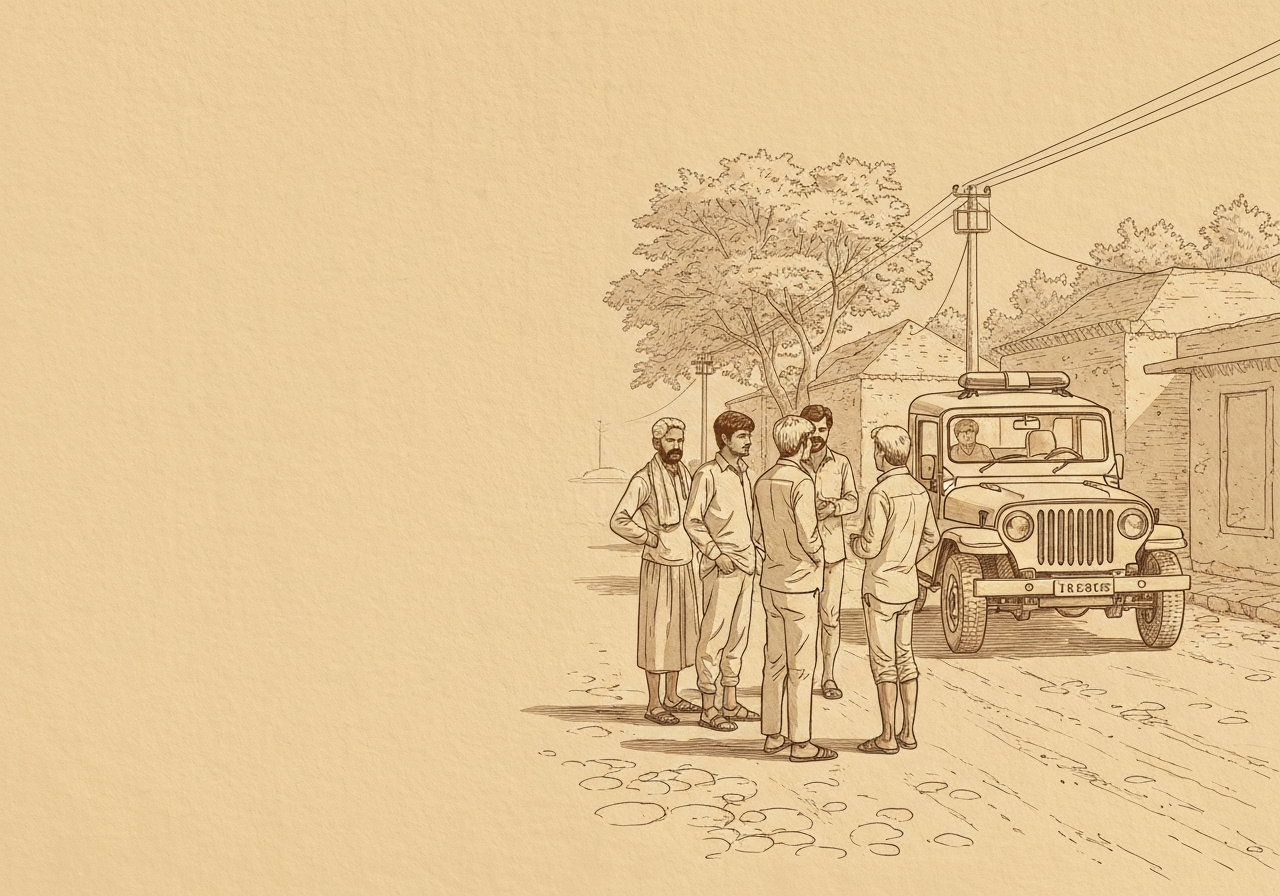
13 villagers allegedly murdered a man. But every eyewitness said police stood by and watched — and never explained why. On a June morning in 1989, in a village in Dibrugarh, Assam, Pradip Phukan was killed. His sister-in-law filed a complaint naming 13 villagers who, she said, came to their house, injured her brother-in-law Robi, and three of them murdered Pradip with sharp weapons. But the witnesses kept saying the same thing: police personnel had accompanied the accused to the house and were present throughout the incident without intervening. They just watched. The courtroom fell silent each time this detail was repeated across the years.
When the brother told a different story
The brother of the deceased revealed something the FIR (the written complaint that starts a police investigation) had left out. Police had come to arrest him and Pradip in connection with a prior criminal case — one lodged by one of the accused. That changed everything. The police presence was no longer a bystander's detail. It was the centre of the story. The FIR was registered on 13 June 1989 as Chabua Case No.70/89 at Police Station Chabua, District Dibrugarh. The charge-sheet was filed on 3 May 1991 against eight accused, with five declared absconders. The Sessions Case — No.27 of 2000 — had taken years to reach trial.
The Sessions Court convicted all 11 accused for murder and rioting. The Gauhati High Court confirmed the conviction in November 2015 through Criminal Appeal No.113/2014. Four of them appealed to the Supreme Court. By then, 34 years had passed since the sharp weapons had done their work.
Why the police presence mattered
The prosecution relied on four eyewitnesses. All were relatives of the deceased. All consistently deposed that police personnel accompanied the accused and remained present throughout the incident. The prosecution never explained why the police were there. It never explained why they did nothing. It never explained why the brother's statement about the arrest attempt was ignored. The weight of those unanswered questions pressed down on the courtroom.
Material inconsistencies existed between the FIR — registered as Chabua Case No.70/89 on 13 June 1989 — and the trial depositions regarding the roles attributed to specific accused. One witness said one thing in the FIR. Another said something different in court. The prosecution story began to crack. The charge-sheet had been filed on 3 May 1991 against eight accused, with five declared absconders. The Sessions Case — No.27 of 2000 — had taken years to reach trial.
The legal question the court had to answer
The appellants challenged their convictions under several sections of the Indian Penal Code: Section 302 (murder), Section 147 (rioting), Section 148 (rioting armed with a deadly weapon), Section 447 (criminal trespass), Section 323 (voluntarily causing hurt), and Section 149 (every member of an unlawful assembly is guilty of an offence committed in prosecution of a common object).
The defence argued that the ingredients of an unlawful assembly under Sections 141-149 IPC were not established. There was no evidence of a common object — the shared criminal intent that makes every member of a group liable for what any one of them does. The prosecution had not shown that all 13 people shared knowledge of what was going to happen. Mere presence of multiple persons, without evidence of shared criminal intent, is not enough.
The prosecution said the eyewitness testimony was consistent enough. The defence said it was materially inconsistent, and all witnesses were interested parties — relatives of the deceased with a motive to implicate the accused. The court noted that the Trial Court had failed to exercise its duty to seek clarifications on aspects that surfaced from the evidence, a failure that vitiated the judgment.
What the Supreme Court found
The bench — Justice B.R. Gavai, Justice Vikram Nath, and Justice Sanjay Karol — found the prosecution story deeply suspect. The police presence was never explained. The eyewitness testimony was materially inconsistent. And the court observed something even more troubling: it was possible that the police themselves killed the deceased during an arrest attempt and then framed the accused using existing enmity.
The court held that the investigation was tainted. As the ratio decidendi (the principle of law that forms the basis of the judgment) made clear: "The prosecution must not accept the complainant's version as gospel truth; the investigation must be fair and transparent, must ascertain the truth, and the Investigating Officer must analyse the evidence collected before submitting a report under Section 173(2) CrPC."
The court further held that where eyewitness testimony is materially inconsistent regarding the roles attributed to named accused, and the FIR version differs significantly from trial depositions, the testimony cannot be relied upon for conviction — particularly where all witnesses are interested parties. The bench also clarified that for conviction under Section 149 IPC, the prosecution must establish that all members of the assembly shared knowledge of the common object and the offence likely to be committed in prosecution thereof. Mere presence of multiple persons without evidence of shared criminal intent is insufficient.
Where prosecution witnesses consistently testify that police accompanied the accused and were present throughout the commission of a crime without intervening, and no explanation is offered for their presence or inaction, this creates a serious doubt on the genesis of the prosecution story, warranting benefit of doubt to the accused.
The judgment that ended 34 years
The Supreme Court allowed Criminal Appeal No. 906 of 2016. The conviction and sentence were set aside. The four appellants were ordered to be released forthwith, if not wanted in any other case. They had spent 34 years fighting a case where the prosecution's own witnesses had said the police were there, watching, doing nothing — and the prosecution never bothered to explain why. The bench pronounced the operative order: "The appeal is accordingly allowed. The conviction and sentence are set aside. The appellants are set at liberty forthwith. They are in judicial custody. They may be released forthwith, if not wanted in any other case."
THE PLAY: When prosecution witnesses consistently testify that police were present during the commission of a crime without intervening, and the prosecution offers no explanation, the court must treat this as a serious doubt on the genesis of the prosecution story — and acquit.
The court ended where it began: with a village, a murder, and police who watched but never spoke. The 34-year-old file — the FIR as Chabua Case No.70/89, the charge-sheet of 3 May 1991, the Sessions Case No.27 of 2000, the Gauhati High Court's Criminal Appeal No.113/2014 — was finally closed.
```