Presumed constitutional, yet stayed: the farm laws' interim freeze.
The Supreme Court stayed three farm laws not because they were unconstitutional, but because the crisis they triggered required judicial intervention to protect fundamental rights and enable dialogue.
3
laws.
The Supreme Court stayed three farm laws not because they were unconstitutional, but because the crisis they triggered required judicial intervention to protect fundamental rights and enable dialogue.
Two shots at the farm gate: The Supreme Court stays three laws and creates a committee
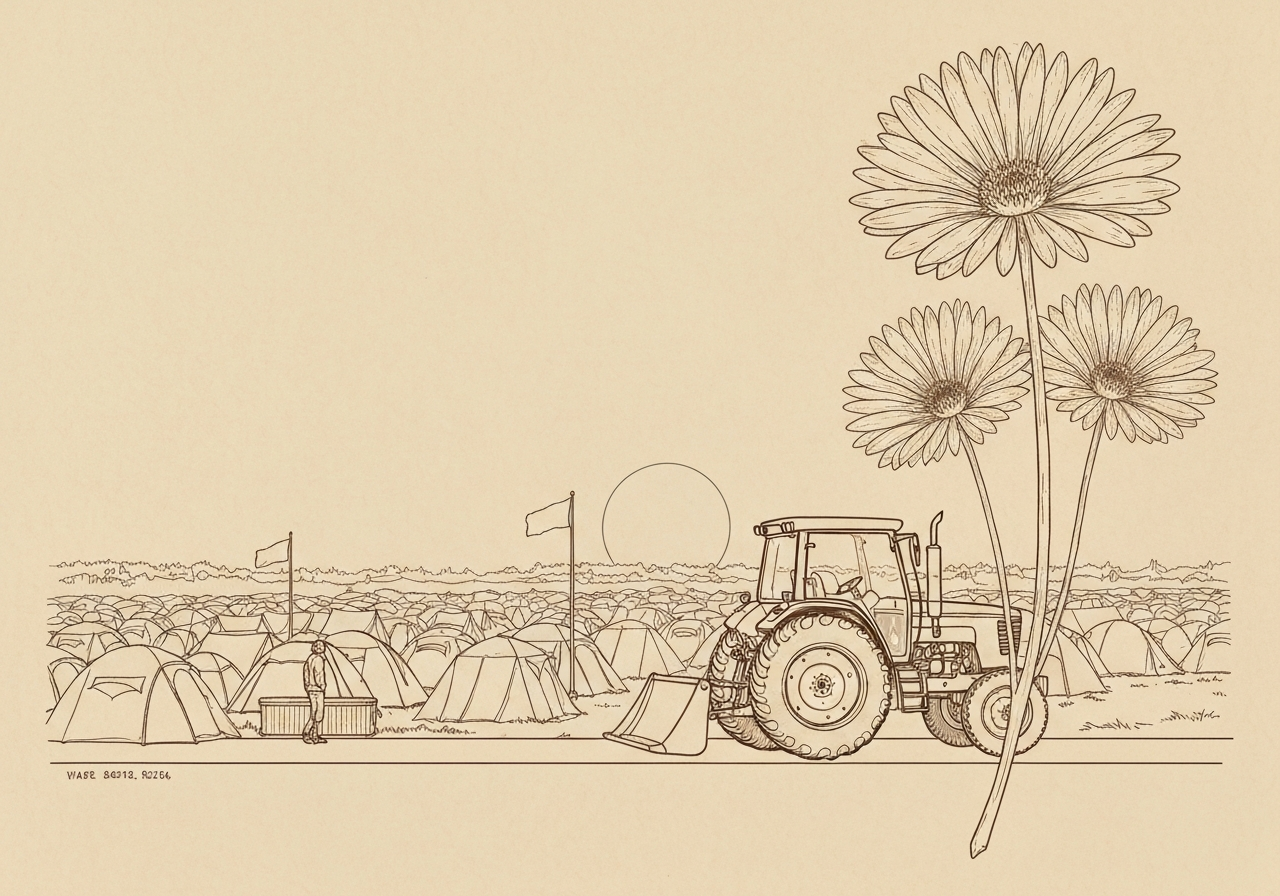
When Rakesh Vaishnav and others approached the Supreme Court of India in 2020, they were not alone. They were part of a wave of petitioners — farmers, activists, and citizens — challenging the constitutional validity of three farm laws enacted by Parliament that year. On the other side stood the Union of India, defending the statutes. And in between, on the outskirts of Delhi, hundreds of thousands of farmers from Punjab and neighbouring states had been protesting for months, blocking roads and highways, braving winter and COVID-19. The stakes could not have been higher: the future of India's agricultural markets, the right to protest, the freedom of movement of Delhi's residents, and the lives and health of thousands of men, women, and children camped at the borders.
The three laws that sparked a fire
Parliament passed three Acts in 2020: the Farmers' Produce Trade and Commerce (Promotion and Facilitation) Act, the Essential Commodities (Amendment) Act, and the Farmers (Empowerment and Protection) Agreement on Price Assurance and Farm Services Act. The government argued these laws would liberalise agricultural trade, attract private investment, and empower farmers to contract directly with buyers. The protesting farmers saw them differently: a dismantling of the Minimum Support Price (MSP) system, a threat to their land holdings, and a surrender of Indian agriculture to corporate interests.
Multiple writ petitions under Article 32 of the Constitution — the right to constitutional remedies — landed before the Supreme Court. Some petitioners challenged the laws' validity. Others supported them. A third group, residents of Delhi, invoked their rights under Article 19(1)(d) (freedom of movement) and Article 19(1)(g) (right to carry on trade and business), arguing that the road blockades by protesters had paralysed the capital. One petition even challenged the Constitution (Third Amendment) Act, 1954, which had substituted Entry 33 in List III of the Seventh Schedule — the concurrent list entry that governs trade and commerce in foodstuffs.
What the Attorney General argued — and why the Court disagreed
The Attorney General for India, appearing for the Union, opposed any interim stay of the farm laws. He relied on a line of precedents: Bhavesh D. Parish & Ors. v. Union of India & Anr. (2005) 5 SCC 471; Health For Millions v. Union of India & Ors. (2014) 14 SCC 496; State of UP & Ors. v. Hirendra Pal Singh & Ors. (2011) 5 SCC 305; and Siliguri Municipality & Ors. v. Amalendu Das & Ors. (1984) 2 SCC 436. The principle, he argued, was clear: courts should not stay the implementation of legislation. There is a presumption of constitutionality. The remedy lies in a final hearing, not an interim freeze.
The Bench — Hon'ble The Chief Justice S.A. Bobde, Justice A.S. Bopanna, and Justice V. Ramasubramanian — did not disagree with the principle. But they distinguished the precedents. The Court noted that it was not powerless to grant a stay of executive action under a statutory enactment, particularly when such a stay could facilitate resolution of an ongoing crisis and protect fundamental rights. The Bench cited its own recent order in Dr. Jaishri Laxmanrao Patil v. The Chief Minister & Anr. (Civil Appeal No.3123 of 2020), where it had directed that admissions and appointments be made without reference to the reservation provided under the impugned legislation. If the Court could stay executive action under a statute, it could certainly stay the implementation of the statute itself in extraordinary circumstances.
The protest: peaceful, but with shadows
The Court acknowledged that the farmers had "laudably carried on the agitation peacefully without any untoward incident." But it also noted apprehensions — raised by the government and others — about "non-farmer elements" joining the protests and the alleged financing by the banned organisation "Sikhs for Justice." The Bench did not decide these allegations. It simply recorded them, observing that while the Court may not stifle a peaceful protest, the stay order should be perceived as achieving the purpose of the protest — at least for the present.
This was a delicate balancing act. On one side, the fundamental right to protest. On the other, the rights of Delhi's residents to move freely and carry on business. And in the middle, the lives of thousands of senior citizens, women, and children living in makeshift camps during winter and a pandemic. The Court decided that the best way forward was not to adjudicate the constitutional validity of the laws immediately, but to create a mechanism for dialogue.
The order: stay, protect, and negotiate
On 12 January 2021, the Supreme Court passed an interim order that changed the course of the protest. It directed:
- Stay of implementation of all three farm laws until further orders.
- Protection of MSP — the existing system to be maintained, and no farmer to be dispossessed or deprived of title under the farm laws.
- Constitution of a four-member expert committee to hear grievances and make recommendations within two months from its first sitting, which was to be held within ten days. The committee comprised Bhupinder Singh Mann, Dr. Parmod Kumar Joshi, Ashok Gulati, and Anil Ghanwat. All expenses were to be borne by the Central Government.
- Participation of all farmers' bodies — whether supporting or opposing the laws — in the committee's deliberations.
- Listing after eight weeks.
The Court made it clear: the stay was not a final determination of the laws' validity. It was an interim measure to "assuage hurt feelings," encourage stakeholders to negotiate in good faith, and protect the lives, health, and properties of citizens involved in the prolonged protest.
The doctrine that mattered: when can a court stay a law?
The ratio decidendi of this judgment is narrow but significant. The Supreme Court held that it is not completely powerless to grant a stay of executive action under a statutory enactment, even where there is a presumption of constitutionality. Such a stay may be warranted when it can facilitate resolution of an ongoing crisis and protect fundamental rights. This is not a departure from the principle of judicial restraint. It is an exception — one that the Court carefully confined to the facts before it.
The Court did not strike down the laws. It did not even express a final view on their constitutionality. It simply paused their implementation and created a space for negotiation. The message was clear: the Court's interim power is not a rubber stamp for every government action, nor is it a tool for routine judicial overreach. It is a scalpel, to be used sparingly and only when the stakes are existential.
THE PLAY: When challenging legislation on constitutional grounds, do not assume the Court will grant an interim stay. You must demonstrate an extraordinary crisis — one that threatens fundamental rights, lives, or public order — and show that a stay would facilitate resolution rather than obstruct governance.
Why this matters in practice
For advocates, this judgment is a reminder that the presumption of constitutionality is not absolute. It can be overcome — at least at the interim stage — by evidence of an ongoing crisis that the Court's intervention can help resolve. The key is to frame the stay not as a judicial veto of legislative wisdom, but as a temporary pause to enable dialogue and protect rights.
For CFOs and founders, the takeaway is different. The farm laws were designed to liberalise agricultural markets. Their stay meant that the regulatory framework for agri-business remained uncertain. If you operate in a sector that depends on legislative reform, this judgment shows that even well-intentioned laws can be halted by judicial intervention if the social and political context is volatile. Legal risk is not just about the text of the law — it is about the ground reality of protest and public sentiment.
For the protesting farmers, the stay was a victory — but a temporary one. The committee was meant to hear their grievances and make recommendations. Whether those recommendations would be accepted by the government or the Court remained to be seen. The judgment did not end the protest. It merely changed its terms.
The bottom line
The Supreme Court stayed three farm laws not because they were unconstitutional, but because the crisis they had triggered — a massive, prolonged protest threatening lives, health, and public order — warranted an interim pause to enable negotiation and protect fundamental rights. The Court's power to stay legislation is real, but it is an exception, not the rule. Use it only when the stakes are existential and the remedy is dialogue.