She said the Will was signed. The court asked: where are the witnesses?
The Supreme Court ruled that proving a Will requires mandatory attestation—no shortcuts, even if no one disputes the signature.
"Proof of attestation of the will is a mandatory requirement."
The rule the Supreme Court appliedApoline D' Souza v. John D' Souza — 2024 LiveLaw (SC) 123
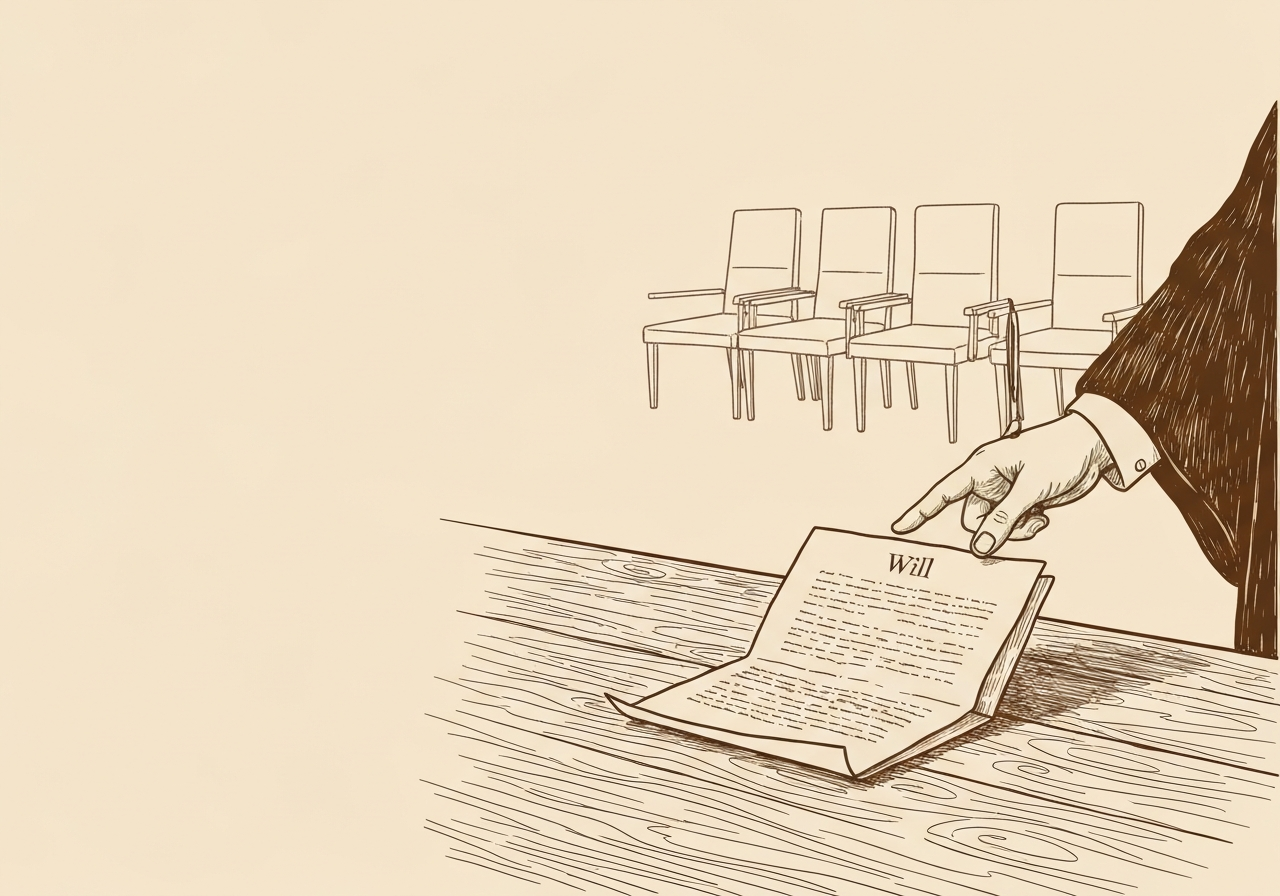
The Supreme Court ruled that proving a Will requires mandatory attestation—no shortcuts, even if no one disputes the signature.
The Will looked fine. The signature looked real. But the court said: prove the witnesses saw him sign.
Apoline D' Souza stood in a courtroom holding a document that could decide her inheritance. The signature on the Will matched the deceased's handwriting. No one was disputing that he had put pen to paper. Yet the Supreme Court stopped the proceedings cold. It demanded something Apoline had not brought: the people who watched the man sign. Without them, the Court said, the Will was nothing.
The question hanging over the case was deceptively simple. Can a Will be accepted as valid when the person claiming it cannot produce the people who saw it signed? The answer would reshape how every lawyer in India prepares a Will case.
When the Will arrived in court
The case, Apoline D' Souza v. John D' Souza, began in a trial court where two sides of a family fought over a dead relative's estate. One side produced a Will. The other side challenged it. But the challenge was not about forgery or fraud. The question was narrower: had the person presenting the Will proved that it was properly witnessed?
The trial court examined the evidence. The signature matched. There was no allegation of coercion. The document looked clean. Yet the court found that the person propounding the Will — the one asking the court to accept it — had not brought forward the attesting witnesses (the people who saw the deceased sign). Without them, the court said, the Will could not be proved.
The losing side appealed. The High Court agreed. The matter reached the Supreme Court.
The legal wall that stopped the case
The Supreme Court looked at Section 68 of the Evidence Act, 1872 — the provision that governs how a Will must be proved. The language is unforgiving. It says a document that requires attestation by law — and a Will is such a document — cannot be used as evidence unless at least one attesting witness is called to testify.
The Court observed that "the question as to whether due attestation has been established or not will depend on the fact situation obtaining in each case." Every case turns on its own facts. But the Court then added a line that left no room for manoeuvre: "Proof of attestation of the will is a mandatory requirement."
This was not a technicality that could be waived. It was not a formality that could be bypassed because the signature was undisputed. The law demanded that someone who saw the deceased sign the Will must step into the witness box and say so under oath.
The Court also referred to its earlier judgment in Vrindavanibai Sambhaji Mane v. Ramachandra Vithal Ganeshkar and others. In that case, the Supreme Court had clarified that a Will "has to be proved like any other document except for the fact that it has to be proved after the death of the testator." This means the person who wrote the Will is dead and cannot confirm it. So the law shifts the burden to the person who wants the Will accepted. That person must prove two things: the testamentary capacity of the deceased (the mental ability to make a Will) and the signature of the deceased. But before either of those can be examined, the first step is mandatory: prove the attestation.
Why the witnesses matter
The logic is straightforward. A Will takes effect only after the person who made it is dead. The deceased cannot be cross-examined. The signature could be genuine, but the circumstances around the signing could be suspicious. The attesting witnesses are the only living people who can confirm that the deceased signed freely, understood what they were signing, and did so in the presence of two witnesses who then signed in the presence of each other.
Without that testimony, the court has no way to know whether the Will was executed properly. A genuine signature on a document does not, by itself, prove that the document was signed as a Will.
The Supreme Court in Apoline D' Souza v. John D' Souza did not create a new rule. It restated what Section 68 already says. But the restatement matters because it shuts down a common argument: that if no one disputes the signature, the attestation requirement can be relaxed. The Court said no. The requirement is mandatory. It does not depend on whether the other side is fighting the case or staying silent.
The practical trap for lawyers
For practitioners, the judgment is a warning. Many lawyers handling Will cases assume that if the signature is proved through handwriting experts or through the testimony of someone familiar with the deceased's handwriting, the attestation requirement is satisfied. That is wrong. The handwriting expert can prove the signature is real. But the expert cannot prove that the deceased signed in the presence of two witnesses who then signed in the presence of the deceased and each other. Only the attesting witnesses can do that.
The judgment also clarifies that the burden of proof does not shift to the challenger. Even if the challenger does not produce any evidence of fraud or forgery, the person propounding the Will must still prove attestation. The burden stays where it starts.
The trial court's finding and the High Court's reasoning
In the trial court, the evidence was examined. The signature on the Will was not disputed. No allegation of coercion was made. Yet the court found that the person propounding the Will had not brought forward the attesting witnesses. Without them, the court concluded, the Will could not be proved. The losing side appealed. The High Court agreed with the trial court's reasoning. The matter then reached the Supreme Court, which upheld the requirement that attestation must be proved as a mandatory step.
The Court examined the record from the trial. The person propounding the Will had relied on the signature alone. No attesting witness had been called. The trial judge had noted this gap and ruled against the Will. The High Court, on appeal, had reviewed the same evidence and reached the same conclusion. When the case reached the Supreme Court, the bench asked a single question: where are the witnesses? The courtroom fell silent. The file on the judge's desk was thin — it contained the Will, the trial court's order, and the High Court's judgment, but no affidavit from any attesting witness. The judge peered at the document, a single folded sheet of paper. The signature was clear. But the law required more.
Apoline D' Souza stood in the courtroom holding the Will. When the court asked for the witnesses, the silence that followed was heavy. No one stepped forward. No one could say they had seen the deceased sign. The Court ended where it began. A document that looked fine. A signature that looked real. And a legal requirement that could not be ignored. Apoline walked out without her inheritance — not because the Will was fake, but because she could not produce the people who watched it signed.
THE PLAY: Before you file a Will for probate, locate at least one attesting witness who is alive and willing to testify — without that witness, the Will cannot be proved, no matter how genuine the signature looks.