The Supreme Court's two-condition test for CIRP wages under Section 5(13).
The Supreme Court ruled that wages during insolvency count as CIRP costs only if the company was a going concern and the workers actually worked — but provident funds sit untouched outside the waterfall.
272
workers.
The Supreme Court ruled that wages during insolvency count as CIRP costs only if the company was a going concern and the workers actually worked — but provident funds sit untouched outside the waterfall.
272 workers, one shipyard, and a question the IBC didn't answer
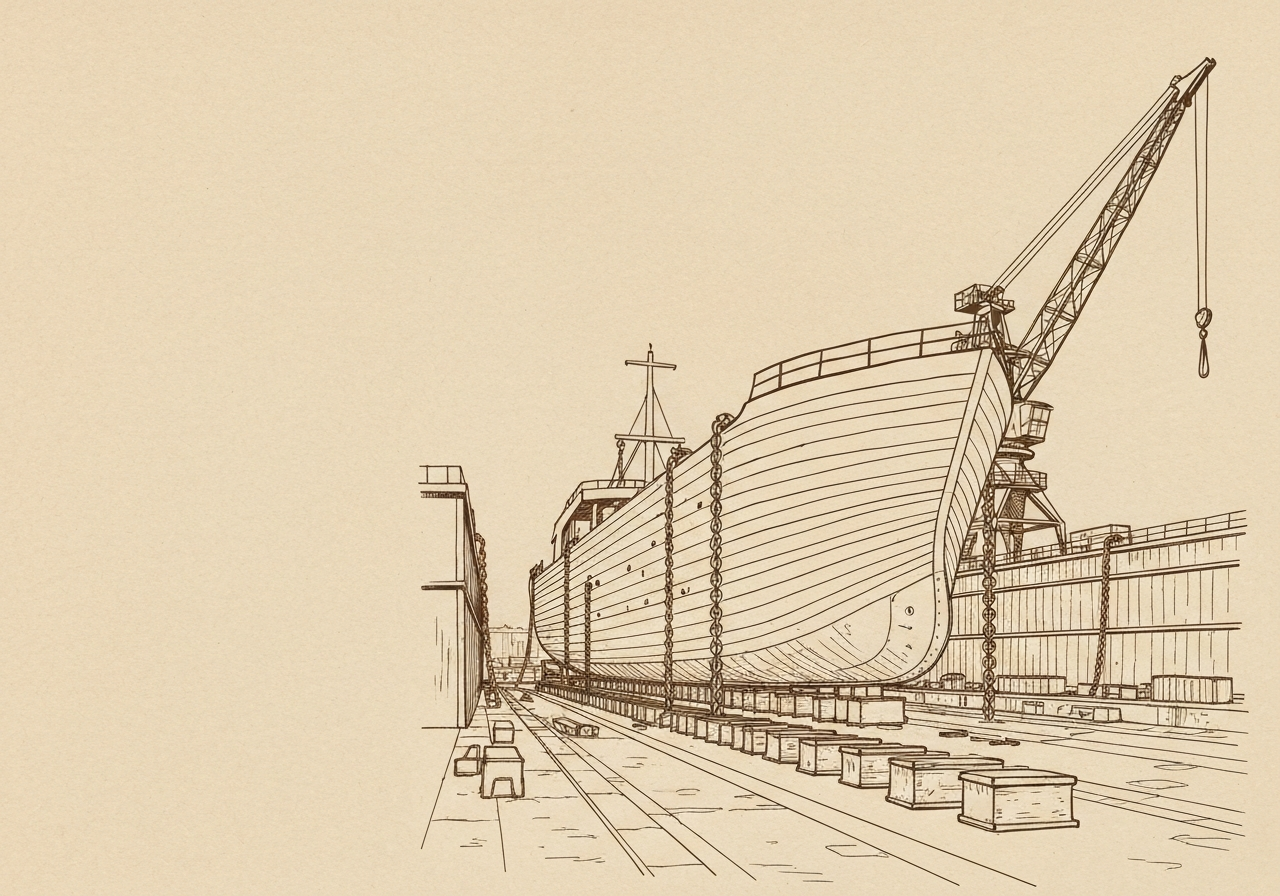
When ABG Shipyard Limited went into insolvency in August 2017, it had two sprawling yards — one at Dahej, another at Surat — and a head office in Mumbai. The Dahej yard had been silent since 2015. Surat shut down by October 2017. But 272 workmen and employees at Dahej and Mumbai insisted they were still on the payroll, still reporting for duty, still entitled to their wages. The resolution professional disagreed. The tribunals declined to grant automatic relief. And for sixteen years of appeals, the question that hung over the case was deceptively simple: did these workers actually work during the insolvency resolution process?
The Supreme Court finally answered that question on April 19, 2022. And the answer has changed how every resolution professional, liquidator, and workmen's counsel must approach wage claims under the Insolvency and Bankruptcy Code.
The ship that stopped sailing
ABG Shipyard was admitted into the Corporate Insolvency Resolution Process (CIRP) by the NCLT, Ahmedabad Bench on August 1, 2017. An Interim Resolution Professional (IRP) was appointed. The company had hundreds of workmen and employees on its rolls. But the yards were not operational. Dahej had been idle since 2015. Surat operations wound down by October 2017. The head office in Mumbai remained open, but the question of whether the company was a "going concern" during the 20-month CIRP period became the central factual dispute.
On April 25, 2018, the NCLT directed the deposit of Rs.2.75 crores as an interim measure, subject to the final outcome of the workmen's application. But when no resolution plan was approved and the company was ordered into liquidation on April 25, 2019, the NCLT disposed of the workmen's application without granting relief. The NCLAT, New Delhi dismissed the appeal on May 31, 2019, directing the workmen to file individual claims before the Liquidator for verification.
The workmen approached the Supreme Court. They argued that their wages and salaries during the CIRP period were "Insolvency Resolution Process Costs" under Section 5(13) of the IBC, and therefore entitled to priority payment under Section 53(1)(a) — the very top of the waterfall. The resolution professional and the liquidator countered that the workmen had not actually worked, that the company was not a going concern, and that the claims should be treated as ordinary workmen's dues under Section 53(1)(b) or (c).
What the workmen argued — and what they didn't prove
The learned Counsel for the appellants, the workmen, placed heavy reliance on the Supreme Court's decision in Swiss Ribbons Pvt. Ltd. v. Union of India (2019) 4 SCC 17, which held that the IBC aims to maximize the value of the corporate debtor's assets so that they run efficiently as a going concern. They also cited Gujarat Urja Vikas Nigam Ltd. v. Amit Gupta (Civil Appeal No. 9241 of 2019, decided on 08.03.2021), which reiterated the going concern mandate under the IBC.
The core of their argument was this: Section 20 of the IBC requires the resolution professional to manage the corporate debtor as a going concern. If the statute mandates it, they argued, the company must be presumed to have been a going concern during the CIRP. And if it was a going concern, the workmen who remained on the payroll were entitled to wages as CIRP costs — regardless of whether they actually performed work.
The resolution professional and the liquidator disagreed. They pointed to the factual reality: the Dahej yard had been non-operational since 2015, Surat closed by October 2017, and the workmen had not actually rendered any services during the CIRP period. The company was not a going concern in any meaningful sense. The workmen's claims, they argued, should be treated as ordinary workmen's dues under Section 53(1)(b) and (c) of the IBC — not as CIRP costs.
The test the Supreme Court laid down
Justice M.R. Shah, writing for the two-judge Bench (with Justice Aniruddha Bose concurring), delivered a judgment that cuts through the abstraction. The Court held that wages and salaries during the CIRP period qualify as CIRP costs under Section 5(13) only if two conditions are proved:
First, the corporate debtor was managed as a going concern during the CIRP. Second, the concerned workmen or employees actually worked during the CIRP period.
Both conditions must be satisfied. Neither can be presumed.
The Court rejected the argument that Section 20 of the IBC creates a presumption of going concern. Section 20 uses the phrase "every endeavour" — it imposes a duty on the resolution professional to try to manage the company as a going concern, but it does not guarantee that the company was in fact a going concern. That is a factual determination, to be made on the evidence.
THE TEST: For wages during CIRP to be treated as CIRP costs under Section 5(13), the workmen must prove both that the corporate debtor was a going concern and that they actually worked. One without the other is not enough.
The Court also clarified what happens to workmen who do not satisfy this test. Their wages and salaries are not lost — they are simply governed by the waterfall mechanism under Section 53(1)(b) and (c) of the IBC, which gives them priority over financial creditors but below CIRP costs. In other words, non-working employees during a non-going-concern CIRP are not left empty-handed; they are just moved down the priority ladder.
The provident fund, gratuity, and pension bombshell
But the most significant part of the judgment — the part that will have every CFO and founder paying attention — concerns the treatment of provident fund, gratuity fund, and pension fund dues.
The Court held, unequivocally, that these funds are excluded from the liquidation estate under Section 36(4) of the IBC. The Section 53(1) waterfall mechanism is inapplicable to them. The liquidator has no claim over such funds. They belong to the workmen and employees, and must be paid from the excluded funds directly.
This is not a matter of priority. It is a matter of ownership. The Court traced the legislative history from the Companies Act, 1956 through the Companies Act, 2013 to the IBC, showing a progressive protection of workmen's dues, with provident fund, gratuity, and pension given outright protection outside the liquidation estate.
WHAT THIS MEANS FOR YOU: If you are a liquidator, you cannot touch provident fund, gratuity fund, or pension fund monies. They are not part of the liquidation estate. If you are a workman, these funds are yours — regardless of the waterfall.
Why this matters in practice
For advocates advising resolution professionals, this judgment provides a clear framework for evaluating wage claims during the CIRP. The days of blanket claims that "all workmen on the payroll are entitled to CIRP costs" are over. The resolution professional must now examine two factual questions: was the company actually operating as a going concern, and did the workmen actually work?
For CFOs and founders of companies undergoing insolvency, the judgment offers some comfort. If your company is not genuinely operating during the CIRP — if the factories are silent, the machines are idle, and the workmen are not actually working — their wage claims will not automatically leapfrog to the top of the waterfall. They will be treated as ordinary workmen's dues, which still have priority over financial creditors but are below CIRP costs.
For workmen and their counsel, the judgment is a double-edged sword. On one hand, the Court has affirmed that provident fund, gratuity, and pension are completely protected — the liquidator cannot touch them. On the other hand, the Court has made it harder to claim wages as CIRP costs. The workmen must now prove actual work during a genuine going concern CIRP. That is a factual burden that may be difficult to discharge, especially in cases where the company has been non-operational for years before the CIRP began.
The Court remanded the claims to the Liquidator for factual adjudication within 12 weeks. The Liquidator must determine whether ABG Shipyard was a going concern during the CIRP period, and whether the 272 workmen actually worked. If both conditions are proved, the wages will be paid as CIRP costs under Section 53(1)(a). If not, they will be paid under Section 53(1)(b) or (c). And the provident fund, gratuity, and pension will be paid from the excluded funds, regardless of the outcome.
The bottom line
If you are a resolution professional, a liquidator, or a workmen's counsel, remember this: wages during CIRP are not automatic CIRP costs. You must prove the company was a going concern and the workmen actually worked. And provident fund, gratuity, and pension are never part of the liquidation estate — the liquidator has no claim over them, and the waterfall does not apply.