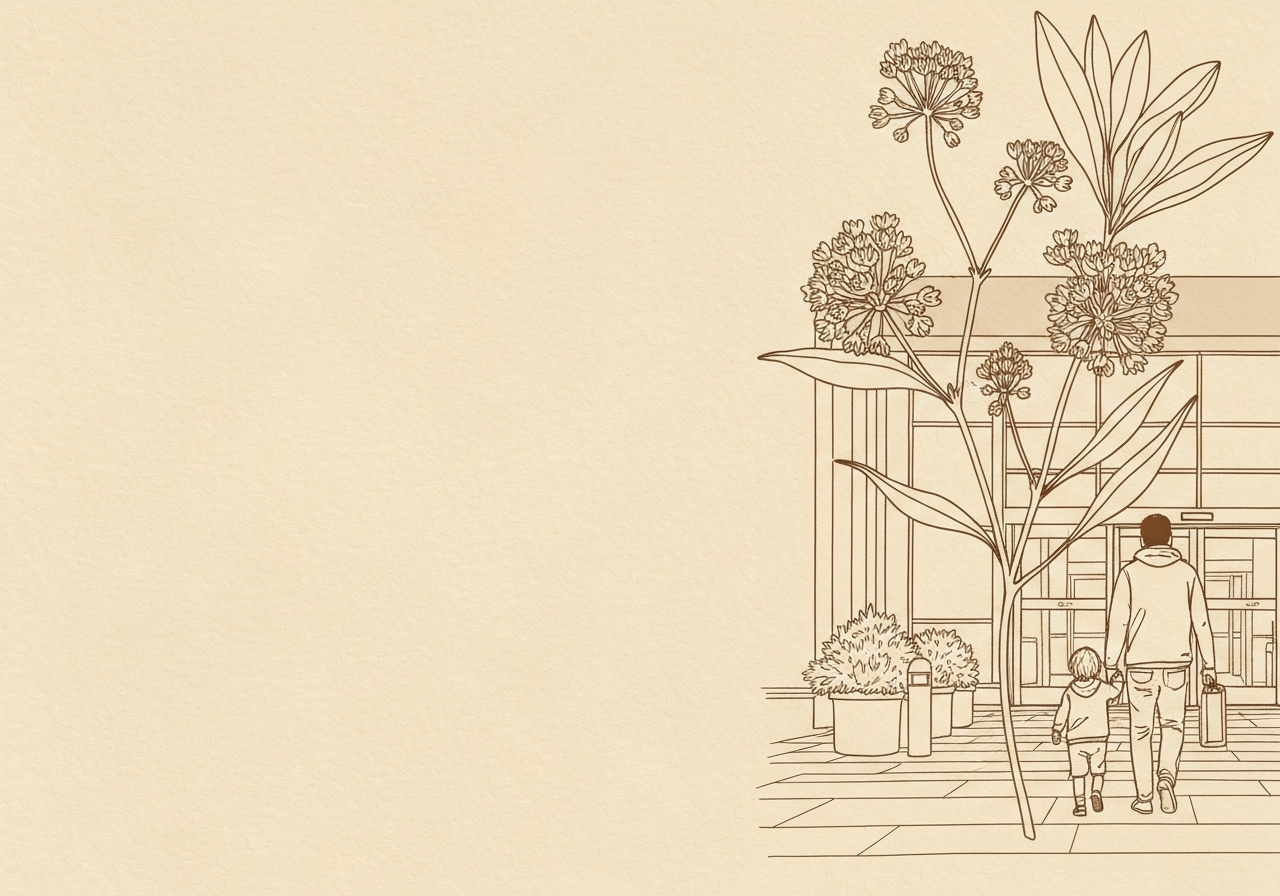
This father lost his Sunday to a court corridor. The Supreme Court gave it back at a mall.
A father's Sunday visitation was confined to a court corridor until the Supreme Court ruled that the environment of a visit is as crucial as the visit itself for a child's welfare.
Modified.
From court to mall.
Child welfare first.
A father's Sunday visitation was confined to a court corridor until the Supreme Court ruled that the environment of a visit is as crucial as the visit itself for a child's welfare.
A Sunday at the Mall, Not the Courtroom
Adarsh C.B. wanted to see his child. The Family Court in Kerala said yes — but only on Sundays, from 11 a.m. to 4 p.m., and only inside the court premises. The father was not a litigant who had misbehaved. He was not a flight risk. He was simply a parent in a custody dispute, and the court had decided that the safest place for a child to meet its father was a courtroom corridor.
The Kerala High Court saw nothing wrong with this. It upheld the order. So Adarsh C.B. approached the Supreme Court of India. And on October 3, 2023, a two-judge Bench of Justice A.S. Bopanna and Justice Manoj Misra asked a question that had apparently not been asked before: Is a court premises really the right place for a child to spend time with a parent?
The answer was a quiet but firm no. The Supreme Court modified the visitation arrangement, moving it from the court to the entrance of RP Mall, Kollam, and reducing the hours from five to three. The matter was kept pending. But the principle it established — that the environment of visitation is as important as the fact of visitation itself — is one that every family lawyer, every parent, and every judge handling custody matters should now carry in their pocket.
What the Family Court Actually Ordered
The dispute began in the Family Court, Kerala, which on November 10, 2022, granted the father visitation rights. The order was specific: every Sunday, from 11 a.m. to 4 p.m., the father could meet his child — but only within the court premises. The mother was to bring the child to the court. The father was to spend time with the child there. And then the child would go home.
This was not a punishment. It was, presumably, an attempt to create a neutral, supervised environment. Courts often do this when there is acrimony between parents, or when one parent alleges that the other might not return the child. But the Family Court did not stop to consider what it actually feels like for a child to spend a Sunday afternoon in a court building — the hard benches, the uniformed staff, the smell of files and disinfectant, the constant reminder that this is a place where disputes are fought, not where families are built.
The High Court's Missed Opportunity
The father moved the Kerala High Court at Ernakulam, filing OPFC No. 665/2022. He argued that the court-premises restriction was unnecessary and harmful. The High Court, however, declined to interfere. It observed — rightly, as the Supreme Court later noted — that the welfare of the child is paramount in matters of this nature. But then it stopped. It did not ask whether the welfare of the child was actually served by forcing a child to meet a parent inside a courtroom every week. It simply upheld the Family Court's order.
That was the error. The High Court applied the right principle — child welfare — but failed to apply it to the specific facts. It treated the visitation arrangement as a procedural detail, not as a substantive question of the child's well-being.
What the Supreme Court Saw
When the matter reached the Supreme Court via Special Leave Petition (C) No. 2437/2023, the Bench did not spend time on legal technicalities. It did not examine whether the Family Court had jurisdiction, or whether the High Court had erred in law. Instead, it looked at the practical reality of the arrangement.
Justice Bopanna, writing for the Bench, observed that the environment in which visitation is exercised is material to the child's welfare. Repeated visitation in court premises, the Court held, is not in the interest of the child. The court environment is simply not conducive to the child's well-being. A child should not have to associate a parent with a courtroom. A Sunday visit should feel like a visit, not like a supervised parole meeting.
The Court modified the arrangement on its own motion. It directed that the mother hand over the child to the father at the entrance of RP Mall, Kollam, on Sundays at 11 a.m. The father would return the child at 2 p.m. at the same spot. The hours were reduced from five to three — a practical adjustment, since a mall visit does not require the same time as a court visit. The matter was kept pending, listed for further consideration on October 31, 2023.
The Doctrine That Mattered
The Supreme Court did not cite a single precedent. The precedent registry in this judgment is empty. That is unusual, but it is also telling. The Court was not breaking new legal ground. It was applying a principle so fundamental that it did not need citation: the welfare of the child is paramount.
But the Court gave that principle a specific, practical meaning. It said that the environment of visitation is part of the child's welfare. A court cannot simply grant visitation rights and then leave the logistics to chance. The place, the time, the duration — all of these are part of the child's experience. And if the experience is harmful, the visitation is not truly in the child's interest.
THE TEST: When granting visitation rights, ask: Is this environment conducive to the child's well-being? If the answer is no — even if the arrangement is logistically convenient for the court — the arrangement must be changed.
Why This Matters in Practice
For advocates handling custody and visitation matters, this judgment is a tool. It is a reminder that the Family Court's order is not the final word on logistics. If a client is being forced to meet a child in a court premises, or in any environment that is not child-friendly, this judgment can be cited to argue for a change of venue.
For CFOs and founders who may be involved in custody disputes — and this is more common than one might think, given the high-stress nature of entrepreneurial life — the takeaway is practical: do not accept a visitation arrangement that feels wrong. If the court says you can only see your child in a courtroom, you have the right to ask for a better environment. The Supreme Court has now said so explicitly.
For judges, the message is equally clear. A visitation order is not just a legal document. It is a lived experience for a child. The court must consider not just whether visitation happens, but how it happens. A child should not have to grow up associating a parent with a court building.
The Bottom Line
When the Supreme Court of India, in Adarsh C.B. v. Aswathy Sidharthan (2023 LiveLaw (SC) 847), moved a father's Sunday visitation from the court premises to the entrance of RP Mall, Kollam, it did more than change a venue. It established that the environment of visitation is a component of child welfare — and that no court should force a child to meet a parent in a place that feels like a dispute, when it should feel like a relationship.