Why a post-mortem report alone can't prove murder
The court said a medical certificate is not substantive evidence—even if the doctor says something in cross-examination, it's just a possibility.
Held.
Report alone
cannot convict.
The court said a medical certificate is not substantive evidence—even if the doctor says something in cross-examination, it's just a possibility.
A man was killed. The post-mortem report said one thing. The court said: that's not enough.
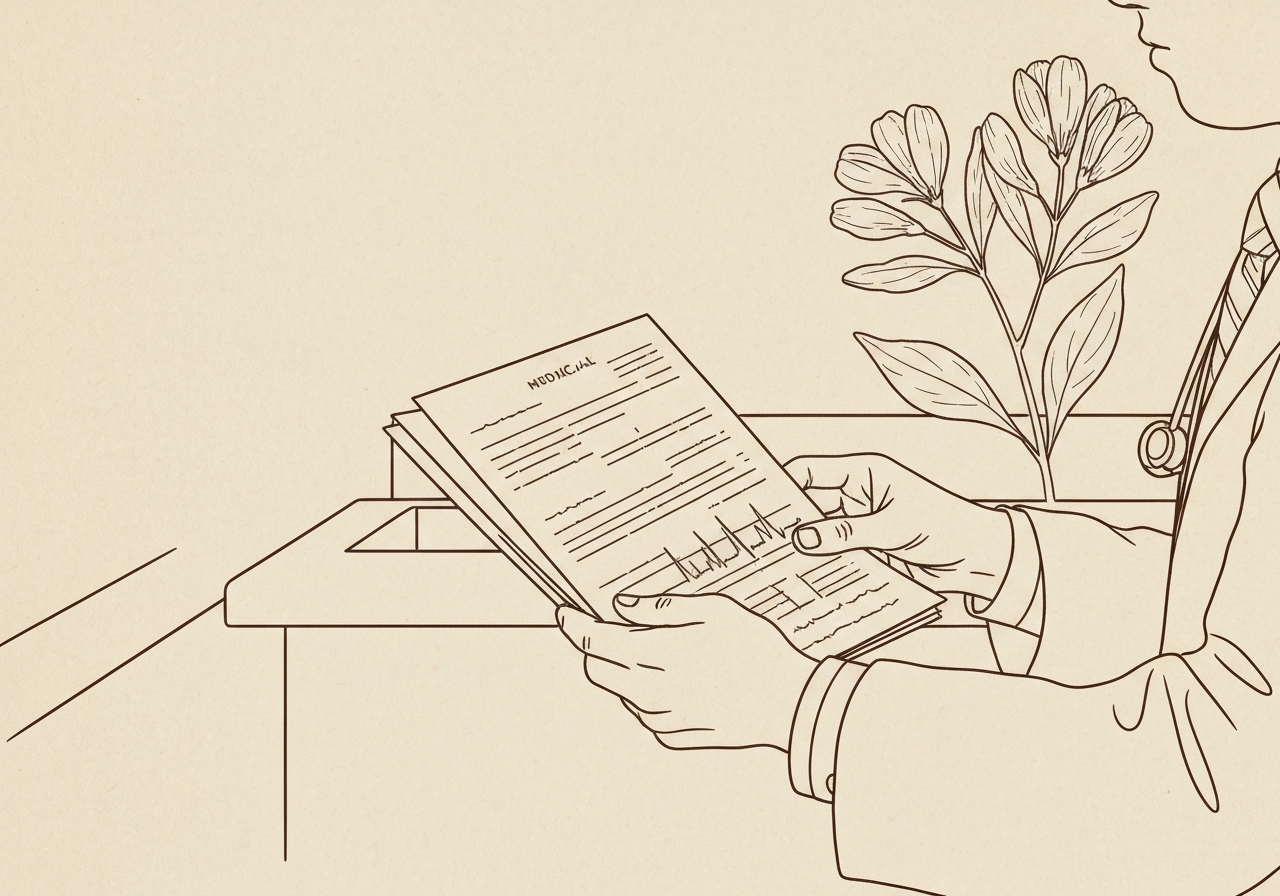
The courtroom fell silent as the doctor's report was read aloud. The file felt thin in the judge's hands — a few pages of medical observations that the prosecution insisted proved murder. The doctor sat in the witness box, his hands resting on the same report he had written weeks earlier. The judge's expression remained impassive as the defence lawyer pounced on a stray remark made during cross-examination. The question before the court was deceptively simple: could a piece of paper, however detailed, stand alone as proof of homicide?
The case: Vadugu Chanti Babu v. State of A.P. The question it answered is one that haunts every criminal trial in India: What is a post-mortem report actually worth in court?
When the doctor's report became the only witness
The facts are straightforward. A man died. The prosecution believed it was murder. The body was sent for autopsy. The doctor who conducted the post-mortem prepared a detailed report — noting injuries, cause of death, and the probable weapon used. The prosecution built its case around this report. They had no eyewitness who saw the accused strike the fatal blow. They had no confession. They had a doctor's written opinion and little else.
At trial, the prosecution called the doctor to the witness box. He identified his own report. He confirmed what he had written. The smell of old paper filled the air as he flipped through the pages. But under cross-examination, the doctor made a stray statement — a casual remark that suggested the injuries could have been caused in a manner different from what the prosecution alleged. It was not a retraction. It was not a contradiction. It was a possibility, floated in the heat of questioning. The defence lawyer's voice rose as he seized the moment. The judge's pen paused over the notebook.
The defence seized it. The trial court convicted the accused anyway, relying heavily on the post-mortem report as proof of homicide. The matter reached the High Court, and eventually, the Supreme Court — though the narrative does not specify which court delivered the final judgment. What is clear is that the court took up the specific question of what evidentiary weight a post-mortem report carries.
The legal problem: a document that cannot speak
Indian evidence law draws a sharp line between two kinds of proof. Substantive evidence is evidence that directly proves a fact — a witness saying "I saw him stab the man." Corroborative evidence supports or confirms substantive evidence but cannot stand alone. A post-mortem report, the court held, falls into the second category.
The court observed that a post-mortem report or wound certificate is explicitly not substantive evidence. It is a record of what the doctor observed, reduced to writing. But the writing itself cannot testify. Only the doctor — a living person who can be cross-examined — can provide substantive evidence. The report is merely a piece of paper that helps the doctor refresh his memory while he speaks.
This distinction matters because of a basic rule: a document that is not itself a witness cannot be used to prove the truth of its contents unless the person who created it appears in court and vouches for it under oath. The post-mortem report, no matter how detailed, no matter how accurate, is legally mute until the doctor gives it a voice. The courtroom's silence during the reading of the report was not reverence — it was the silence of a document that could not answer back.
Why a stray statement during cross-examination is not a conclusion
The court went further. It addressed the doctor's stray remark during cross-examination — the one the defence had used to argue that the death might not have been murder. The court said: a stray statement made by a doctor during cross-examination cannot be treated as a conclusive medical opinion. It is, at best, a possibility. A possibility is not proof. It does not demolish the prosecution's case. It does not create a reasonable doubt unless it is supported by the doctor's own final opinion or by other evidence.
This is a crucial clarification. In many trials, defence lawyers celebrate when a medical expert says something even slightly favourable during cross-examination. They argue that the doctor has "admitted" that the injuries could have been accidental. The court in Vadugu Chanti Babu shut that door. A stray remark, made without the doctor having time to reflect or review his notes, is not a considered opinion. It is a conversational fragment. The court must look at the doctor's entire testimony — his examination-in-chief (the initial questioning by the prosecution), his cross-examination, and his report — to determine what his true opinion is.
The judge's expression did not change when the defence lawyer repeated the stray remark. The court had seen this before — a single sentence, pulled from hours of testimony, waved like a flag. The law required more.
The corroboration rule: what the report can actually do
So what is a post-mortem report good for? The court answered: it serves a largely corroborative function. If the prosecution has an eyewitness who says "I saw the accused stab the deceased," the post-mortem report can confirm that the injuries described by the witness match the injuries found on the body. That is corroboration — one piece of evidence supporting another. But if the prosecution has only the post-mortem report, with no eyewitness, no confession, no circumstantial evidence linking the accused to the crime, the report alone cannot sustain a conviction.
This is not a loophole. It is a protection. A post-mortem report can be forged. It can be mistaken. It can be incomplete. The law insists that a living person — the doctor — must stand in court, face the accused, submit to cross-examination, and say: "I conducted this autopsy. These are my findings. This is my opinion." Only then does the report acquire legal weight.
The court in Vadugu Chanti Babu cemented this position. Medical opinion, while indispensable in practice, does not substitute oral, substantive proof. The doctor must speak. The report is just his script.
Procedural steps: how a post-mortem report enters evidence
The process is straightforward but often misunderstood. First, the doctor who conducted the autopsy must be summoned to court. Second, the prosecution must examine the doctor — this is the examination-in-chief, where the doctor identifies his report and states his findings. Third, the defence gets to cross-examine the doctor, testing his conclusions and probing for weaknesses. Only after this entire process is complete does the post-mortem report become part of the evidence. If the doctor is not produced, the report is legally worthless — a stack of paper with no voice.
This procedural requirement is rooted in Section 45 of the Indian Evidence Act, which deals with expert testimony. The doctor is an expert witness. His report is his expert opinion reduced to writing. But the opinion itself must be spoken in court. The report is a memory aid, not a substitute for testimony. The court in Vadugu Chanti Babu reinforced this distinction, making clear that the evidentiary value of the report flows from the doctor's oral testimony, not from the document itself.
A second illustrative scenario: the limits of medical evidence
Consider a hypothetical case that mirrors the logic of Vadugu Chanti Babu. A woman dies within seven years of marriage. The post-mortem report notes signs of strangulation. The prosecution charges the husband and in-laws with murder. The doctor appears in court and confirms his report under oath. But during cross-examination, the doctor admits — in a stray remark — that some of the injuries could have been caused by a fall. The defence argues that the death was accidental. The court, applying the rule from Vadugu Chanti Babu, examines the doctor's entire testimony. It finds that the doctor's final opinion, stated clearly in his examination-in-chief, is death by strangulation. The stray remark is a possibility, not a conclusion. The court does not treat it as creating reasonable doubt.
This scenario illustrates the practical impact of the judgment. The stray remark does not automatically win the case for the defence. The court looks at the totality of the evidence — the doctor's report, his examination-in-chief, his cross-examination — and decides what his true opinion is. A single sentence, plucked from hours of testimony, is not enough to overturn a conviction.
What this means for practitioners
For prosecutors: never rely solely on a post-mortem report. Ensure the doctor is present in court, that his examination-in-chief is thorough, and that his opinion is clearly stated. A report without a doctor is a body without a pulse.
For defence lawyers: cross-examine the doctor, yes. But do not assume that a stray remark during cross-examination is a victory. The court will weigh the doctor's entire testimony, not just the fragments that favour your client.
For judges: the post-mortem report is a tool, not a witness. It corroborates. It does not prove. The doctor's voice, not his handwriting, carries the weight of evidence.
THE PLAY: A post-mortem report is not evidence until the doctor who wrote it testifies in court — and even then, the report only corroborates, never replaces, oral testimony.
The man was killed. The post-mortem report described it. But the court needed a voice, not a document. The doctor's hands had held the scalpel. His voice, in the witness box, held the truth.