80 kg of ganja mixed with chillies — court says weight not proved
Police seized bundles of marijuana and green chillies together, never weighed separately. Supreme Court says that makes the commercial quantity charge unprovable.
80
kgs.
Police seized bundles of marijuana and green chillies together, never weighed separately. Supreme Court says that makes the commercial quantity charge unprovable.
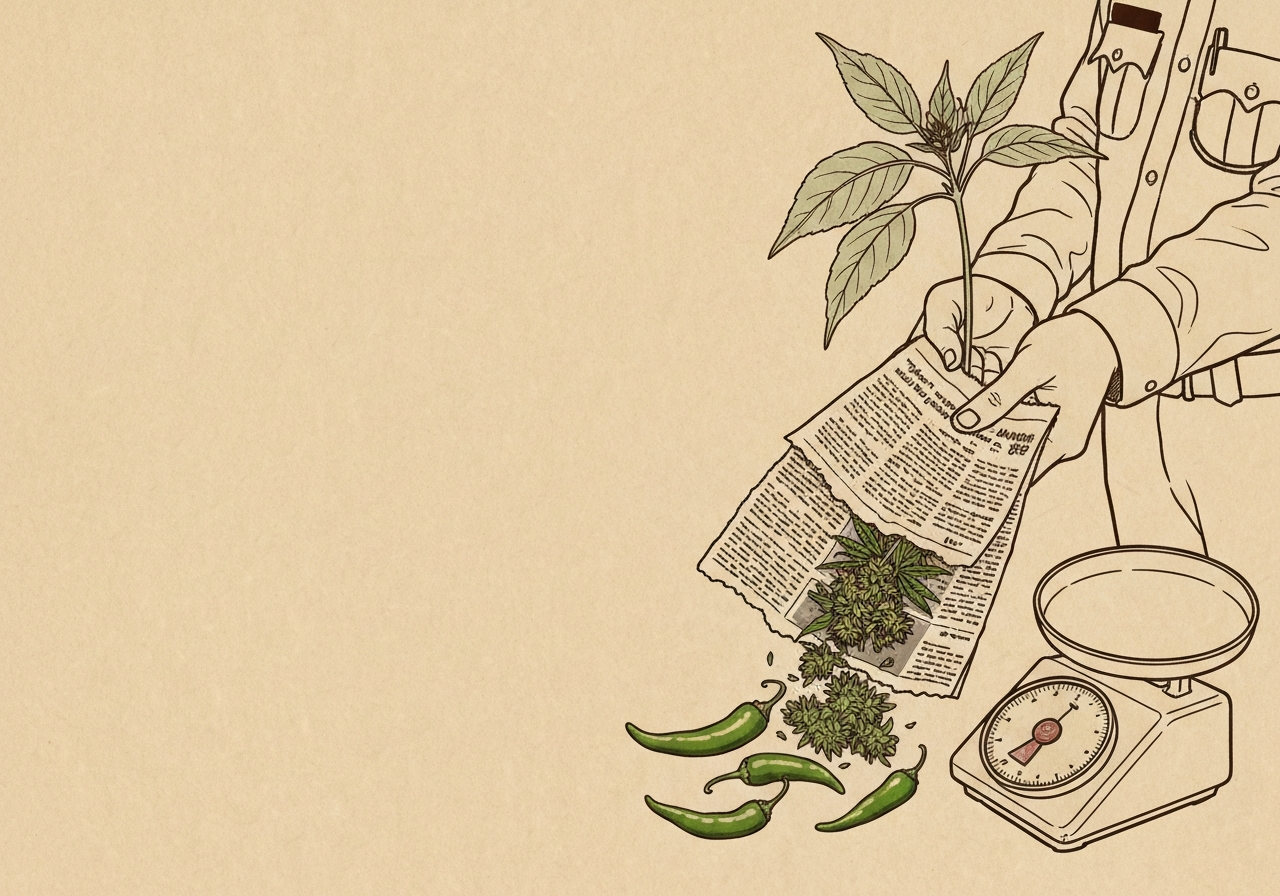
The police found 80 kg of ganja — but it was mixed with green chillies, and they never weighed the two apart. The Supreme Court said: that's a fatal flaw.
On a Hyderabad afternoon in May 2009, a police inspector acting on a tip intercepted a Toyota Qualis near Galaxy Theatre. Inside the vehicle, he found three bundles. They contained marijuana and green chillies, packed together. The inspector did not separate them. He did not weigh the ganja alone. He ordered arrests. What followed was a prosecution so riddled with procedural failures that the Supreme Court would eventually call it "the highest degree of perversity."
Could four men be sent to prison for a commercial quantity of cannabis when the police never actually proved how much of the seized material was marijuana and how much was just vegetables? That was the question that hung over Mohammed Khalid and Another v. The State of Telangana — and the answer would turn on a single, astonishing oversight.
When the chillies and the ganja came bundled together
On 8th May 2009, the police stopped the Qualis and found three bundles. Inside: ganja, allegedly weighing about 80 kgs, mixed with green chillies. Two occupants — A-1 and A-2 — were arrested on the spot. Based on their interrogation, two more persons — A-3 and A-4 — were arrested later.
But from the very beginning, the case was a procedural disaster. The ganja was never weighed separately from the chillies. Independent witnesses were never examined. Samples were mishandled — one sample was given to the accused, yet three still somehow reached the lab. The seized material was repacked from three bags into seven, with no official record of why or when. The samples reached the Forensic Science Laboratory (FSL) after a two-month delay, with no documentation of who handled them in between. The mandatory procedures under Section 52A of the NDPS Act (the law requiring seized narcotics to be inventoried and sampled in front of a magistrate) were never followed.
Despite all this, the trial court convicted all four accused. The High Court for the State of Telangana at Hyderabad affirmed the conviction on 10th November 2022. The men appealed to the Supreme Court.
What the law actually requires
The accused were charged under Section 8(c) read with Section 20(b)(ii)(c) of the NDPS Act — the offence of possessing a commercial quantity of cannabis. Under the NDPS Act, the quantity of the drug determines the severity of the punishment. A "commercial quantity" triggers much harsher penalties than a small quantity. So the weight of the actual contraband — not the weight of the contraband plus chillies — was the single most critical fact in the case.
The prosecution argued that the total weight of the bundles — about 80 kgs — was enough to prove commercial quantity. The defence said no: the law required the police to segregate the ganja from the non-contraband material (the green chillies) and weigh the ganja separately. Without that, no one could say with certainty how much marijuana was actually there.
But the problems didn't stop at the weighing scale. The prosecution also had to prove that the samples sent to the lab were the same samples seized from the vehicle — a concept called "chain of custody." Here, the chain was broken at every link. The two police witnesses — PW-1 and PW-5 — gave contradictory accounts of who collected the samples. The carrier constable who supposedly transported the samples was never examined. The malkhana records (the official register of seized property kept at the police station) were never produced. The two-month delay in sending samples to the FSL was never explained.
On top of all this, the police had repacked the seized material from three original bags into seven new bags — without any proceedings, without any memo, and without permission from any court. The Supreme Court would later note that this meant the original seized material could not be said to have been produced before the court at all.
Why the Supreme Court called it "perverse"
The Supreme Court bench — Justice B.R. Gavai and Justice Sandeep Mehta — delivered its judgment on 1st March 2024. The court found that the prosecution's case suffered from multiple fatal infirmities, and that the conviction was so flawed it amounted to "the highest degree of perversity."
On the weight issue, the court held that where contraband is seized along with non-contraband material, the seizure officer must segregate the contraband and weigh it separately. Failure to do so means the weight of the contraband cannot be established with certainty — and that is fatal for determining whether the quantity falls within the commercial category. The 80 kgs included chillies, and no one knew how much of that was actually ganja.
On the chain of custody, the court held that where the prosecution fails to prove link evidence — including contradictions about who collected samples, non-examination of persons who handled samples, absence of malkhana records, and unexplained delay in transmission — the FSL report cannot be read in evidence at all.
On the Section 52A issue, the court was even more blunt. The investigating officer had failed to prepare an inventory and obtain samples in the presence of a magistrate, as required by law. The court held that this rendered the FSL report inadmissible — calling it "nothing but a waste paper."
And for A-3 and A-4, the case was even worse. They had been convicted solely based on confessions made by the co-accused to the police. Under Section 25 of the Indian Evidence Act (which says a confession made to a police officer cannot be used as evidence), those confessions were completely inadmissible. The court held that convicting someone based on police-recorded interrogation notes was illegal and could not sustain a conviction under the NDPS Act.
What this means for every NDPS investigation
The Supreme Court acquitted all four appellants. They were in custody and were ordered to be released forthwith, unless wanted in any other case. The judgment quashed both the trial court's conviction and the High Court's affirmation.
For practitioners, the message is clear: the NDPS Act demands procedural precision at every step. Weigh the contraband separately from non-contraband. Document every transfer of custody. Get the magistrate involved before sampling. And never, ever rely on police-recorded confessions to convict someone.
THE PLAY: In every NDPS seizure involving mixed material, weigh the contraband separately at the spot, prepare an inventory before a magistrate under Section 52A, and document every hand-to-hand transfer of samples — or watch the entire case collapse.
The chillies and the ganja came bundled together. The Supreme Court untangled them — and set four men free.