A 1958 partition decree was void for land it never owned
The Supreme Court ruled that land granted to farmers by the Nizam before 1948 could not be divided among heirs of a noble, even if a court had already ordered it.
65
years.
The Supreme Court ruled that land granted to farmers by the Nizam before 1948 could not be divided among heirs of a noble, even if a court had already ordered it.
A 1958 court order said this land belonged to a noble's heirs. But farmers had papers from the Nizam—dated before 1948.
On a June afternoon in 2023, the Supreme Court of India killed a partition decree that had been chased for six decades. The land was never the noble's to begin with.
The question took sixty-five years to answer. Could a family claim inheritance over land that the Nizam of Hyderabad had already given away to farmers before Independence? Three rounds at the High Court, two remands from the Supreme Court, and a single stroke from the top bench later, the answer arrived. It was a quiet earthquake for anyone holding a decades-old partition decree over land they never owned.
When the Nizam's grant met a noble's will
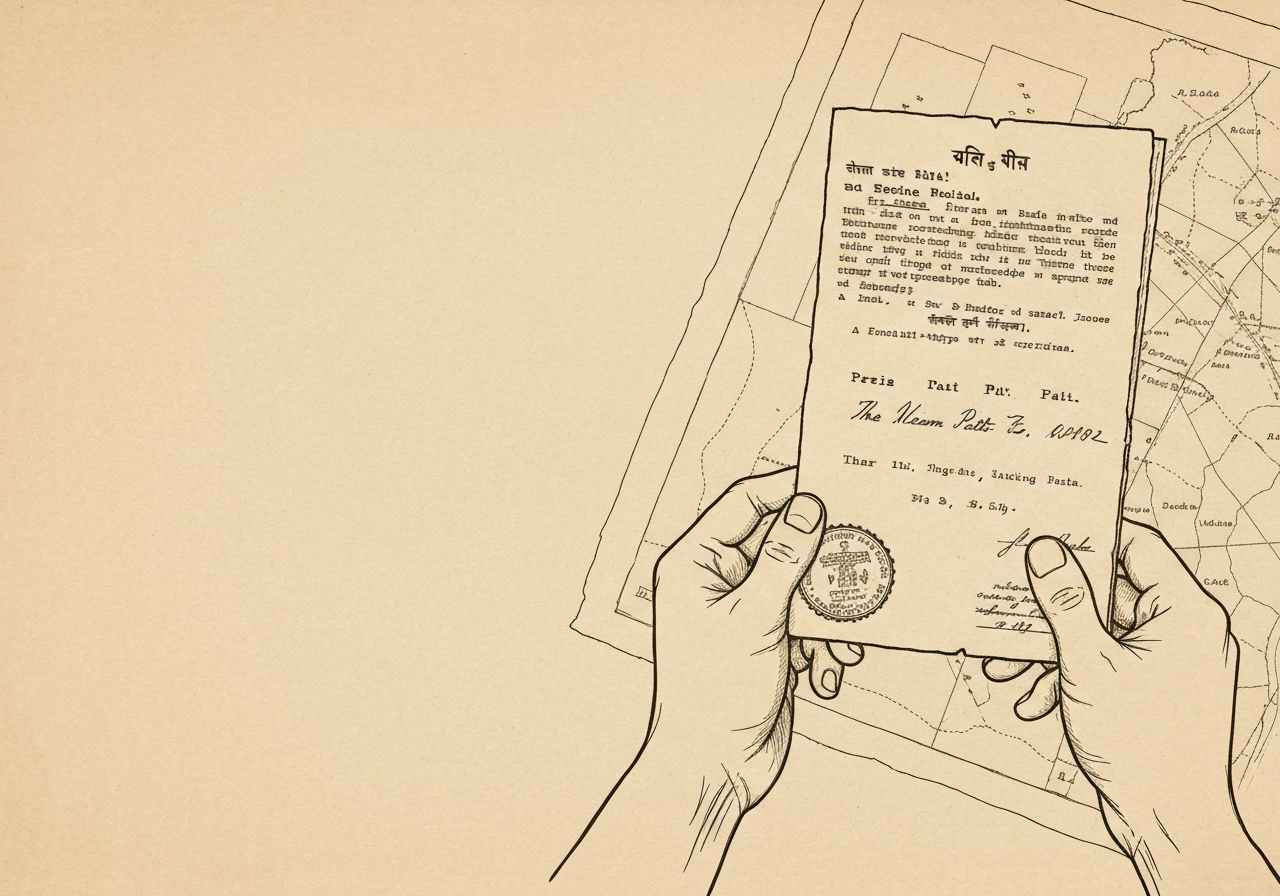
Hydernagar village, Telangana. Survey No. 172—a patch of land that once belonged to the Khurshid Jah Paigah estate. The Paigah estates were among the largest noble holdings in the Hyderabad State, granted by the Nizam to his most trusted nobles. The pattas the farmers held were brittle, handwritten in Persian on yellowed paper, their seals still visible—each one a quiet testament to a grant made before 1948, when the Nizam's Revenue Secretariat still functioned.
After the abolition of jagirs (a system where nobles collected revenue from land) in 1949, the heirs of Nawab Khurshid Jah filed a partition suit in 1958. They claimed these lands were Mathruka property—inheritance to be divided among family members. The courtroom in Hyderabad smelled of old paper and dust as the suit was argued, the files thick with genealogical tables and estate maps.
The City Civil Court in Hyderabad passed a preliminary decree on 28 June 1963, declaring the properties as Mathruka and ordering partition. On paper, the noble's heirs had won. But on the ground, something else was happening.
The farmers who never left
While the heirs fought over the decree, cultivating ryots (tenant farmers) were living on and farming Survey No. 172. They held pattas—official grant documents—issued by the Nizam's Revenue Secretariat before 1948. These were not informal arrangements. The Nizam's government had recorded these grants, and the farmers had been in possession for generations. The farmers stood in the courtroom decades later, their hands calloused from the same soil their fathers had tilled, their claim petitions clutched like lifelines.
When the decree-holders tried to take possession in 1996 through an execution petition (EP 3/1996 filed in the District Court, Ranga Reddy District), the farmers' successors filed claim petitions under Order XXI Rules 97 to 101 of the Code of Civil Procedure (the procedure for challenging execution of a decree when third parties claim title). The District Court refused to hear them. The farmers appealed.
The first round: a remand and a reversal
In 1996, the Division Bench of the High Court directed the District Court to entertain the claim petitions. The Supreme Court, in the first round of appeals on 14 August 1997, remanded the matter back to the High Court for a fresh hearing. A Single Judge of the High Court, Justice L. Narasimha Reddy, on 26 October 2004, upheld the farmers' title and dismissed the decree-holders' application. The judge's order was crisp: the claim petitioners had shown valid title through pre-1948 pattas, and the execution could not proceed against them.
But the decree-holders appealed again. In 2006, a Division Bench reversed the Single Judge's order on 23 June, restoring the execution. The farmers went back to the Supreme Court. The courtroom fell silent as the farmers' counsel argued that their clients had been in possession for over half a century—the land was theirs, not the noble's.
The second remand: a bench without authority
In 2014, the Supreme Court found a critical flaw. The Division Bench that reversed the Single Judge's order was not properly constituted—a situation the court called coram non judice (a bench without lawful authority to hear the case). On 5 March 2014, the Supreme Court remanded the matter a second time, this time to a properly constituted Division Bench of the High Court for the State of Telangana.
On 20 December 2019, that Division Bench delivered the decisive blow. The Hydernagar land was Jagir land—not Mathruka property. The farmers had obtained title through valid pattas granted before 1948. The preliminary decree of 1963, insofar as it covered these lands, was vitiated by fraud and void ab initio (invalid from the very beginning). The court's order was 37 pages long, each page methodically dismantling the decree-holders' claim.
What the Supreme Court saw
The decree-holders, now including Trinity Infraventures Ltd. and Goldstone Exports Pvt. Ltd., appealed to the Supreme Court. The bench of Justice V. Ramasubramanian and Justice Pankaj Mithal examined the record and found a fundamental problem: the 1958 partition suit had included lands that the Nizam had already granted to farmers. The noble's estate never held title to those lands after the grants were made.
The court applied the Hyderabad Jagir Abolition Regulation, 1358 Fasli (the law that ended the jagir system in the Hyderabad State). Under that regulation, when a jagir was abolished, land that had been validly granted to ryots before abolition did not vest in the State government. The farmers kept their title. Survey No. 172 was not part of the estate.
The compromise that couldn't give what wasn't owned
The decree-holders argued that even if the land was not Mathruka property, the preliminary decree had been passed by compromise among the parties. The Supreme Court rejected this argument with a sharp observation. As the court held, "no party to a suit for partition, even by way of compromise, can acquire title to any specific item of property or any particular portion of a specific property, if such compromise is struck only with a few parties to the suit." If the land belonged to third parties—the farmers—the heirs could not give it away to each other by agreement. The courtroom fell silent as this principle was read out—it was the death knell for the decree-holders' case.
The court cited its own precedent in NSS Narayana Sarma v. M/s Goldstone Exports Pvt. Ltd. and Jamil Ahmad v. Vth Addl. Distt. Judge, Moradabad to reinforce that execution proceedings cannot be used to dispossess third parties who hold independent title.
Why the fraud finding mattered
The High Court had declared the preliminary decree void as to the Hydernagar lands because it was vitiated by fraud. The Supreme Court upheld this finding. The fraud lay in including properties in the partition suit without proper description and without impleading (making a party to the suit) the farmers who held valid title. A decree obtained by concealing the true ownership of land is not merely erroneous—it is a nullity. The court noted that the pattas were registered in the Nizam's Revenue Secretariat records, and the decree-holders could not claim ignorance of these grants.
The court also applied the principle from Himmatsinghji v. State of Rajasthan and Thakur Amar Singhji v. State of Rajasthan, which established that where pattas were granted to cultivating ryots by the Nizam's Revenue Secretariat prior to 1948, title passed to those ryots, and they could validly convey title to subsequent purchasers. The Supreme Court further held that such land did not vest in the State Government after the Jagir Abolition Regulation—the farmers' title was absolute.
THE PLAY: Before buying land that was once part of a noble estate, verify whether the Nizam or the pre-1948 government granted pattas to cultivators—those grants extinguish the noble's title and make any subsequent partition decree unenforceable against the farmers.
The walk-off
The Supreme Court dismissed all civil appeals on 15 June 2023, upholding the Division Bench order of the Telangana High Court dated 20 December 2019. The farmers kept their land. The 1958 decree, for all its years of litigation, had never owned what it tried to divide. The pattas—brittle, handwritten, sealed—had outlasted every court order that sought to ignore them.