A document marked as an exhibit in court — does that prove its contents?
The Supreme Court clarifies that stamping a document as 'exhibit' is just procedural. The real test: who vouches for the truth inside?
"Mere production and marking of a document as exhibit by the court cannot be held to be a due proof of its contents."
The rule the Supreme Court reaffirmedNarbada Devi Gupta v. Birendra Kumar Jaiswal — Supreme Court
The Supreme Court clarifies that stamping a document as 'exhibit' is just procedural. The real test: who vouches for the truth inside?
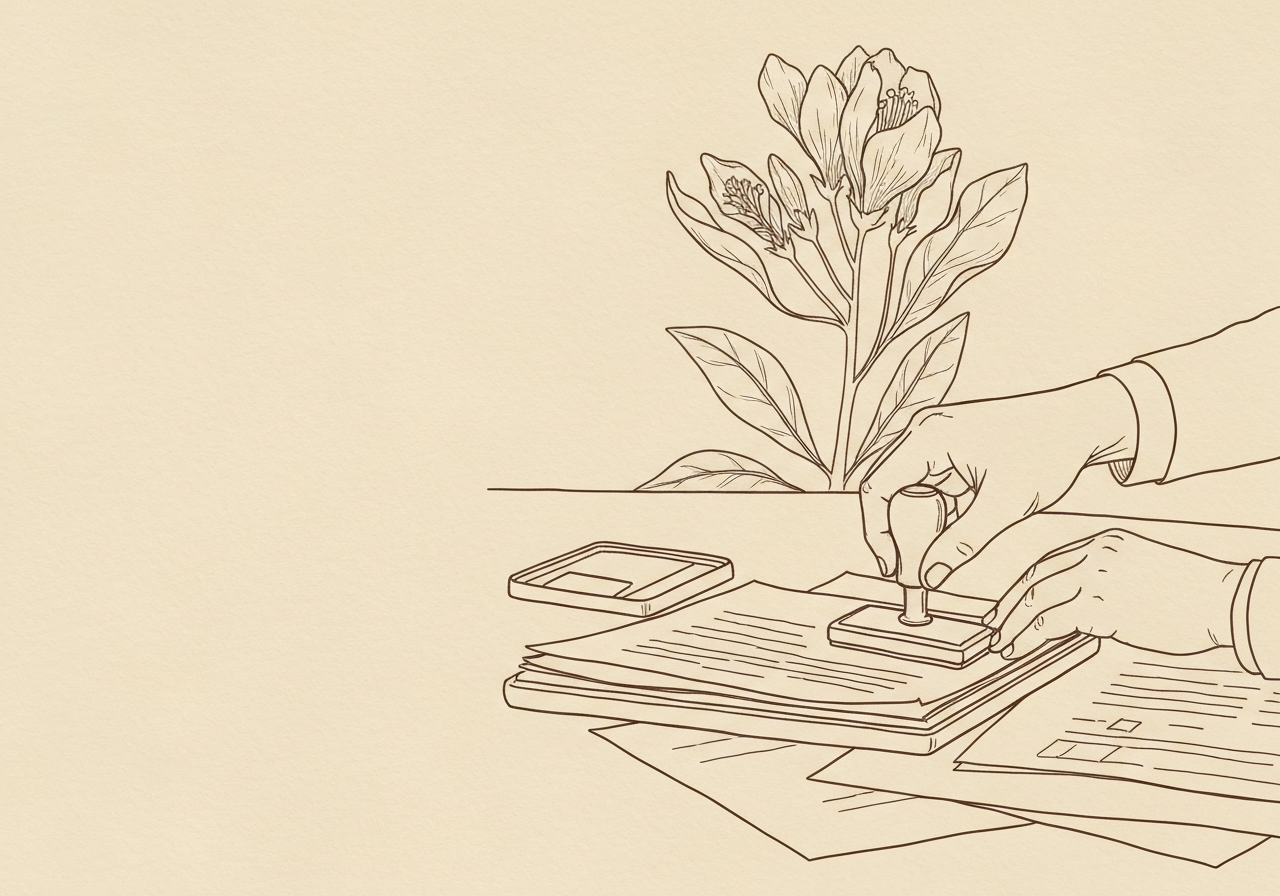
You hand a document to the court. It gets marked as an exhibit. Case closed? Not so fast, says the Supreme Court. On a routine morning in a civil courtroom, a piece of paper changes hands — the court clerk presses a rubber ink pad against it with a dull thud, stamps a number, writes a date. The lawyer on the other side doesn't object. The judge nods. The document is now an exhibit. But does that stamp mean everything written on it is true?
One party in Narbada Devi Gupta v. Birendra Kumar Jaiswal believed exactly that. A high-stakes civil dispute between the two parties hung on a single question: was a document's formal acceptance by the court enough to prove its contents? The other side said no. The Supreme Court had to decide who was right.
The quiet moment before the stamp falls
Civil litigation in India runs on documents. Wills, agreements, receipts, letters — every fact in a lawsuit is backed by a piece of paper. But a quiet, almost invisible process happens before any document can speak in court. The air in the courtroom is still. The lawyer rises, file in hand, and walks to the clerk's desk. The judge's bench looms above, wood polished and worn. The clerk takes the document, flips through its pages, and reaches for the stamp. The rubber hits the paper — a soft thud, the smell of fresh ink. The document is now an exhibit.
For years, litigants and even some lawyers assumed that once a document was marked as an exhibit, its contents were automatically true. The logic seemed simple: if the court accepted it, the court must believe it. That assumption, the Supreme Court now clarifies, is legally wrong.
The line the Court drew
The Court drew a sharp line between two separate steps: the admission of a document and the proof of its contents. Admission — the marking as an exhibit — is purely procedural. It means the document is physically before the court and can be looked at. But proof of contents is substantive. It requires someone to stand in the witness box and say, under oath, that the document is genuine and that the facts it records are true. The witness box is a small wooden enclosure, bare except for a microphone. The person who enters it must raise a hand, swear an oath, and speak — not just hand over a piece of paper.
The Court quoted its own earlier decision in Ramji Dayawala v. Invest Import: "The legal position is not in dispute that mere production and marking of a document as exhibit by the court cannot be held to be a due proof of its contents. Its execution has to be proved by admissible evidence, that is, by the 'evidence of those persons who can vouchsafe for the truth of the facts in issue'."
In plain English: stamping a document as an exhibit does not make it true. Someone must vouch for it.
The procedural history of the dispute
The case of Narbada Devi Gupta v. Birendra Kumar Jaiswal arose from a high-stakes civil litigation. The precise nature of the underlying dispute — whether it concerned property, a contract, or a family matter — is not recorded in the judgment, but the core issue was one that cuts across all civil litigation: reliance on produced documents. One party, the appellant Narbada Devi Gupta, had placed heavy reliance on a document that had been marked as an exhibit in the trial court. The argument was straightforward: the document was before the court, it had been exhibited without objection, and therefore its contents stood proved. The other party, the respondent Birendra Kumar Jaiswal, contested this position, arguing that marking alone did not establish the truth of what the document contained.
The trial court had apparently accepted the document as an exhibit, but the question of whether its contents were actually proved remained unresolved. The matter travelled through the appellate hierarchy until it reached the Supreme Court, which was called upon to settle the legal position once and for all. The Court noted that the appellant had placed "heavy reliance" on Ramji Dayawala v. Invest Import, a previous decision that had addressed a similar question. But the Court clarified that Ramji Dayawala did not stand for the proposition that marking alone suffices — rather, it reinforced the need for substantive proof.
Who stands in the witness box?
The phrase "vouchsafe for the truth" is the heart of the judgment. It means that the person who created the document, or who witnessed its creation, or who can otherwise confirm its authenticity, must testify in court. A written agreement, for example, is not proved simply because it is marked as an exhibit. The party relying on it must call the person who signed it, or at least someone who saw it being signed, to confirm that it is what it claims to be. The witness box becomes the stage where truth is tested — the lawyer asks questions, the judge watches, the other side cross-examines. A document alone cannot answer those questions.
This is not a new rule. The Indian Evidence Act, 1872, has always required that documents be proved by primary evidence (the original document itself) or by secondary evidence (copies, when originals are lost) — and that the person producing the document must be able to explain how it came to be. But in practice, courts sometimes overlooked this step, especially when the other side did not object to a document being marked. The Supreme Court's judgment in Narbada Devi Gupta serves as a reminder that procedural convenience cannot replace substantive proof.
Arguments of the parties
The appellant's case rested on a simple proposition: the document had been produced in court, it had been marked as an exhibit, and no objection had been raised at the time of marking. Therefore, the appellant argued, the contents of the document stood proved. The respondent countered that the marking of a document is a ministerial act — it is the court's way of recording that a document has been received. It does not, and cannot, substitute for the evidentiary requirement that the facts stated in the document be independently proved through oral testimony or other admissible evidence.
The Supreme Court examined both positions. It noted that the appellant had placed "heavy reliance" on Ramji Dayawala v. Invest Import, but the Court clarified that the legal position was not in dispute: "mere production and marking of a document as exhibit by the court cannot be held to be a due proof of its contents." The Court emphasised that "its execution has to be proved by admissible evidence, that is, by the 'evidence of those persons who can vouchsafe for the truth of the facts in issue'." In other words, the document itself is silent; it is the witness who gives it voice.
What this means for different types of documents
The practical implications of this judgment vary depending on the type of document in question. For a will, the requirement is particularly stringent. A will must be proved by the testimony of at least one attesting witness who saw the testator sign the document. Merely producing the will and having it marked as an exhibit does nothing to establish its validity. The witness must confirm that the testator was of sound mind, that the signature is genuine, and that the formalities required by law were observed.
For a written agreement, the party relying on it must call the person who signed it, or a witness to the signing, to confirm its execution. If the agreement is denied by the other side, mere production will not suffice. The witness must be able to say, under oath, that the signatures on the document are genuine and that the terms recorded are accurate.
For a receipt or a letter, the same principle applies. A receipt marked as an exhibit does not prove that payment was made; someone must testify that they received the money and issued the receipt. A letter marked as an exhibit does not prove that it was sent or received; someone must testify to the handwriting, the postal dispatch, or the email trail.
For public documents — such as government orders, certified copies of birth or death certificates, or court judgments — the rule is slightly different. The Indian Evidence Act provides that certain public documents are self-proving; they do not require oral testimony to establish their authenticity. But even then, the contents of the document may still be in dispute. A certified copy of a death certificate proves that a death was registered, but it does not prove the cause of death unless the certificate itself records that information and is admissible for that purpose.
What this means when you walk into court
For lawyers and litigants, the message is clear: do not assume that a document marked as an exhibit is automatically proved. If the truth of its contents is in dispute, you must lead evidence — oral testimony from someone who can confirm the document's authenticity. A stamp and a number on the corner are not enough. The file may feel thin in your hands, but it is the witness who gives it weight.
For the party opposing a document, this judgment is a powerful tool. If your opponent relies on a document but does not call any witness to vouch for its contents, you can argue that the document has not been proved — even if it was marked as an exhibit without objection. The courtroom silence that follows such an argument can be telling.
The judgment also has implications for the conduct of trials. Judges must be vigilant in ensuring that documents are not treated as proved merely because they have been exhibited. The trial court must insist that the party relying on a document leads evidence to establish its contents. This is not a technicality; it is a fundamental requirement of the law of evidence. A document is only as good as the witness who stands behind it.
THE PLAY: When a document is marked as an exhibit, ask: who will vouch for its truth? If the answer is no one, the document is just a piece of paper with a stamp.
The Court ended where it began: with a document, a stamp, and the question of what it really proves. The rubber ink pad dries. The number fades into the paper. But the truth — that requires a voice, a hand raised, an oath sworn in the quiet of the courtroom. The distinction between admission and proof, the Court reminded us, is not a formality. It is the difference between a document that sits silently on the record and one that speaks with the weight of sworn testimony. And in a system that runs on documents, that difference can decide a case.