A dying woman's last phone call: admissible as part of the crime?
She dialed the operator, begged for police, then the line went dead. The court had to decide if her words were part of the transaction that killed her.
1
call.
She dialed the operator, begged for police, then the line went dead. The court had to decide if her words were part of the transaction that killed her.
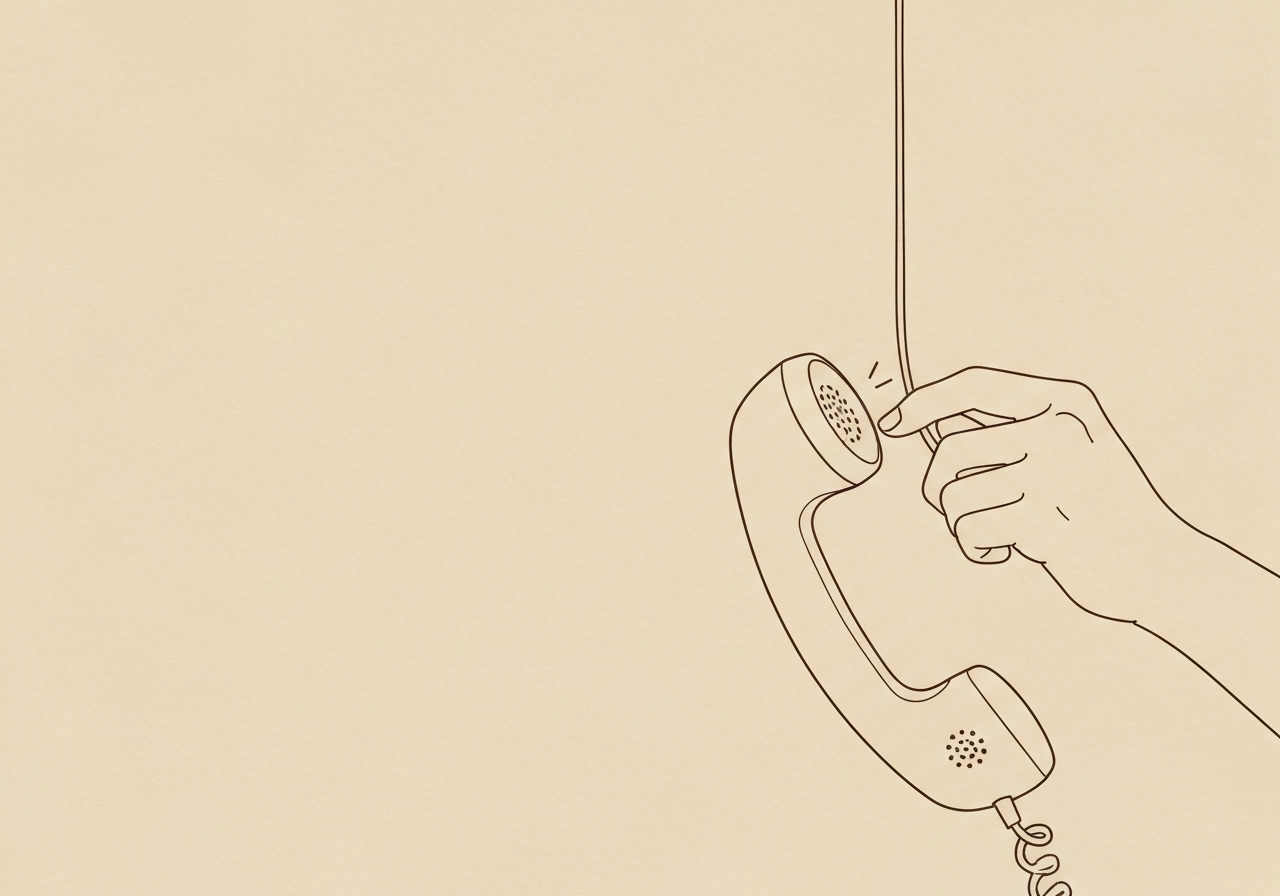
She called the operator, said 'Get me the police please,' gave her address—then the line went dead. When police arrived at the house minutes later, they found a woman dead from a gunshot wound, and a husband who said the whole thing was an accident. The question that followed was deceptively simple: could the jury hear what she said in those final seconds?
The line stayed dead. The question did not.
The shot that ended a phone call
Rattan stood trial for murdering his wife. His defence: the gun went off by accident. A tragic mistake, nothing more.
The Queen's prosecution had evidence that complicated that story. Before she died, the wife dialled the telephone operator. In distress, she said: "Get me the police please." Before the operator could connect her, she gave her address. Then the call ended. The line went dead because, the prosecution argued, the fatal shot was fired at that very moment. The courtroom fell silent as the operator described the abrupt silence on the line — a click, then nothing.
The trial court had to decide whether those words — spoken into a telephone, never completed as a call to the police — could be placed before the jury. Rattan's lawyers objected. A dying woman's panicked words, they said, were hearsay (a statement made outside court, offered to prove the truth of what it says). Hearsay is generally not allowed because the person who made the statement cannot be cross-examined.
The court disagreed. It admitted the evidence. The jury heard the operator testify about the call, her voice steady as she recounted the distress in the caller's tone. Rattan was convicted of murder. He appealed, arguing that the phone call should never have been allowed into the trial.
When a statement becomes part of the crime itself
The appeal court did not look at the phone call as hearsay. Instead, it looked at something older: the doctrine of res gestae (a legal principle that allows statements made as part of an event to be admitted as evidence of that event). The judges considered the thick file before them, the transcript of the operator's testimony, and the stark facts of a life ended mid-sentence.
Under this principle, certain words are not treated as hearsay at all. They are treated as part of the transaction — the thing that happened. If a woman screams "Don't shoot!" and a gun goes off, the scream is not a separate story about the shooting. It is the shooting, unfolding in sound. The law recognises that some statements are so woven into the fabric of an event that separating them would be artificial. The smell of old paper in the courtroom seemed to carry the weight of decades of such rulings.
The court laid down the test: the statement must be contemporaneous with the fact — made "during or immediately before or after its occurrence" — such that the events speak for themselves. The key is the lack of opportunity for reflection or fabrication. If there was time to think, to invent, to shape a story, the statement loses its special status. But if the words burst out in the middle of the action, they carry the same weight as the action itself.
This principle has roots deep in common law. In earlier cases, courts had grappled with similar questions — a dying declaration, a cry heard through a wall, a final whisper to a neighbour. Each time, the test was the same: was the statement so close to the event that it formed part of the same continuous whole? The appeal court in Rattan's case drew on this lineage, weaving the phone call into a tradition that prizes immediacy over formality.
The judges noted that the doctrine of res gestae is not a loophole to bypass the hearsay rule. It is a recognition that some evidence is not hearsay at all. When a statement is part of the event, it is not a second-hand account — it is a primary piece of the puzzle. The wife's words were not a report of what happened; they were what happened, still unfolding as she spoke.
The court also considered the practical implications. If the phone call were excluded, the jury would hear only Rattan's version — that the gun went off accidentally. The operator's testimony provided a counterpoint, a voice from the moment itself. To exclude it would be to silence the only witness who could not be cross-examined, not because of a legal technicality, but because she was dead. The law, the court reasoned, should not create such a vacuum.
Why the phone call passed the test
The wife's call to the operator was not a calm, considered account. She was in distress. She asked for the police. She gave her address. Then the line went dead. The court saw this as a single, continuous event: the call, the shot, the death. The words were not a report of the crime after the fact. They were the crime itself, still happening. The operator's voice, as she testified, carried the memory of that sudden silence — the line that went dead mid-sentence, leaving only the hum of an empty connection.
The court held that her call and the words she spoke were relevant as a part of the transaction which caused her death. The statement was interwoven with the fatal act. There was no gap in time for her to fabricate anything. She was speaking in the moment, and the moment ended with her death. The police who arrived at the scene found her body, the gun nearby, and a silence that echoed the phone line's abrupt end.
The conviction stood. Rattan's appeal failed, and the principle was cemented into the law of evidence. The case became a touchstone for courts across jurisdictions, cited whenever a victim's final words were challenged as hearsay.
What this means for every criminal trial
The ruling in Rattan v. The Queen established a principle that still matters in courtrooms today. A statement made immediately before a fatal act can form part of the continuous whole. The crucial factor is not whether the person survived to testify. It is whether the statement was made under the pressure of the event itself, without time for the mind to invent.
For practitioners, the lesson is practical. When a victim speaks in the middle of an unfolding crime — a phone call, a scream, a cry for help — that statement may be admissible not as an exception to the hearsay rule, but as something that never was hearsay at all. It was the crime speaking. The weight of the case file, the quiet of the courtroom, the operator's steady testimony — all of it converges on a single point: the law trusts the moment itself.
The ruling also offers guidance for defence lawyers. If there is any gap in time, any opportunity for the victim to reflect or fabricate, the statement loses its special status. The key is immediacy. A call made hours before a death, or a statement given after the danger has passed, would not qualify. The doctrine of res gestae is narrow, and courts guard its boundaries carefully.
In the years since Rattan, courts have applied the same logic to texts, voicemails, and emergency calls. The medium changes, but the principle remains: words spoken under the pressure of the event are part of the event itself. A text sent in the middle of a struggle, a voicemail left as the door breaks down, a call to emergency services as the threat closes in — all may be admissible under the same reasoning.
For the prosecution, the lesson is to document the timing meticulously. The call log, the operator's notes, the precise sequence of events — every second matters. The court in Rattan relied on the fact that the call and the shot were virtually simultaneous. Any delay, any break in the chain, could unravel the argument.
THE PLAY: When a victim's words are spoken during or immediately before the fatal act, argue that they are part of the transaction itself — not hearsay, but the event speaking in real time.
The line went dead. The court let the jury hear what was said before it did. The silence that followed the call was not an absence of evidence — it was the evidence itself, the final punctuation on a life that ended mid-sentence. And the law, in its careful way, found a place for that silence to speak.