A will gave a wife only a life interest. The Supreme Court said: that's final.
Ram Devi got land income but couldn't sell. She sold anyway. Buyers argued her interest became absolute. The Court disagreed — and a 1968 will still binds.
54
years.
Ram Devi got land income but couldn't sell. She sold anyway. Buyers argued her interest became absolute. The Court disagreed — and a 1968 will still binds.
Tulsi Ram's 1968 will gave his second wife Ram Devi a life interest — income only, no sale. She sold the land anyway. Then buyers argued her limited estate had become absolute.
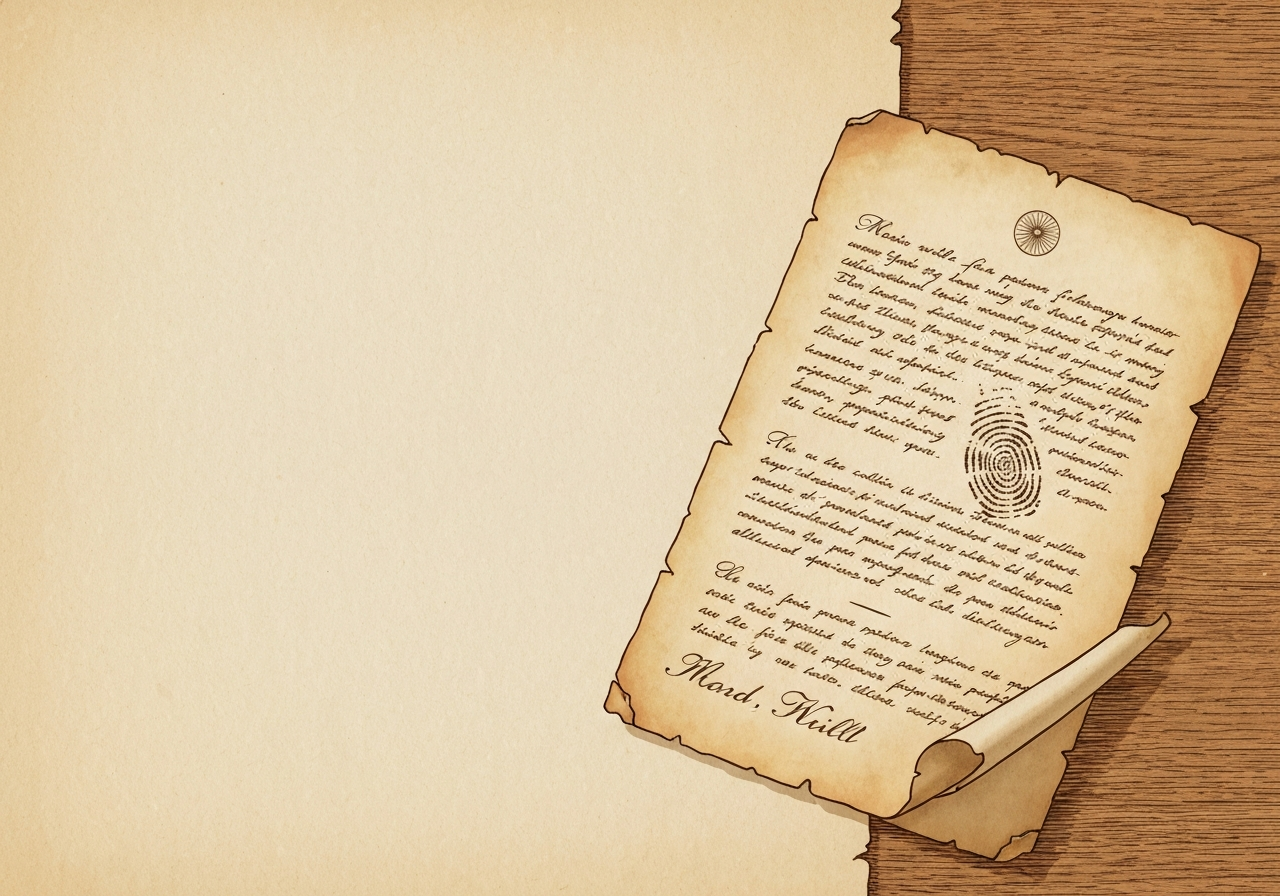
For fifty-four years, a will written on a single day in a Haryana village has refused to die. The document itself — a few sheets of paper, now brittle with age, carrying the looping script of a village scribe and the thumbprint of a man who could not have imagined the legal storm his words would unleash — has survived three rounds of litigation, two High Court appeals, two Supreme Court petitions, and a string of property sales that should never have happened. In February 2022, the Supreme Court of India said it again: Tulsi Ram's 1968 will means what it says. Ram Devi got a life interest. Nothing more. Nothing less.
The courtroom in New Delhi, when the judgment was delivered, had the quiet weight of finality. Justice Sanjay Kishan Kaul and Justice M.M. Sundresh, reading from the file in Jogi Ram v. Suresh Kumar & Ors., traced a legal battle that had begun when the ink on the will was barely dry. The smell of old paper, of case files stacked high in the Supreme Court registry, seemed to hang over the proceedings — the accumulated dust of decades of litigation compressed into a single hearing.
When the will was read
Tulsi Ram owned self-acquired land in Village Jundla, Haryana. On April 15, 1968, he wrote a will dividing his property between two people: his son Jogi Ram from his first wife, and his second wife Ram Devi. The division was equal. But the terms were not.
Jogi Ram got absolute ownership of his half — he could sell, mortgage, or transfer the land as he pleased. Ram Devi got only a life interest in her half. She could collect the income from the land — the rent, the crop proceeds — but she could not sell or transfer it. After her death, her share would go to Jogi Ram. Tulsi Ram died the following year, in 1969.
The will was clear. Ram Devi did not accept it.
One can imagine the scene in Village Jundla when the will was first read out — the hushed voices of relatives, the rustle of the paper as the terms were explained, the tightening of Ram Devi's face as she understood that the land was not truly hers to give away. The boundary walls of the fields she could use but never own stood silent witness to a legal trap that would take half a century to spring fully.
1986: The collusive decree
Seventeen years after Tulsi Ram's death, Ram Devi's daughter Bimla Devi filed a suit in the court of the Sub Judge 1st Class in Karnal. Mother and daughter agreed on the outcome. On January 15, 1986, the court passed a decree declaring that Bimla Devi owned Ram Devi's share. It was a paper transaction designed to bypass the will — the courtroom in Karnal that day saw no real contest, just the quiet murmur of a collusive agreement, the judge stamping a decree that both parties wanted.
Jogi Ram fought back. In 1993, he filed Civil Suit No. 94/1993 in the Senior Sub Judge's court in Karnal, challenging the collusive decree and the sales Ram Devi had begun making to third-party buyers. On September 27, 1995, the trial court decreed in his favour. Ram Devi and the buyers appealed to the Additional District Judge, Karnal, who dismissed the appeal on April 15, 1999. They then went to the High Court of Punjab & Haryana in Second Appeal No. 1700/1999, which was dismissed on October 23, 2001. Finally, they filed a Special Leave Petition (a petition seeking the Supreme Court's permission to appeal) before the Supreme Court, which was dismissed on April 29, 2002.
Jogi Ram had won. The will stood. Ram Devi's interest was limited. The collusive decree was void. The sales were invalid.
But Ram Devi kept selling land anyway.
The sale deeds she executed during this period — handwritten on stamped paper, signed in the presence of witnesses who may not have known the legal history — passed portions of the land to buyers who saw only a woman with possession, not a woman with only a life interest. The fields themselves changed hands, the crops changing with the seasons, while the legal title remained frozen by the will.
2008: More sales, more litigation
Despite losing at every level — trial court, appellate court, High Court, and Supreme Court — Ram Devi sold more portions of the land during the pendency of the litigation. The buyers who purchased from her were not the same as those in the first round. They argued that they had bought the land in good faith, without knowledge of the litigation.
Jogi Ram filed a second suit — Civil Suit No. 256/157 of 2008 — before the Civil Judge, Senior Division, Karnal. On August 13, 2009, the trial court again decreed in his favour. The buyers appealed to the Appellate Court, Karnal, which dismissed the appeal on October 7, 2010.
Then came the twist. The buyers filed a second appeal — RSA No. 210/2011 — before the High Court of Punjab & Haryana. On February 22, 2018, a learned single judge of the High Court allowed the appeal. The High Court held that Ram Devi's limited interest had become absolute under Section 14(1) of the Hindu Succession Act, 1956 (a provision that converts a woman's limited estate into full ownership). The buyers, the High Court said, had acquired valid title.
The courtroom in Chandigarh must have felt different that day — the buyers' lawyers triumphant, Jogi Ram's counsel stunned. After winning for nearly two decades, the will had suddenly been undone by a single judge's interpretation of a statute.
Why the High Court was wrong
The Supreme Court disagreed. On two grounds — each strong enough to decide the case alone.
First ground: res judicata. The first round of litigation had already decided that Ram Devi held only a life interest. That decision had been upheld by the trial court, the appellate court, the High Court, and the Supreme Court. No change in law had occurred between the first and second rounds. The earlier judgment was binding on Ram Devi, her daughter Bimla Devi, and everyone claiming through them — including the buyers. The principle of res judicata (a matter already decided by a competent court cannot be re-litigated) applied with full force.
The Supreme Court was emphatic on this point. The Court held that where the first round of litigation determining a party's limited estate has been upheld through all courts including the Supreme Court, and no change in law occurred between the first and second round of litigation, the earlier adjudication operates as res judicata and the judgment is binding on the parties and their successors-in-interest. The buyers, having purchased land from a person whose title was already adjudicated as limited, could not reopen that question.
Second ground: Section 14(2) of the Hindu Succession Act. The Supreme Court held that Tulsi Ram's will created an independent and new title in favour of Ram Devi for the first time. It did not recognise any pre-existing right she had — such as a right to maintenance. Therefore, Section 14(2) of the Hindu Succession Act applied, not Section 14(1). Section 14(2) says that if a woman gets property through a gift, will, or other instrument that specifically gives her only a limited estate, that restriction cannot be enlarged into absolute ownership under Section 14(1).
The Court cited its own landmark judgment in V. Tulasamma & Ors. v. Sesha Reddy (Dead) by LRs (1977), which had drawn the line between Section 14(1) and Section 14(2). Where a will gives a woman property in recognition of a pre-existing right — like maintenance — Section 14(1) applies and the estate becomes absolute. But where a will creates a new right that did not exist before, Section 14(2) applies and the restriction in the will stands.
Tulsi Ram's will, the Court noted, was a testamentary disposition of his self-acquired property. He was competent to give his wife a limited estate. He had taken care of her maintenance through the life interest. Section 14(1) could not be used to override his clear intention. The Court observed that to interpret Section 14(1) as always converting a limited estate given under a will into absolute ownership would produce the absurd result that a testator could disinherit a wife completely — which is sustainable — but could not give her a limited estate. That could not have been Parliament's intent.
What the buyers got wrong
The buyers had argued that they were bona fide purchasers for value without notice — that they had bought the land in good faith, not knowing about the litigation. The Supreme Court rejected this argument. A purchaser from a person holding only a limited life interest cannot acquire a better title than the vendor possessed. And purchasers who acquire property during the pendency of litigation adverse to the vendor cannot claim to be bona fide. The principle of lis pendens (a legal doctrine that says property cannot be transferred during ongoing litigation) applied.
The Court also noted that Section 41 of the Transfer of Property Act, 1882 (which protects buyers from an ostensible owner) could not help the purchasers. That provision requires the buyer to have acted in good faith after taking reasonable care. Buying land from a person whose title had been repeatedly litigated and declared limited did not meet that standard.
The buyers, the Court held, derived no better title than their vendor Ram Devi possessed. And Ram Devi possessed only a life interest — income only, no sale. The sale deeds were void.
THE PLAY: When drafting a will giving a female relative a limited estate, state explicitly that the grant is a new independent title under Section 14(2) of the Hindu Succession Act — and ensure the will provides for her maintenance separately, so the estate cannot be enlarged under Section 14(1).
The Supreme Court allowed Jogi Ram's appeals, set aside the High Court's judgment, and reaffirmed the trial court's decree of August 13, 2009. The parties were left to bear their own costs.
Tulsi Ram's 1968 will had spoken one last time. The brittle pages, the scribe's looping hand, the thumbprint of a man who died in 1969 — all of it had outlasted three rounds of litigation, a collusive decree, a string of illegal sales, and a High Court judgment that tried to undo what the testator had clearly intended. The Supreme Court's judgment in Jogi Ram v. Suresh Kumar & Ors. is now the law: a will that gives a limited estate means what it says. And no amount of litigation, no collusive decree, no sale to an unsuspecting buyer, can change that.