Army major's confession on temple stairs wasn't voluntary, Supreme Court says
He admitted taking bribes to clear recruits. But the court found the confession was made under pressure—and the money transfers had innocent explanations.
16
years.
He admitted taking bribes to clear recruits. But the court found the confession was made under pressure—and the money transfers had innocent explanations.
He confessed to his superior on the steps of a temple. But the Supreme Court said that confession wasn't voluntary—and quashed his conviction.
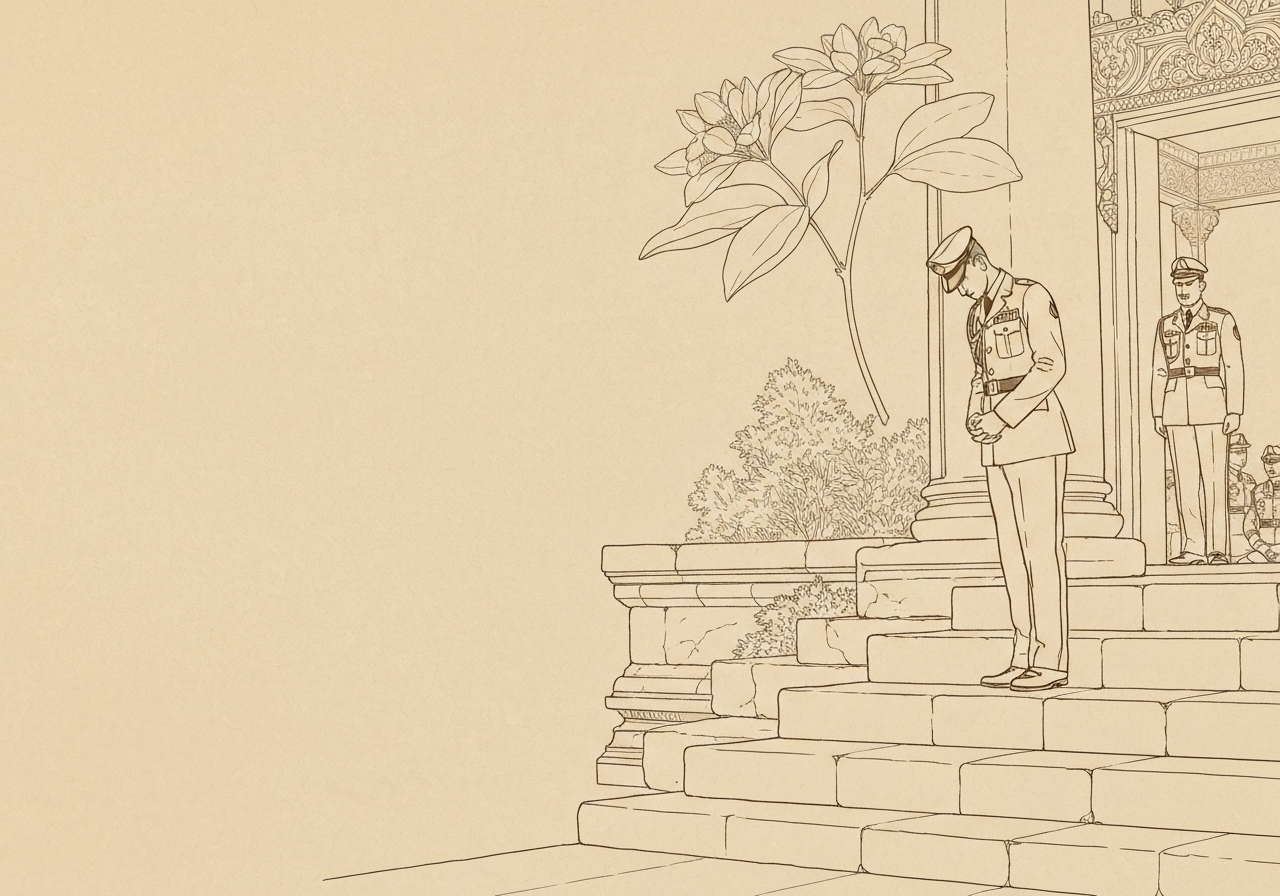
The year was 2009. Major R. Metri, a Recruiting Medical Officer posted in Rajasthan, stood on the stone stairs of a temple — the heat of the day pressing down, the silence broken only by distant voices — and told his commanding officer that he had taken bribes. He had cleared army recruits as medically fit in exchange for money, he said. Later, he put it in writing.
That confession sent him to a court-martial, cost him his career, and landed him a one-year prison sentence. But when the case reached the Supreme Court, the judges asked a different question entirely: Was that confession real — or was it the product of a man who knew he was trapped?
When the money arrived in his father-in-law's account
In 2008-2009, Major Metri was posted as a Recruiting Medical Officer during army recruitment rallies in Rajasthan. His job was straightforward: examine candidates and certify them as medically fit or unfit. Two fellow officers allegedly involved him in a scheme — clear candidates who were not truly fit, in exchange for money.
Rs.65,000 was deposited into his father-in-law's bank account. Another Rs.20,000 went into his own account — entries in a passbook that, on the surface, looked damning: payments flowing in, recruits getting cleared, and a medical officer at the centre of it all.
Then the police stepped in. An FIR (a written complaint that starts a police investigation) — FIR No. 125/2009 — was filed at Adarsh Nagar police station in Ajmer under Sections 406 and 420 of the Indian Penal Code — criminal breach of trust and cheating. Media reports named Major Metri. The army launched a Court of Inquiry.
The confession on temple stairs
It was in this charged atmosphere — police investigation underway, media scrutiny, army inquiry pending — that Major Metri allegedly confessed to his superior officer. The location was not a police station or a courtroom. It was the stairs of a temple. He reportedly admitted to taking bribes to clear recruits. He later gave a written statement confirming the same.
The army moved fast. A General Court Martial (GCM) was convened. Major Metri was charged under Section 69 of the Army Act read with Section 7 of the Prevention of Corruption Act, 1988 — essentially, a public servant taking a bribe. He was also charged under Section 63 of the Army Act for unbecoming conduct.
On April 28, 2013, the GCM convicted him on two charges: taking illegal gratification of Rs.65,000 and Rs.20,000 as a reward for clearing candidates. The punishment was severe: cashiering (dismissal from service with loss of all benefits) and one year of rigorous imprisonment.
Why the Armed Forces Tribunal saw it differently
Major Metri appealed to the Armed Forces Tribunal (AFT), a specialised court that hears cases against court-martial decisions. Under Section 15 of the Armed Forces Tribunal Act, 2007, the AFT has the power to re-appreciate evidence — to look at the facts afresh and decide if the court-martial's findings were legally sustainable.
The AFT did something surprising. It set aside the corruption conviction entirely. The tribunal found that the extra-judicial confession (a confession made outside court, to a non-judicial authority) was not voluntary and lacked corroboration (other independent evidence supporting the same fact).
But the AFT did not let Major Metri walk free entirely. It convicted him of a lesser offence under Section 63 of the Army Act — unbecoming conduct — and imposed a sentence of forfeiture of seniority and a severe reprimand.
Both sides were unhappy. The Union of India appealed to the Supreme Court, arguing the AFT had no right to re-appreciate evidence. Major Metri appealed too, saying even the Section 63 conviction was unsustainable.
What the Supreme Court asked
The core question before the Supreme Court bench of Justice L. Nageswara Rao and Justice B.R. Gavai was this: Could a man be convicted based on a confession made to his superior on temple stairs, when the investigation was already breathing down his neck?
The Union of India argued that the AFT had overstepped its powers. The tribunal, the government said, could only review whether the court-martial followed proper procedure — not re-weigh the evidence itself.
Major Metri's lawyers countered that the confession was made under pressure. The officer knew the police were investigating, the media had named him, and the army inquiry was underway. In that atmosphere, any confession to a superior officer was inherently coercive. Plus, the prosecution's own witnesses had given innocent explanations for the money transfers — Rs.65,000 was a loan repayment, Rs.20,000 was emergency borrowing that was returned.
Why the confession crumbled
The Supreme Court began with the AFT's power. The judges held that under Section 15(4) of the AFT Act, the tribunal was entitled to re-appreciate evidence to determine whether the court-martial's findings were legally unsustainable, involved a wrong decision on a question of law, or resulted from a material irregularity causing a miscarriage of justice. The power was not limited to procedural review alone.
Then the court turned to the confession itself. The bench cited its own precedent in Sahadevan v. State of Tamil Nadu (2012), holding that "an extra-judicial confession is a weak piece of evidence" and that unless it is found to be voluntary, trustworthy, and reliable, a conviction based solely on it — without corroboration — is not justified.
Here, the circumstances screamed involuntariness. The officer confessed to his superior when he knew the police were investigating, the media had named him, and the army inquiry was active. That was not the free will of a guilty conscience. That was a man under pressure.
The court also invoked Article 20(3) of the Constitution (the right against self-incrimination — no person accused of an offence shall be compelled to be a witness against themselves). While the provision applies strictly to formal proceedings, the spirit of the protection coloured the court's assessment of voluntariness.
The bench further relied on The State of Bombay v. Kathi Kalu Oghad (1962) and Chandra Kumar Chopra v. Union of India (2012) to reinforce the principle that confessions extracted under coercive circumstances cannot form the sole basis of a conviction. The Sahadevan precedent was particularly instructive: it laid down that an extra-judicial confession must be spontaneous, consistent, and made in a situation where the confessor is free from external pressure. Here, the confession failed every test.
When the prosecution's own witnesses destroyed the case
But the most devastating blow to the prosecution came from its own witnesses. The very people the army called to prove the bribery scheme ended up explaining the money transfers innocently.
The Rs.65,000 deposited in the father-in-law's account? A loan repayment, the witnesses said. The Rs.20,000 in Major Metri's own account? Emergency borrowing that was returned. The prosecution's case collapsed not because the defence argued well, but because the prosecution's own evidence contradicted the charges.
The Supreme Court applied the "plausible view test." When an appellate court (here, the AFT) acquits an accused, the Supreme Court will not interfere unless the acquittal is perverse — so unreasonable that no court could have reached it. Here, the AFT's view that the confession was involuntary and the money transfers were innocent was entirely plausible. The Supreme Court upheld it, citing Union of India v. Sandeep Kumar (2019) for the proposition that the High Court — and by extension the Supreme Court — should not lightly reverse an acquittal that is based on a plausible view of the evidence.
And then the court went further. It acquitted Major Metri of the Section 63 conviction too. If the money transfers had innocent explanations and the confession was unreliable, there was no basis for even the lesser charge of unbecoming conduct.
What this means for every court-martial
The judgment, delivered on April 4, 2022, ordered Major Metri's reinstatement with continuity of service — but without back wages for the period he was out of employment. He had spent years fighting a case built on a confession that the Supreme Court found was not voluntary.
For lawyers and military officers, the case settles three things. First, the Armed Forces Tribunal can re-appreciate evidence — it is not a rubber stamp for court-martial decisions. Second, extra-judicial confessions made under the shadow of an ongoing investigation are inherently suspect. The court's own words — "an extra-judicial confession is a weak piece of evidence" — now stand as a warning to every court-martial that relies on such confessions without independent corroboration. Third, when the prosecution's own witnesses explain away the financial transactions, the case does not survive.
The procedural texture of the case is worth noting. The journey from the FIR (No. 125/2009, registered on July 11, 2009) through the Court of Inquiry (December 14, 2009), the GCM conviction (April 28, 2013), the AFT's partial relief (March 2, 2017), and finally the Supreme Court's full acquittal (April 4, 2022) — spanned over a decade. Each step added layers of legal scrutiny, and at each stage, the confession's voluntariness was questioned.
The Sahadevan precedent, which the Supreme Court applied, deserves deeper attention. In that case, the court had held that an extra-judicial confession must be "voluntary, trustworthy, and reliable" and that the court must examine the "totality of circumstances" to determine whether the confession was made under any inducement, threat, or promise. Here, the totality of circumstances included a pending police investigation, media exposure, and a superior officer who was part of the military hierarchy — a combination that the court found inherently coercive.
THE PLAY: If you are defending a service member, attack the voluntariness of any confession made to a superior when the investigation is already public — and let the prosecution's own witnesses tell the innocent story.
The confession on temple stairs was not the beginning of guilt. It was the end of a man who had nowhere else to go.