Can a footprint alone prove you were at a crime scene?
The court said bare feet have unique ridges, but the science of footprint ID isn't fully developed. So it can only back up other evidence.
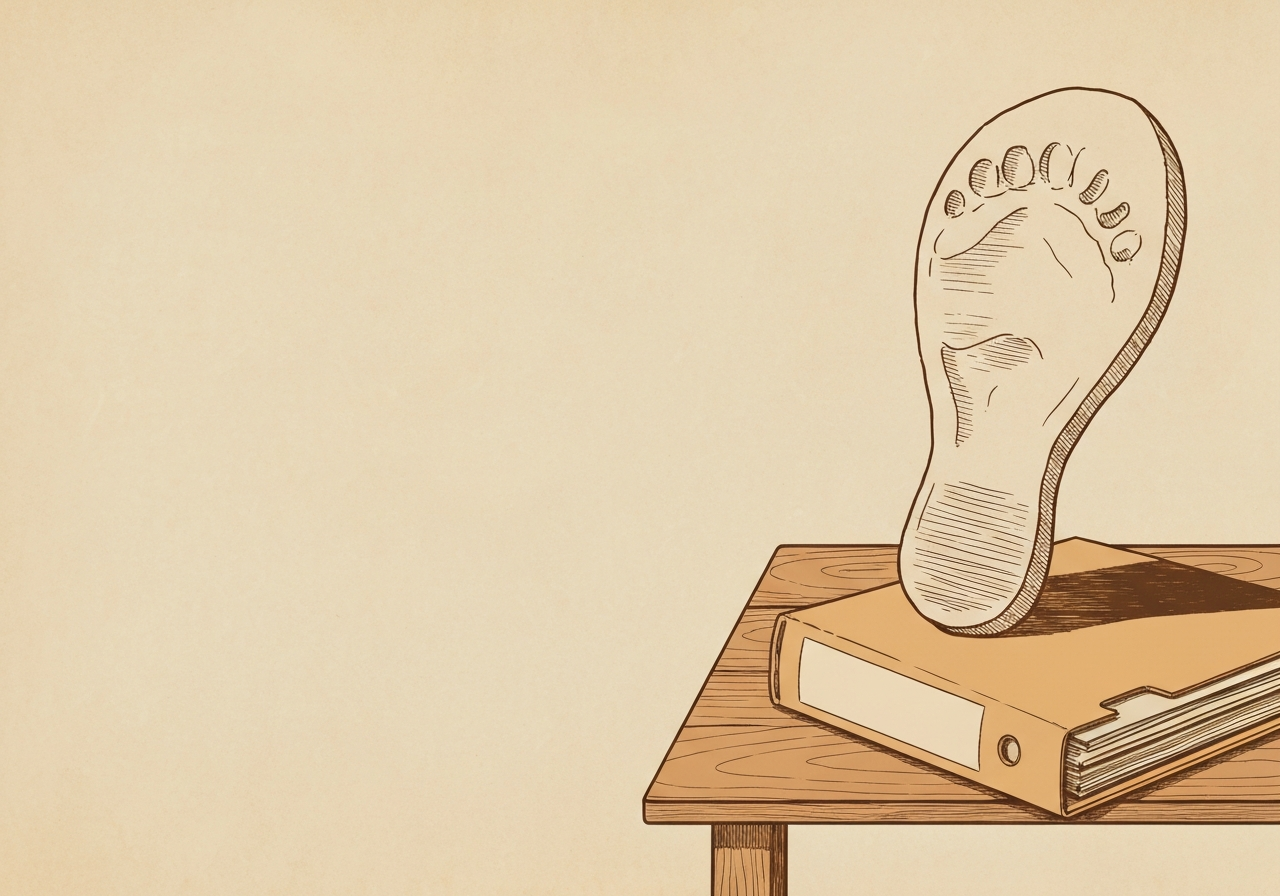
Limited.
Footprint alone
cannot convict.
The court said bare feet have unique ridges, but the science of footprint ID isn't fully developed. So it can only back up other evidence.
The court said bare feet have unique ridges—but that footprint at the crime scene? It can't stand alone.
The question that landed before the court was deceptively simple: Could a footprint, by itself, send a man to prison?
When the footprint became the only clue
The case of Mohd. Aman v. State of Rajasthan began like many others. A crime had occurred. The police gathered evidence. Among the physical traces collected was a footprint—an impression left by a bare foot at the location where the offence took place. The plaster cast of that print, lifted from the dusty floor, sat in a police file—a silent, ridged witness.
Forensic experts examined the print. They compared its friction ridge patterns—the tiny raised lines on the sole of a human foot, similar to fingerprints—with the feet of the accused, Mohd. Aman. The expert concluded that the print matched the accused's foot. A report, signed and sealed, was placed before the court.
This was the prosecution's key piece of evidence. But was it enough?
The science of bare feet
The court acknowledged a basic truth: every human foot has a unique pattern of ridges, just like fingertips. No two people share the same arrangement of these lines. In theory, a footprint could be as distinctive as a fingerprint. The bench noted that bare feet contain unique friction ridge patterns.
But the court also noted a critical gap. The science of footprint identification, the bench observed, "is not a well-established fully developed science." Unlike fingerprint analysis—which has decades of research, standardised protocols, and accepted error rates—footprint identification remains a field in its infancy. The methods are less tested. The databases are smaller. The conclusions are less certain. The expert's report, for all its technical language, rested on a foundation the court itself described as incomplete.
This distinction mattered. The court was not saying footprint evidence was useless. It was saying the science had not yet matured enough to carry the full weight of a conviction on its own. The courtroom fell silent as the bench read out this qualification—a careful, deliberate pinning of the evidence to its proper place.
What the prosecution argued
The prosecution presented the footprint expert's testimony as evidence that placed the accused at the crime scene. The logic was straightforward: if the footprint matched, the accused must have been there. The expert's opinion, they argued, was reliable enough to establish identity. The cast of the print was held up, its ridges displayed, as if to say: this is proof.
The defence countered that the science was too shaky. Without corroboration—other independent evidence supporting the same conclusion—a footprint match was nothing more than an educated guess. The accused could not be convicted on such uncertain ground. The defence pointed to the very words of the court's earlier observations: the science was not fully developed.
What the court decided
The court carved out a careful middle path. It did not throw out footprint evidence entirely. But it placed strict limits on how that evidence could be used.
The bench held that footprint identification may be used only to reinforce the conclusions as to identify the culprit already arrived at on the basis of other evidence. In plain terms: you need other evidence first—something solid, something independent—that points to the accused. Once that primary evidence exists, the footprint expert's opinion can serve as a secondary confirmation. But the footprint cannot be the foundation of the case.
The court's reasoning was rooted in the science itself. Because footprint identification is not fully developed, it cannot transform into conclusive proof by itself. It remains a supporting actor, never the star witness. The file on the judge's desk—thin, containing only the footprint report and nothing else—would not be enough.
Why this distinction matters
This judgment draws a clear line between two categories of forensic evidence. Some sciences—like DNA profiling or fingerprint analysis—have reached a level of reliability where they can be primary evidence. Others, like footprint identification, have not.
For lawyers and investigators, the lesson is practical: if your case rests on a footprint alone, you are on thin ground. You need to build the case with other evidence first—eyewitness accounts, CCTV footage, recovered stolen property, confessions, or other forensic traces. Only then can the footprint expert step in to say, "And this confirms what we already know."
For the accused, the judgment offers a shield. A footprint match, however convincing it may seem to a judge, cannot by itself become the sole basis for a conviction. The state must bring something more.
The procedural backdrop: how the case reached the court
The case of Mohd. Aman v. State of Rajasthan arrived before the court at a stage where the admissibility and evidentiary weight of footprint identification was squarely at issue. The petitioner, Mohd. Aman, had been accused of a crime. The prosecution's case leaned heavily on a footprint expert's opinion that placed him at the scene. The defence challenged this, arguing that the science was not reliable enough to establish identity beyond reasonable doubt. The courtroom, filled with the smell of old paper and the rustle of case files, awaited the bench's answer.
The court was thus called upon to decide a question that had not been settled with clarity in earlier precedents: Could footprint evidence, standing alone, be treated as conclusive proof of presence at a crime scene? The answer would shape how lower courts across the country treated this form of forensic evidence for years to come.
The court's exact language: a careful limitation
The court's observation bears repeating in full. It acknowledged that footprint identification is reliable because bare feet contain unique friction ridge patterns. But it immediately qualified that recognition by stating that the science of identification of footprints "is not a well-established fully developed science." This was not a throwaway line—it was the doctrinal anchor of the entire judgment.
Because of this lack of full scientific development, the court explicitly limited the utility of footprint evidence. The bench held that if evidence is found satisfactory in a given case, it may be used only to reinforce the conclusions as to identify the culprit already arrived at on the basis of other evidence. The phrase "reinforce the conclusions" is critical: it sets a standard where other evidence is the primary source of the conclusion, and the expert's evidence serves strictly as secondary reinforcement. The footprint cast, the expert's report, the dust on the floor—none of it could stand alone.
This defines a category of forensic science that cannot, by itself, transform into conclusive proof. The court was not being dismissive of footprint evidence—it was being precise about its limits.
What this means for future cases
The judgment in Mohd. Aman v. State of Rajasthan sets a clear precedent for how footprint evidence must be treated in Indian courts. Going forward, no conviction can rest solely on a footprint match. The prosecution must first establish the accused's involvement through other independent evidence—witness testimony, documentary evidence, circumstantial links, or other forensic traces. Only then can the footprint expert's opinion be brought in to reinforce that conclusion.
This creates a two-step framework for judges evaluating footprint evidence:
Step one: Is there other evidence that independently points to the accused's guilt? If not, the footprint evidence cannot fill the gap.
Step two: If other evidence exists, does the footprint expert's opinion confirm what that evidence already suggests? If yes, it may be admitted as reinforcement.
For investigators, the message is equally clear: do not rely on footprint evidence as your primary lead. Collect it, preserve it, use it—but only as part of a broader evidentiary strategy. A footprint in the dust is a clue, not a conviction.
THE PLAY: Never rely on footprint evidence as your primary proof—it can only reinforce conclusions already supported by other independent evidence.
The court ended where it began: with a footprint at the crime scene, and the question of whether it was enough. The answer, it turned out, was no—not alone.