Can the police force you to give a DNA sample?
The Supreme Court said yes — and explained why it's not 'testifying against yourself.'
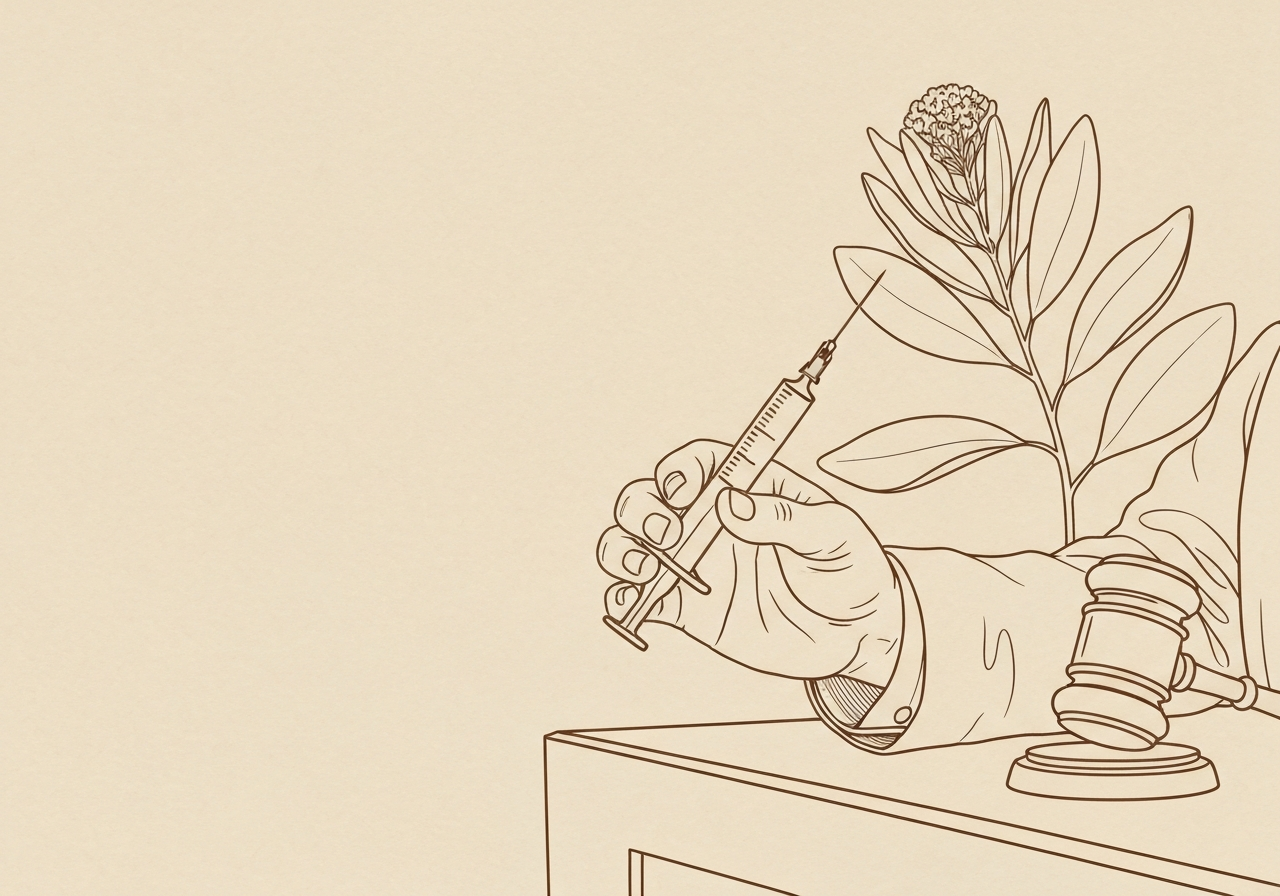
Held.
Blood is not
testimony.
The Supreme Court said yes — and explained why it's not 'testifying against yourself.'
The accused refused to give a blood sample. He said it would violate his right against self-incrimination. The Supreme Court disagreed — and the logic changed everything.
In a Bombay courtroom, the air was thick with the smell of old paper and the weight of a constitutional question. The accused — a man whose name is not recorded in the judgment — looked at the order and said no. He was not afraid of the needle. He was afraid of what that blood would prove. The police wanted a sample to match against evidence from a crime scene. The accused argued that the Constitution protected him — that forcing him to give blood was the same as forcing him to testify against himself. The case would travel all the way to the Supreme Court, and the answer the court gave would reshape how Indian criminal investigations work for decades.
The line between silence and skin
Could the state force an accused person to provide physical evidence — blood, hair, semen, a thumb impression, a specimen signature — without violating Article 20(3) (the right against self-incrimination)? That article says: "No person accused of any offence shall be compelled to be a witness against himself." The words sound simple. But what does "being a witness" actually mean? Does handing over a blood sample count as giving testimony? Or is it something else entirely?
The case was The State of Bombay v. Kathi Kalu Oghad & Others. The Supreme Court had to decide where the line falls between a person's right to silence and the state's need for evidence.
When the accused said no
The facts began with a criminal investigation. The police had gathered physical evidence — the kind that could link a specific person to a specific crime. They needed samples from the accused: a thumb impression, a specimen signature, blood, hair, semen. The accused refused. His lawyers argued that compelling him to provide these samples would force him to "be a witness" against himself, which Article 20(3) explicitly forbids.
The trial court had to decide. The question was not small. If the accused was right, then entire categories of forensic evidence — DNA tests, fingerprint matching, handwriting analysis — would become impossible to obtain from a suspect who refused to cooperate. Investigations would grind to a halt. If the state was right, then the constitutional protection against self-incrimination would be narrower than many had assumed.
The case was referred to a larger bench of the Supreme Court. The court framed the issue precisely: does compelling an accused person to give physical samples — a thumb impression, a specimen signature, blood, hair, semen — amount to "being a witness" against themselves under Article 20(3)? The court considered various queries on whether forensic evidence violates Article 20(3), centering on whether compelling an accused to give physical samples constituted "being a witness" against themselves.
The state: "Blood does not speak"
The state's lawyers said no — giving a blood sample is not the same as giving testimony. Testimony involves words, statements, communications that reveal what a person knows. A blood sample is just biology. It exists whether the accused speaks or not. A thumb impression is not a statement. A specimen signature does not confess. Hair does not testify. The state argued that Article 20(3) protects a person from being forced to speak or write something that incriminates them. It does not protect them from being a source of physical evidence.
The prosecution pointed out that the Constitution itself distinguishes between "being a witness" and "being produced as evidence." A witness testifies. A blood sample is produced. The two are fundamentally different.
The defence: "The needle is a question"
The accused's lawyers took a broader view. They said the Constitution protects a person's entire being — not just their words. If the state can force you to give blood, and that blood proves you committed a crime, then you have been compelled to provide evidence against yourself. The result is the same as being forced to confess. The protection of Article 20(3), they argued, should cover any act that the state compels and that leads to incrimination — whether it involves speech or a syringe.
The defence also warned of a slippery slope. If the state can take blood today, what stops it from taking bone marrow tomorrow? If the court allows compelled physical samples — thumb impressions, specimen signatures, blood, hair, semen — where does the power stop?
The court's answer: "Hair does not testify"
The Supreme Court rejected the defence's argument. The court observed that giving a thumb impression, a specimen signature, blood, hair, or semen by the accused does not amount to "being a witness" within the meaning of Article 20(3). The court explicitly stated that these samples "do not amount to 'being a witness'" as defined under the constitutional protection.
The court drew a critical distinction. "Being a witness" means communicating something — conveying information through words or actions that have a communicative element. A thumb impression is not communication. Blood is not testimony. Hair does not speak. Semen is not a statement. A specimen signature is not a confession. These are physical objects, not statements. The Constitution protects a person from being forced to say something incriminating. It does not protect them from being a source of physical evidence that the state can examine.
The court concluded that the accused has no right to object to DNA examination for the purposes of investigation and trial. The physical production of non-testimonial evidence — evidence that does not involve communication — falls entirely outside the scope of constitutional protection against self-incrimination. This verdict established that physical production of non-testimonial evidence falls outside the scope of constitutional protection against self-incrimination.
Why the needle matters
The judgment in Kathi Kalu Oghad became the foundation for how Indian courts treat forensic evidence. Every time a court orders a DNA test, a fingerprint match, or a handwriting sample, it relies on this reasoning. The accused cannot refuse on Article 20(3) grounds.
For practitioners, the rule is clean: if the evidence is physical and non-communicative — a thumb impression, a specimen signature, blood, hair, semen — the right against self-incrimination does not apply. If the evidence requires the accused to say something — to answer a question, to write a statement, to explain a document — then Article 20(3) may protect them.
THE PLAY: When seeking forensic samples from an accused, argue that physical evidence is non-testimonial — the Constitution protects words, not biology.
The blood stayed in the syringe
The accused in Bombay lost his argument. The needle went in. The courtroom fell silent as the order was read — the judge's voice steady, the file on the desk thin but heavy with consequence. The smell of old paper lingered. And the law of evidence in India was never the same again.