Car bomb plot case hits procedural roadblock: old law still applies
NIA charged a terror conspiracy but skipped a key authorization. The Supreme Court said the old J&K code governs — and the defect can be fixed.
196-A
the gatekeeping section.
NIA charged a terror conspiracy but skipped a key authorization. The Supreme Court said the old J&K code governs — and the defect can be fixed.
The NIA had the explosives, the plot, the chargesheet. What they didn't have was a single piece of paper — and the judge said: no case.
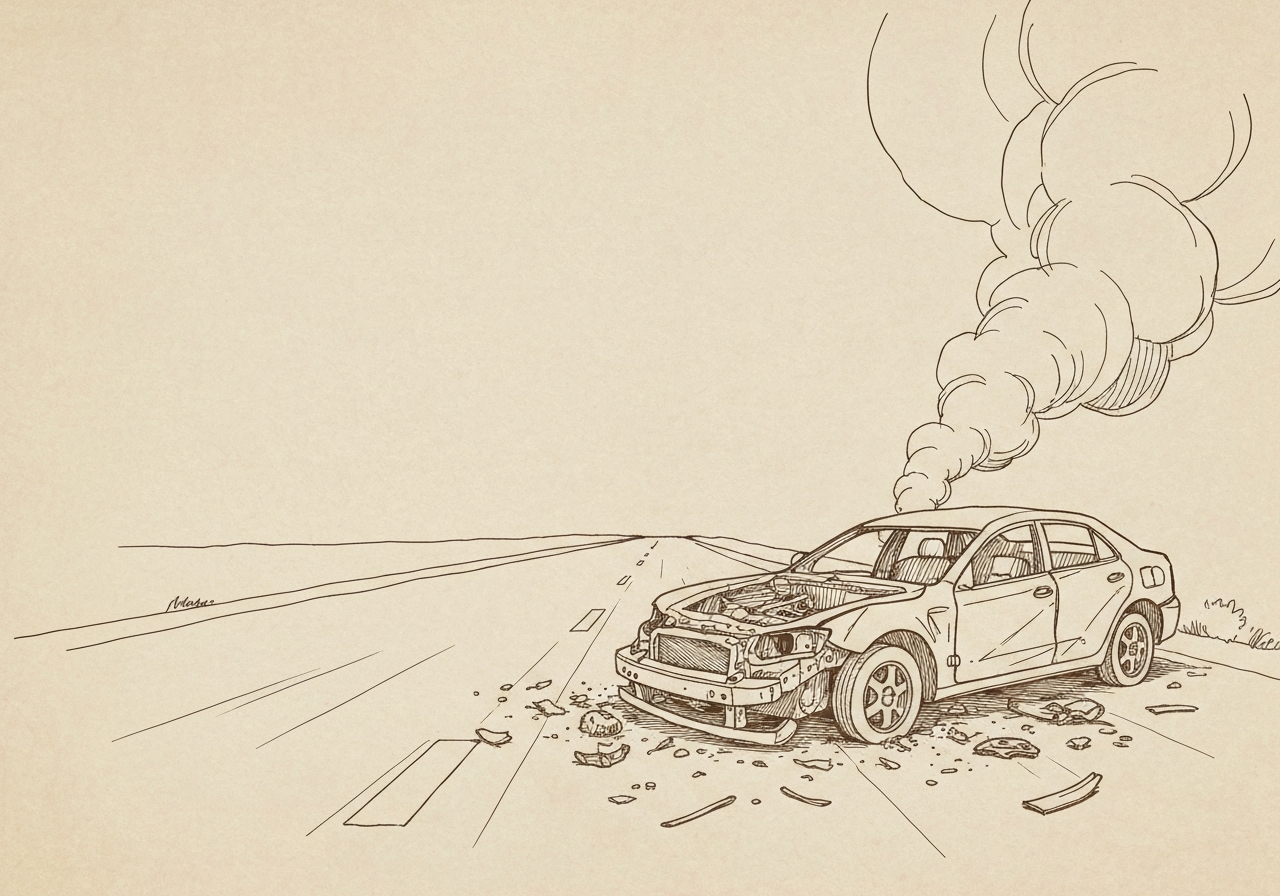
On a Jammu highway, a car packed with explosives sat waiting for a CRPF convoy. The blast came early — before the ambush could succeed — and the men behind the plot vanished into the crowd. By the time the National Investigation Agency (NIA) filed its chargesheet, the case seemed airtight: conspiracy, explosives, an attack on the State. But when the Special Judge looked at the papers, he found something missing. Not evidence. Not witnesses. A single authorization letter that the NIA had never bothered to get. Without it, the judge refused to hear the conspiracy charge at all.
The question that followed was deceptively simple: when a whole state's procedural law gets replaced mid-investigation, which set of rules applies — the old ones the investigation started under, or the new ones that didn't exist when the crime happened?
The car bomb that didn't wait
The facts began in 2019, before Jammu & Kashmir's special status was abrogated and the state was reorganized into two Union Territories. A group of men allegedly loaded a car with explosives and positioned it to attack a CRPF convoy. The plan was an ambush — the kind of attack that has killed dozens of security personnel in the region over the years. But the explosives detonated prematurely. The car blew up before the convoy arrived. The accused fled.
The jurisdictional police registered an FIR (a written complaint that starts a police investigation) as Case Crime No. 39 of 2019. Soon after, the NIA took over, re-registering the case as RC-03/2019/NIA/JMU on April 15, 2019. By September 25, 2019, the agency filed a chargesheet before the Special Judge, NIA (3rd Additional Sessions Judge) in Jammu. The chargesheet listed multiple serious offences: Sections 15, 16, 18, and 20 of the Unlawful Activities (Prevention) Act, 1967 (UAPA — India's primary anti-terror law); Sections 3 and 4 of the Explosive Substances Act, 1908; and, crucially, Section 120-B of the Ranbir Penal Code, 1989 (RPC — Jammu & Kashmir's equivalent of the Indian Penal Code), which deals with criminal conspiracy.
The missing paper that stopped the case
The Special Judge took cognizance (formally accepted the chargesheet for trial) for most of the offences. But for three specific charges under the Ranbir Penal Code — Sections 121 (waging war against the State), 121-A (conspiracy to wage war), 122 (collecting arms with intent to wage war), and 120-B (criminal conspiracy) — the judge refused. The reason: the NIA had not obtained the required government authorization under Section 196-A of the Jammu & Kashmir Code of Criminal Procedure, 1989 (CrPC 1989 — the procedural law that governed criminal investigations in the state before its reorganization).
Section 196-A of CrPC 1989 is a gatekeeping provision. It says that for certain categories of criminal conspiracy — particularly those involving offences against the State — a court cannot take cognizance unless the government (central or state) has given prior written sanction. The idea is simple: conspiracy charges are easy to file and hard to defend against. The authorization requirement acts as a filter, ensuring that the State's prosecutorial machinery doesn't weaponize conspiracy allegations without high-level scrutiny.
The NIA had filed the chargesheet on September 25, 2019. Just over a month later, on October 31, 2019, the Jammu & Kashmir Reorganisation Act came into effect. Among other things, it repealed CrPC 1989 and replaced it with the Code of Criminal Procedure, 1973 (CrPC 1973 — the central criminal procedure code that applies across most of India). The central CrPC has no equivalent of Section 196-A. So the NIA's argument was straightforward: since the old law no longer exists, the requirement of authorization under Section 196-A has fallen away. The court should proceed under the new law, which has no such requirement.
Why the High Court said no
The NIA appealed the Special Judge's refusal to the High Court of Jammu & Kashmir at Jammu. A Division Bench heard the matter and delivered its judgment on April 27, 2021. The High Court confirmed the Special Judge's order in part: the refusal to take cognizance for the conspiracy charge under Section 120-B RPC was upheld. For certain other charges, the High Court remitted (sent back) the matter to the trial court for fresh consideration.
The High Court's reasoning was rooted in a basic principle of criminal procedure: the law that governs a case is the law that was in force when the investigation was conducted. The investigation in this case was completed before October 31, 2019 — before the reorganization. The chargesheet was filed under CrPC 1989. The procedural requirements of CrPC 1989, including Section 196-A, were therefore mandatory. The repeal of the old code did not retrospectively erase the requirement. The NIA had failed to comply, and the court could not ignore that failure simply because the law had changed.
The NIA, dissatisfied, appealed to the Supreme Court.
The Supreme Court's answer: old law, but a second chance
Before the Supreme Court, the NIA pressed its argument: the J&K Reorganisation Act, 2019 had repealed CrPC 1989 and applied CrPC 1973 from October 31, 2019. Since the central code has no Section 196-A, the authorization requirement had ceased to exist. The court should take cognizance under the new law.
The bench — Justice M.M. Sundresh and Justice S.V.N. Bhatti — rejected that argument. The court held that CrPC 1973 cannot apply retrospectively (backward in time to cover actions taken before it came into force). The investigation was completed, and the chargesheet was filed, under CrPC 1989. The procedural validity of that investigation must be judged by the law that was in force at the time. Section 196-A of CrPC 1989 was mandatory. The NIA's failure to obtain authorization meant the Special Judge was correct in refusing to take cognizance of the conspiracy charge.
But the court did not stop there. It found that the defect was curable — meaning it could be fixed later rather than permanently killing the conspiracy charge. The court relied on Para 2(13) of the Jammu and Kashmir Reorganisation (Removal of Difficulties) Order, 2019 — a transitional provision designed to smooth the shift from the old legal system to the new one. Para 2(13) preserves the operation of repealed laws for ongoing investigations and allows both the continuation and initiation of proceedings under the old law. But it does not excuse non-compliance with mandatory requirements. What it does is allow the NIA to go back, obtain the required authorization, and then ask the court to take cognizance afresh.
The Supreme Court allowed the appeal in part. It set aside the High Court's order insofar as it confirmed the refusal to take cognizance for the conspiracy charge. But instead of ordering the trial court to proceed immediately, the court granted liberty to the NIA to comply with Section 196-A of CrPC 1989 by seeking the appropriate government authorization. If the NIA obtains that authorization, the trial court shall then take cognizance and proceed with the trial in accordance with law.
What this means for every investigation that crosses a legal boundary
For practitioners, the takeaway is sharp and practical. When a state's procedural law is replaced mid-investigation, the old law governs everything done before the change. You cannot ignore mandatory requirements simply because the new law is more lenient. But the Supreme Court has also made clear that procedural defects of this kind are not fatal — they can be cured, provided the prosecuting agency acts promptly to comply.
The NIA's mistake was not in the evidence it gathered or the charges it filed. It was in the paperwork — a single authorization that should have been obtained before the chargesheet was filed. The court gave the agency a second chance. Not every agency will get one.
THE PLAY: Before filing a chargesheet for criminal conspiracy under a repealed procedural code, obtain the required government authorization — the court will not excuse non-compliance simply because the old law has been replaced.
The car bomb plot still waits for its day in court. The explosives, the plan, the accused — all of it is ready. What the NIA needs now is a piece of paper it should have had from the start.