Dad's Sunday visits with son moved from court to mall
Supreme Court says holding visitation in court premises harms child's welfare, orders change of venue to a shopping mall.
5
hours.
Supreme Court says holding visitation in court premises harms child's welfare, orders change of venue to a shopping mall.
A father could only see his son inside a courtroom. The Supreme Court just changed the address.
For months, a man in Kerala met his young son every Sunday — not at a park, not at a playground, but inside a courtroom. The boy, caught between warring parents, spent his weekly visitation hours surrounded by wooden benches, a judge's podium, and the quiet tension of a family court. Then, on an October morning in 2023, the Supreme Court looked at this arrangement and effectively asked: what kind of childhood is this?
When the courtroom became a playground
The case, Adarsh C.B. v. Aswathy Sidharthan, began like countless others in India's family courts. A husband and wife, locked in a bitter custody battle over their son, could not agree on how the father should spend time with the child. The Family Court at Kollam, Kerala, stepped in with a compromise: the father could see his son every Sunday from 11 AM to 4 PM. But the visits had to happen inside the court premises, as per the order dated 10.11.2023.
The father was not happy. A courtroom, he argued, was no place for a child to bond with his parent. The mother opposed any change, as recorded in the proceedings, likely fearing that unsupervised visits outside could lead to complications — perhaps the father might not return the child, or the environment might not be safe. The Family Court's solution was a middle ground that satisfied neither party's deeper concerns.
The father approached the Kerala High Court, asking it to change the venue. The High Court, in OPFC No. 665/2022, declined to interfere via an order dated 10.01.2023. For the father, the only option left was the Supreme Court.
A courtroom is no place for a child
The father filed a Special Leave Petition (SLP — a request for the Supreme Court to hear an appeal against the High Court's order) under Article 136 of the Constitution (the Supreme Court's special power to hear appeals from any court or tribunal in the country). He argued that forcing a child to repeatedly visit court premises was harmful to the child's mental and emotional well-being.
The Supreme Court bench, comprising Justice A.S. Bopanna and Justice Manoj Misra, heard the matter on October 3, 2023, in Petition(s) for Special Leave to Appeal (C) No(s). 2437/2023. The judges did not take long to see the problem. The echo of footsteps in the courtroom corridor, the wooden benches of the family court, the formal silence of the chamber — all of it, they observed, is an environment of formality, conflict, and stress. For a young child, repeated exposure to such a setting — even for a few hours every week — could create lasting anxiety. The child might begin to associate his father not with warmth and play, but with the cold, adversarial atmosphere of litigation.
The court held that when granting visitation rights to a non-custodial parent (the parent who does not have primary custody), the environment in which the visits take place is a material consideration — meaning it is a factor that must be weighed seriously. The bench ruled: "Repeated visitation in court premises is inimical to the child's welfare." This verbatim quote from the ratio underscores the court's core reasoning: a child's well-being cannot be separated from the setting in which visitation occurs.
The new address: RP Mall, Kollam
Instead of simply sending the matter back to the Family Court for a fresh decision, the Supreme Court took an unusual step. It modified the visitation arrangement itself, on an interim basis (a temporary order while the case continues).
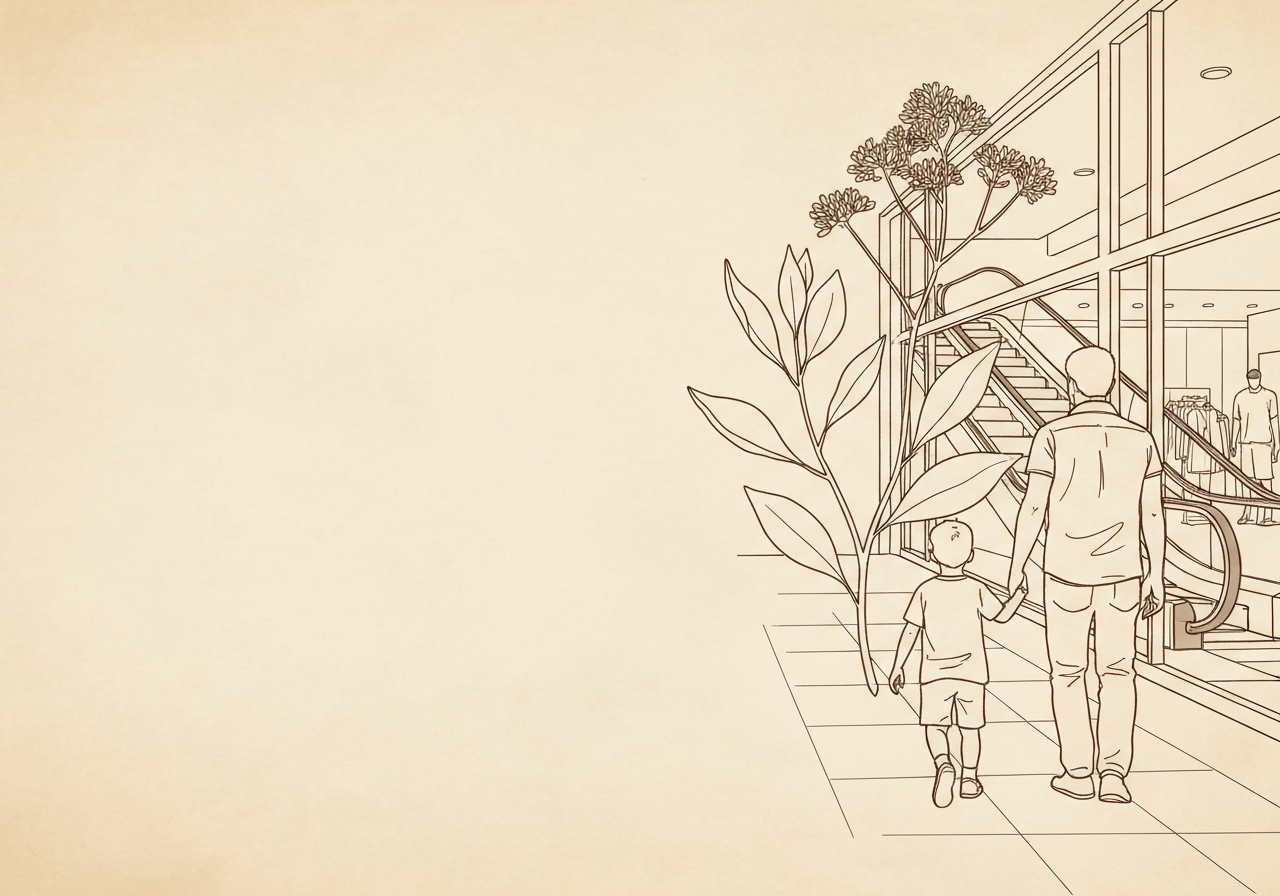
The court changed the venue from the court premises to RP Mall, Kollam — a shopping mall in the same town. On a Sunday morning, the mall's glass doors slide open to families, and children run past clothing racks. The father would now meet his son at that mall entrance at 11 AM on Sundays. He could take the child inside the mall, spend time with him — eating, walking, playing at any children's area the mall might have — and return him to the same spot at 2 PM. The mother would hand over the child at the entrance and collect him there at the end of the visit.
The court also reduced the visitation hours from five hours (11 AM to 4 PM) to three hours (11 AM to 2 PM). The reasoning was practical: a shorter duration in a neutral, public space was better for the child than a longer duration in a stressful environment.
A child is not evidence
The Supreme Court's order is a small but significant shift in how Indian courts think about child welfare in custody disputes. The judgment does not change any law — it simply applies the existing principle that the child's best interests are paramount. But by moving the venue from a courtroom to a mall, the court acknowledged something that is often forgotten in legal battles: a child is not a piece of evidence to be produced in court. A child is a person who needs to grow up in normal, happy spaces.
A shopping mall, for all its commercial chaos, is a far more natural environment for a father-son outing than a courtroom. The father can buy the child ice cream, let him run around, talk to him without a court clerk listening. The mother, too, can be assured that the visit happens in a public, safe location where she can observe from a distance if needed.
The case has been listed for further hearing on October 31, 2023, meaning the Supreme Court may eventually pass a more permanent order. But for now, the interim arrangement stands — and it sends a clear message to family courts across India.
Procedural context: the journey through three courts
The dispute began at the Family Court, Kollam, where the father was granted visitation rights on Sundays from 11 AM to 4 PM, restricted to court premises. The father's appeal to the Kerala High Court at Ernakulam, filed as OPFC No. 665/2022, was dismissed on January 10, 2023. The High Court declined to interfere with the Family Court's order, leaving the father with no remedy except a Special Leave Petition to the Supreme Court under Article 136 of the Constitution.
The Supreme Court, in its interim order dated October 3, 2023, modified the visitation arrangement. The operative order specifies that the father shall receive custody of the child at the entrance of RP Mall, Kollam, at 11 AM on Sundays, and shall return custody at the same spot at 2 PM. The mother is to hand over and collect the child at the mall entrance. This arrangement continues on Sundays as ordered by the Family Court, with the matter listed for further hearing on October 31, 2023.
Broader implications for visitation disputes
The court's reasoning — that repeated visitation in court premises is inimical to the child's welfare — has implications beyond this single case. Family courts across India routinely order visitation within court premises as a compromise between warring parents. The Supreme Court has now signaled that such arrangements may be legally unsustainable if challenged. The environment of visitation, the court held, is a material consideration — meaning it must be weighed seriously by every court when crafting custody orders.
For parents in similar disputes, the takeaway is clear: the venue of visitation is not a minor detail. It is a welfare consideration that can be argued before any court. A courtroom, with its formal atmosphere and adversarial associations, is never a neutral space for a child. The Supreme Court's order provides a template for alternative venues — public, neutral spaces like shopping malls, parks, or community centers — that better serve the child's interests.
THE PLAY: When seeking or opposing visitation rights, always argue that the venue of visitation is a welfare consideration — a courtroom is never a neutral space for a child.
The boy will now meet his father at a mall. It is not a perfect solution, but it is a kinder one.