FCI tried to recover railway demurrage from its truckers. The Supreme Court said no.
The contract only said 'charges'—not demurrage. And the truckers weren't even responsible for loading or unloading the grain.
Held.
One word.
Two contracts.
The contract only said 'charges'—not demurrage. And the truckers weren't even responsible for loading or unloading the grain.
The Food Corporation hired truckers to move grain. When trains sat too long, Railways charged demurrage. FCI blamed the truckers. The Supreme Court asked: does 'charges' in the contract include demurrage?
The answer turned on a single word in a single clause. And the difference between two kinds of contracts that the Food Corporation of India (FCI) uses — one where truckers load and unload, and one where they only drive.
When the trains arrived and the grain sat still
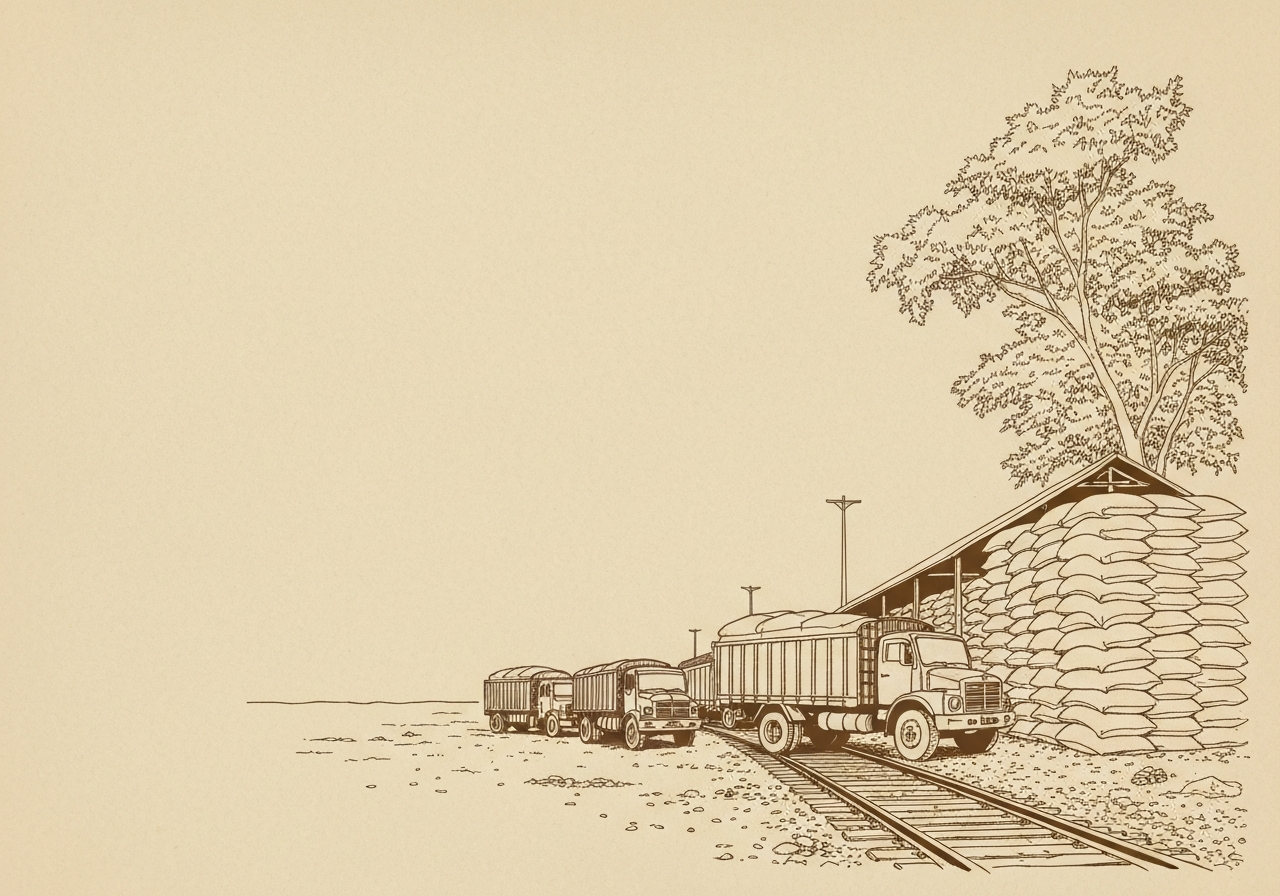
FCI, the government agency that buys, stores, and moves foodgrains across India, needed to shift grain from a railway siding in Assam to food depots in Tripura. The air at the siding was thick with dust from the grain bags stacked in the heat, and the trucks lined up on the gravel waited, their engines ticking. FCI hired road transport contractors — truck owners — to do the job. The contract was simple: the truckers would carry the foodgrains by road. They were not responsible for loading the grain onto their trucks from the railway wagons, nor for unloading it at the depots.
But when the trains arrived at the siding, FCI could not unload the wagons fast enough. The Railways, which charges a fee for every day a wagon sits idle beyond a set time, slapped FCI with demurrage (a penalty for delaying the return of railway wagons). FCI paid the Railways. Then it turned to its truckers and said: you didn't bring enough trucks on time. That caused the delay. You pay.
The security deposit that FCI kept
FCI withheld the security deposits of several contractors to recover the demurrage amounts. The contractors, one of whom was Abhijit Paul, went to the High Court of Tripura. Their argument was direct: the contract never said we are liable for demurrage. Our job was only to drive. We didn't load or unload. How could we control how fast the wagons were emptied?
The procedural journey through the High Court was long. In the first set, a Single Judge allowed the contractors' writ petitions. FCI appealed to a Division Bench, which dismissed the appeal on 7 September 2018. FCI then filed a Review Petition, dismissed on 22 January 2019. A second set of writ appeals by FCI was dismissed on 15 May 2019. Meanwhile, a third set of appeals — this time by the contractors themselves, whose cases had been dismissed on procedural grounds — was also dismissed by the Division Bench on 4 January 2021. The contractors argued that the High Court had erred in refusing to hear their cases on merits, and that the demurrage claim was fundamentally flawed because the contract imposed no loading or unloading duty on them. They pointed to the silence of the contract on demurrage, and to the fact that FCI's own Handling and Transport Contracts — which explicitly mention demurrage — proved that FCI knew how to draft such a clause when it wanted one.
The High Court agreed with the contractors on the substantive issue. FCI appealed to the Supreme Court.
What the contract actually said
The dispute centred on Clause XII(a) of the Road Transport Contract. That clause gave FCI the power to recover "damages, losses, charges, costs and expenses" from the contractor. FCI argued that "charges" was a broad word. It included demurrage. The contractors said no — "charges" meant charges arising from the contractor's own work, not penalties imposed by a third party (the Railways) for something the contractor had no control over.
The typed clause sat in a slim file, its language plain on the page. The Supreme Court did something that looks simple but is legally significant: it compared this contract with other contracts that FCI uses. FCI has two standard templates. One is the Road Transport Contract — the one in this case — where the trucker only drives. The other is the Handling and Transport Contract, where the contractor is responsible for loading and unloading the grain as well.
In the Handling and Transport Contract, FCI explicitly mentions demurrage in the liability clause. The 2010 and 2018 versions of that contract say, in clear terms, that the contractor will be liable for demurrage. The Road Transport Contract, by contrast, never mentions demurrage at all.
Why the silence mattered
The Court applied what lawyers call contextual and purposive interpretation (reading a contract as a whole, not picking out one word and stretching it). If FCI intended demurrage to be recoverable from road transport contractors, why did it explicitly mention demurrage in the handling contracts but not in the road transport contracts? The answer, the Court said, was obvious: because the road transport contractor had no role in loading or unloading, and therefore no ability to cause or prevent the delay that triggers demurrage.
The Court also noted that Clause X(a) of the Road Transport Contract listed the contractor's liabilities — and demurrage was absent. Clause XIII, which described the contractor's responsibilities, also said nothing about demurrage. The entire contract, read together, showed that the parties never agreed that the trucker would bear the cost of railway delays.
The Court held: "The expression 'charges' in a contractual recovery clause must be interpreted in the context of the entire contract, including the scope of work and responsibilities assigned to the contracting party." Where the contract does not assign loading/unloading duties to the contractor and omits express mention of demurrages in liability clauses — unlike other contracts of the same entity which do so — "charges" cannot be read to include demurrages. The courtroom fell still as the judgment was read, the words settling the question that had travelled from a dusty siding in Assam to the highest court in the land.
The precedent that sealed it
The Supreme Court relied on its own earlier judgment in Union of India v. Raman Iron Foundry (1974), where it held that a contract clause allowing recovery of "damages" does not automatically include every kind of loss — the clause must be read in the context of the specific obligations the party agreed to perform. If the obligation doesn't exist, the liability for its breach cannot be imposed.
The Court also cited Bihar State Electricity Board v. Green Rubber Industries (1990), which held that when a contract uses different language in different provisions, the court must assume the parties intended different meanings. Here, FCI used different language in its two contract templates — demurrage in one, silence in the other — and the Court assumed FCI meant what it wrote.
The Court further applied the principle of latent ambiguity: where a contractual expression appears unambiguous on its face but yields multiple outcomes when applied to a specific context, extrinsic evidence is admissible to ascertain the meaning of the words used. The comparison with the Handling and Transport Contracts was that extrinsic evidence — it showed that FCI itself distinguished between contracts where demurrage was recoverable and contracts where it was not.
What the Court finally decided
The Supreme Court dismissed all of FCI's appeals. The High Court's decisions in favour of the contractors were upheld. At the same time, the Court allowed the appeals filed by the contractors themselves — those contractors whose writ appeals had been dismissed by the High Court on procedural grounds got their cases restored. The Court set aside those dismissals and sent the matters back to the High Court for fresh decisions on merits. The operative order was clear: Civil Appeals arising out of SLP Nos. 16009-16010 of 2019 and SLP Nos. 16063-16068 of 2019 filed by the Corporation were dismissed. Civil Appeals arising out of SLP Nos. 4045-4046 of 2021 filed by the contractors were allowed. Parties were directed to bear their own costs.
The core holding was this: where a contract does not assign loading or unloading duties to the contractor, and does not explicitly mention demurrage in its liability clauses, the word "charges" in a recovery clause cannot be stretched to include demurrage imposed by the Railways.
THE PLAY: If your contract does not assign a specific duty to the other party, do not assume a general recovery clause will cover penalties arising from that duty — write it in explicitly.
The grain eventually moved. But the money stayed where the contract left it: with the truckers.