Gold earrings in his pocket — but was he a murderer?
The Supreme Court says no. When stolen goods are found on someone soon after a killing, the law lets judges presume theft — but murder? That's a leap too far.
2
possibilities.
The Supreme Court says no. When stolen goods are found on someone soon after a killing, the law lets judges presume theft — but murder? That's a leap too far.
He had the victim's gold earrings and silver lingakar. The High Court said: theft + murder. The Supreme Court said: not so fast.
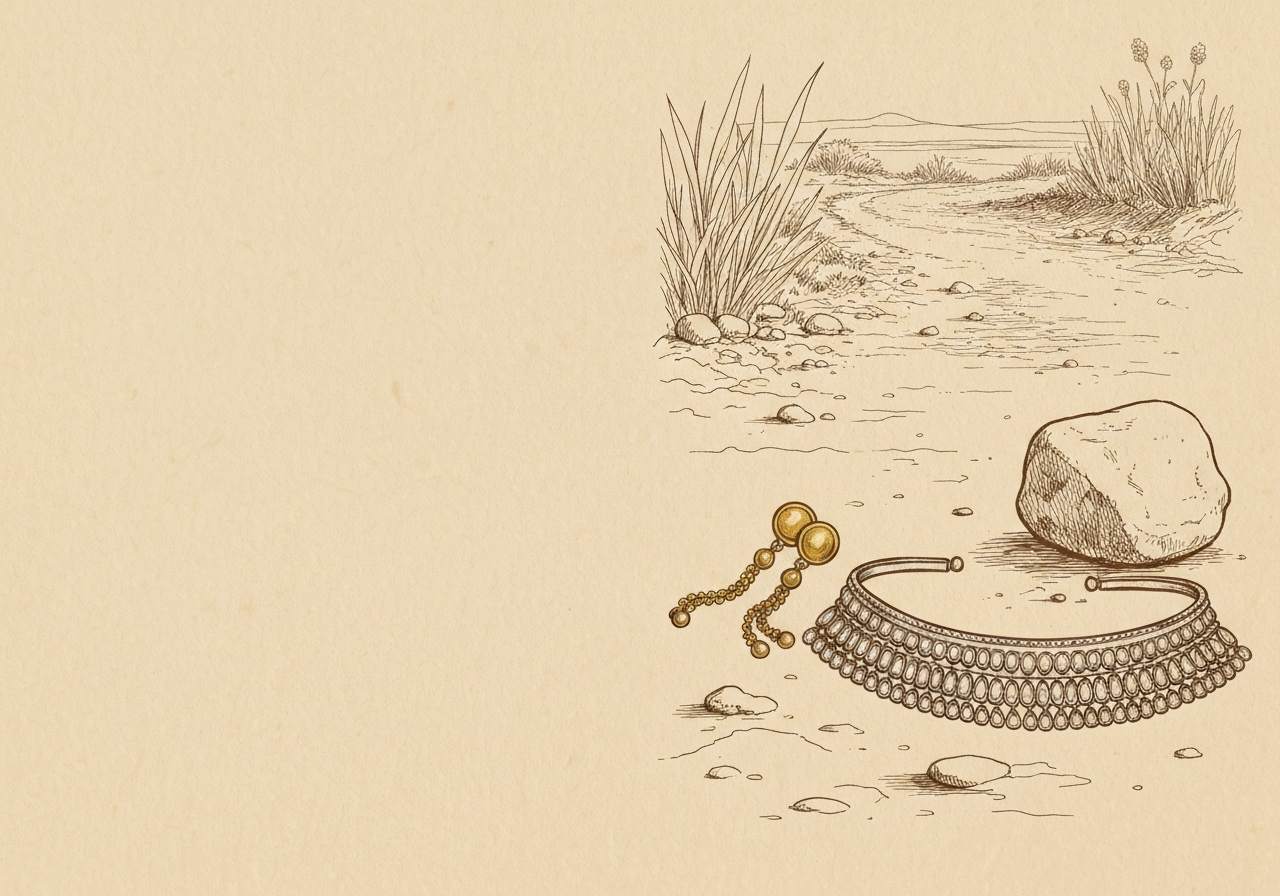
The man was killed on an ordinary day. The body lay on a dusty path, a stone nearby, the silver lingakar still warm against the skin. When police arrived, there were no witnesses, no motive, no account of what happened. What they did find, soon after, was a suspect carrying the dead man's belongings — gold earrings and a silver lingakar (a traditional waist ornament worn by men in parts of Maharashtra). The prosecution told a simple story: the man who had the valuables must have killed to get them. The High Court agreed. The Supreme Court did not.
When the gold earrings became the only clue
The case — Limbaji v. State of Maharashtra — began in a trial court. The accused faced two grave charges: murder under Section 302 of the Indian Penal Code (the law that punishes intentional killing) read with Section 34 (common intention — when multiple people act together with a shared plan), and robbery under Section 392 read with Section 34.
The prosecution's case rested on one piece of evidence: the recovery of the victim's golden earrings and silver lingakar from the accused, based on information the accused themselves gave to the police. The accused pulled the earrings from his pocket — small, heavy, still flecked with dried blood.
No eyewitness. No forensic evidence linking the accused to the killing. No confession. Just the ornaments, found in their possession soon after the murder.
The trial court heard the prosecution's evidence — the police officer who recorded the disclosure, the panch witnesses who signed the seizure memo, the ornaments themselves produced as material exhibits. The defence argued that mere possession of the ornaments could not prove the killing. But the trial court, relying on the recovery and the timing, convicted the accused for both murder and robbery. The case then moved to the High Court.
The legal shortcut the High Court took
The High Court leaned on Section 114 of the Evidence Act — a provision that lets judges draw certain inferences from proven facts. The section lists several "illustrations" where the court may presume a particular fact unless the accused explains otherwise. The first illustration was the one that mattered: "the court may presume that a man who is in possession of stolen goods soon after the theft is either the thief or has received the goods knowing them to be stolen, unless he can account for his possession."
In plain terms: if you're caught with stolen property shortly after it was taken, the law lets the judge assume you either stole it or knowingly received stolen goods. The High Court stretched this presumption further. It said: because the accused had the victim's ornaments, and because the victim was dead, the accused must have committed the murder too. Theft plus murder, the High Court reasoned, were part of the same act. The High Court examined the recovery evidence, noted the proximity in time between the killing and the seizure, and concluded that the only reasonable inference was that the accused had killed the victim to take the ornaments. It upheld the trial court's conviction.
Why the Supreme Court stopped the leap
The Supreme Court saw the problem immediately. The first illustration under Section 114 permits a presumption about theft — not about murder. Those are two different crimes, requiring different mental states and different proof. A person can steal from a dead body without having killed the person. A person can find valuables near a corpse and take them. The law's presumption about stolen goods does not, by itself, answer how the victim died.
The Court examined the facts and found two possibilities. Either there was a pre-meditated plan to murder the victim and then take the ornaments — a cold, calculated killing for gain. Or, one of the accused suddenly picked up a stone and killed the victim in a spontaneous act, followed by theft — a crime of opportunity, not design. No one saw it. No one confessed.
The Court stated plainly: when there is "reasonable scope for two possibilities" and the actual sequence of events is unknown, it is "not safe to extend the presumption under Section 114 so as to find the appellant guilty of the offence of murder." The presumption about stolen goods could only take the prosecution so far. It could prove theft. It could not, by itself, prove murder.
One might imagine the judges weighing the two possibilities aloud in the courtroom. "Could the accused have planned this?" a judge might ask. "The ornaments were valuable, yes — but there is no evidence of prior enmity, no witness who heard a threat, no preparation." The other judge might reply: "But they had the earrings in their pocket within hours. That is strong evidence of theft. Is it strong enough for murder?" The answer, the Court concluded, was no. The gap between theft and murder was too wide to bridge with a presumption alone.
The cautious approach the law demands
The Supreme Court stressed that when a court relies on recent possession of a victim's belongings to draw inferences, it must adopt a cautious approach. The court must have "an assurance from all angles that the accused not merely committed theft" but also committed the killing. That assurance was missing here. The ornaments proved the accused took something that wasn't theirs. They did not prove the accused took a life.
The Court set aside the conviction for murder under Section 302 of the IPC. But it did not let the accused walk free. Instead, it found them guilty of a lesser but still serious offence: Section 394 read with Section 34 of the IPC — robbery with attempt to cause death or grievous hurt (grievous hurt means serious injury like fractures, loss of sight, or permanent damage). The sentence was reduced to rigorous imprisonment (hard labour in jail) for the robbery charge, rather than life imprisonment or death for murder.
The judgment carefully parsed the difference between the two offences. Murder requires an intention to cause death, or knowledge that the act is so imminently dangerous that it will in all probability cause death. Robbery with attempt to cause death or grievous hurt requires only that the accused, while committing robbery, attempted to cause death or grievous hurt — a lower threshold of intent. The Court found that the evidence supported the latter but not the former. The stone that killed the victim could have been picked up in a sudden impulse during the robbery, not as part of a pre-meditated design to kill.
What this means for every criminal trial
For lawyers and judges, this judgment is a reminder that presumptions in evidence law have limits. Section 114's first illustration is a tool for proving theft, not a magic wand that proves every crime connected to the stolen property. The prosecution must still prove murder through independent evidence — eyewitness accounts, forensic reports, motive established through other means. Possession of stolen goods, however recent, cannot fill that gap.
The judgment also clarifies the sentencing implications. A conviction for murder under Section 302 carries a minimum sentence of life imprisonment, and in some cases the death penalty. A conviction under Section 394 carries a maximum of life imprisonment but often results in a fixed term of rigorous imprisonment. The difference is not merely academic — it determines whether a man spends the rest of his life behind bars or serves a determinate sentence and is released. In this case, the Supreme Court's careful parsing of the evidence meant the difference between a life sentence and a term of years.
For defence lawyers, the judgment provides a powerful argument: when the only evidence linking the accused to a killing is recent possession of the victim's property, argue that the presumption under Section 114 extends only to theft — not to murder — and the court must acquit on the murder charge unless independent evidence proves the killing. The Supreme Court has now made clear that a conviction for murder cannot rest on a presumption alone. The prosecution must do more than point to the ornaments in the accused's pocket. It must show, through evidence that leaves no room for the second possibility, that the accused intended to kill.
The gold earrings and silver lingakar told the court one story: theft. The murder remained a story the prosecution could not prove.
THE PLAY: When the only evidence linking an accused to a killing is recent possession of the victim's property, argue that the presumption under Section 114 of the Evidence Act extends only to theft — not to murder — and the court must acquit on the murder charge unless independent evidence proves the killing.