He refused a DNA test. The court said: that's his right.
Defendants wanted to prove the plaintiff wasn't their brother. But the judge ruled that forcing a DNA test would violate his privacy—at least at this stage.
114
of Evidence Act.
Defendants wanted to prove the plaintiff wasn't their brother. But the judge ruled that forcing a DNA test would violate his privacy—at least at this stage.
The defendants said: 'He's not our brother. Make him take a DNA test.' The plaintiff refused. And the Supreme Court just backed him.
On one side stood a man who claimed he was the son of the family—armed with school certificates, affidavits, and a lifetime of paperwork. On the other side stood the people he called his siblings, insisting he was a stranger. Their weapon: a DNA test. His shield: the right to privacy. In Ashok Kumar v. Raj Gupta & Ors, the Supreme Court had to decide which one wins—at least for now.
When the family said no
The plaintiff walked into court with a simple demand: declare me the owner of this property. He said he was the son of the parents and therefore the brother of the defendants. The defendants didn't just disagree—they denied the relationship entirely. He wasn't their brother, they said. He wasn't even their parents' child.
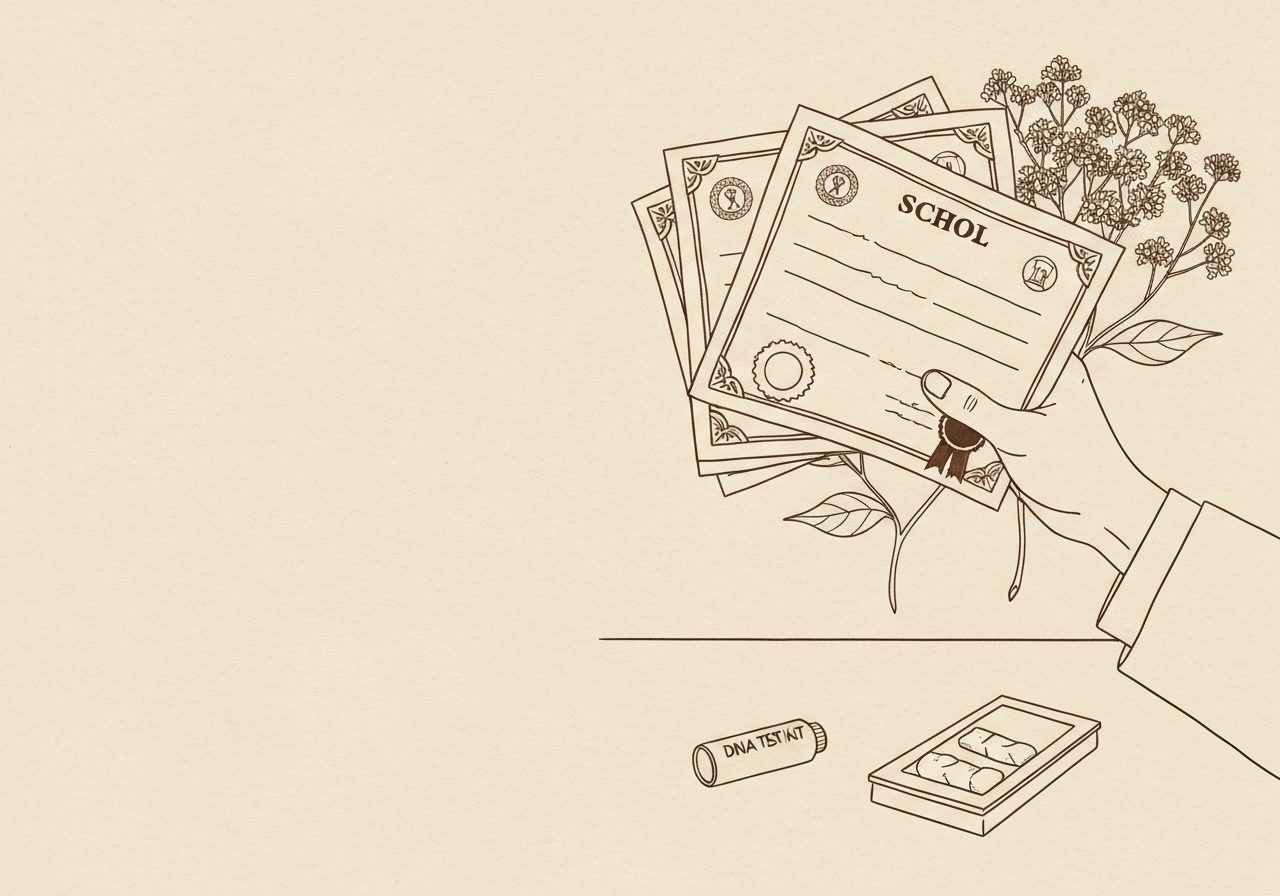
The plaintiff had already done his homework. He had submitted his documentary evidence—school certificates and affidavits, papers that traced his life on paper. Then the defendants made their move. They filed an application asking the court to compel the plaintiff to undergo a DNA test. If he was really their brother, they argued, the science would prove it. If he refused, the court should draw an adverse inference (a legal conclusion that the refusal itself suggests the test would have hurt his case).
The trial court dismissed the application. The matter was then addressed subsequently, and it reached the Supreme Court.
The problem with forcing a test
The case presented a unique procedural posture. The application to force the DNA test came during the defendants' phase of presenting evidence—after the plaintiff had already closed his own case. The plaintiff had put forward his school certificates, his affidavids, his version of the story. Now the defendants wanted to rip open that story with a biological test.
The plaintiff refused. He had already led his documentary evidence, he said. The burden was on him to prove his case, and he had done so with documents. He wasn't going to hand over his DNA.
The Supreme Court saw the tension clearly. On one hand, the court wants the truth. A DNA test is, in most cases, the closest thing to an absolute answer on biological relationships. On the other hand, forcing someone to give a bodily sample—blood, saliva, tissue—is not a trivial thing. It invades the body. It invades privacy.
The Sharda precedent and the 'eminent need' test
The Court turned to its own earlier judgment in Sharda v. Dharmpal. In that case, the Supreme Court had observed that "if despite an order passed by the court, a person refuses to submit himself to such medical examination, a strong case for drawing an adverse inference" can be made out against that person. The legal basis for this is Section 114 of the Evidence Act (a provision that allows a court to presume certain facts based on the conduct of a party—like refusing to take a test that could prove or disprove a claim).
The plaintiff in Ashok Kumar knew this. He was conscious that his refusal could be used against him later. The court could look at his refusal and say: if the test would have helped you, you would have taken it. Your refusal suggests the truth would have hurt you.
But the Court also said something else. The power to order a DNA test is not automatic. It must pass a threshold called the "test of eminent need." This means the court must be convinced that the test is genuinely necessary at that stage of the case—not just convenient, not just a fishing expedition, but truly essential to decide the dispute. And at this stage, with the plaintiff's documentary evidence already on record and the defendants yet to present their case, the Court found that the test of eminent need was not satisfied.
The Court emphasized the need to balance the interests of the parties, including the quest for truth and the right of privacy. The onus was on the plaintiff initially to prove his case—and he had done so through his school certificates and affidavits. The defendants could not leapfrog their own evidentiary burden by forcing the plaintiff to submit to a test at this procedural juncture.
Privacy first—for now
The Supreme Court upheld the trial court's decision. The defendants could not compel the plaintiff to take a DNA test at this procedural stage. The protection of the right to privacy took precedence because the test of eminent need had not been met.
But the Court left a door open. The refusal itself does not disappear. The issue of drawing an adverse inference under Section 114 of the Evidence Act may still arise later in the trial. If the plaintiff's documentary evidence is weak, or if the defendants present strong evidence contradicting his claim, the court could look at his refusal to take the test and draw a conclusion against him. The refusal is not a free pass—it is a gamble.
The Court's message was clear: you cannot force a person to give their DNA just because it would be convenient for the other side. But if you refuse, you carry the risk that the court will assume the test would have exposed you.
THE PLAY: Before asking a court to compel a DNA test, show that the test is genuinely necessary at that stage of the case—not just that it would be helpful.
The balance that holds
The Supreme Court did not say DNA tests are never allowed. It did not say privacy always wins. It said that at this stage, with the plaintiff having already presented his documentary evidence—his school certificates and affidavits—and the defendants yet to begin theirs, the need for the test was not urgent enough to override the plaintiff's right to refuse a bodily intrusion.
The case is not over. The trial will continue. The plaintiff's school certificates and affidavits will be tested against whatever evidence the defendants bring. And somewhere in the background, the plaintiff's refusal will sit like a shadow—a fact the judge may use against him if the rest of his case wobbles.
The Court ended where it began: with a man who said no to a test, and a court that said his no was lawful—for now.