He said 'I stabbed him.' The court said: That's not a confession.
Lord Atkin explained why even a full admission of guilt can leave the prosecution with work to do — and why that matters for every criminal trial.
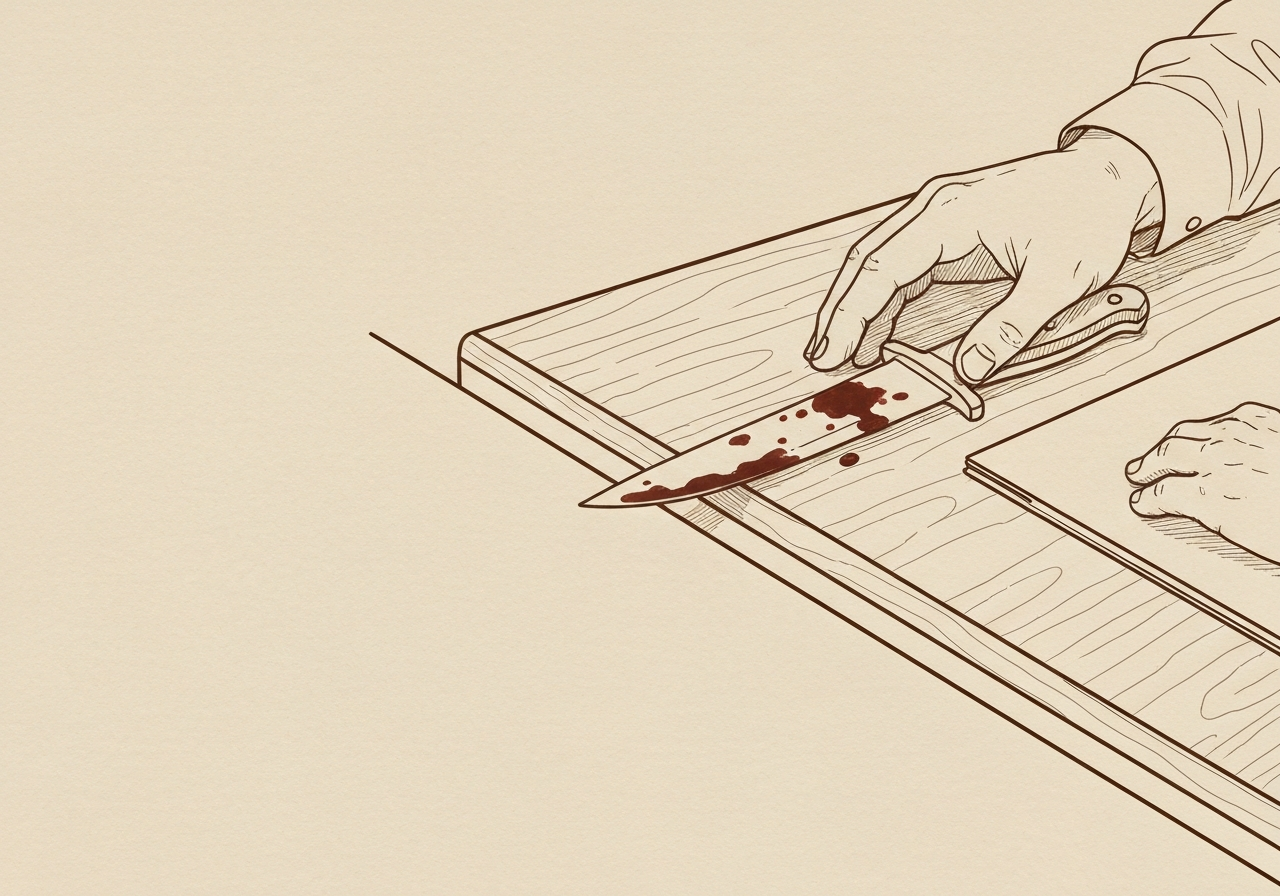
Not a confession.
He said: 'I stabbed him.'
Still not a confession.
Lord Atkin explained why even a full admission of guilt can leave the prosecution with work to do — and why that matters for every criminal trial.
He told the police: 'I stabbed the victim to death with this knife.' The judge said: That's still not a confession.
The accused had walked into the station. He handed over the weapon. He spoke the exact words any investigating officer would dream of hearing. But when the case reached the Privy Council, Lord Atkin looked at that statement and saw something entirely different — a confession that was not a confession at all.
The moment the knife hit the table
The facts in Pakla Narayan Swami v. Emperor were stark. The accused said he had "stabbed the victim to death through his knife, and admit the knife as well." On the surface, it was a full admission — the act, the weapon, the result. Any prosecutor would have felt the case was closed.
But the law does not work on surface impressions. The question was deceptively simple: Was this statement a confession? Lord Atkin's answer was a firm no. And the reasoning behind that answer has shaped how criminal courts in India treat admissions ever since.
'I did it' is not the same as 'I am guilty'
A confession is a specific thing in law. It is an admission where the accused admits guilt in its absolute terms — leaving the prosecution with nothing to prove. It is a complete surrender. The accused does not just say "I did it." The accused says "I did it, and there is no legal reason why I should not be punished for it."
The statement in Pakla Narayan Swami did not meet that standard. Lord Atkin observed that even this highly inculpatory admission — the accused naming the victim, describing the act, handing over the murder weapon — was "still not confession." Why? Because the prosecution would still have had to prove something crucial: whether the act was covered by any private defence (the right to protect oneself or another person from harm) or protected under any general exception, such as unsoundness of mind (a legal defence where the accused was mentally incapable of understanding the nature of the act).
The burden the prosecution could not escape
The logic was sharp and practical. A confession must be so complete that it leaves the prosecution with zero burden. If the accused says "I killed him, but I was defending myself," that is not a confession — it is a defence. If the accused says "I killed him, but I was insane at the time," that too is not a confession — it raises a question the prosecution must answer.
In Pakla Narayan Swami, the accused's statement did not rule out these possibilities. He admitted the act, but he did not admit that the act was unlawful. He did not say "I had no right to do this." He did not say "I was of sound mind when I did it." The prosecution still had to prove that the killing was not justified by private defence and that the accused was mentally competent. The statement, however damning, was not a confession — because it did not eliminate the legal defences that might have applied.
What every police officer misunderstands
The case established a principle that is often misunderstood. A confession must be absolute. It must admit guilt in such a way that the prosecution's case is complete. A partial admission — even one that includes the words "I stabbed him" — is not enough if it leaves room for the accused to later argue that the act was justified or excused.
This is why investigating officers are trained to record confessions with extreme care. A statement that says "I killed him" without more may be powerful evidence, but it is not a confession in the legal sense. The prosecution still has to prove that the killing was unlawful, that no exception applied, and that the accused was responsible for his actions.
Lord Atkin's example in Pakla Narayan Swami remains one of the clearest illustrations of this principle. A man walks into a police station, hands over a bloody knife, and says "I stabbed him." The law says: that is an admission, but it is not a confession. The prosecution still has to prove that the stabbing was murder, not self-defence. The prosecution still has to prove that the man was sane, not insane. The prosecution still has to prove everything that makes the act a crime.
THE PLAY: When recording a statement from an accused, never assume that an admission of the act is a confession — always ask whether the statement eliminates every possible legal defence, because if it does not, the prosecution's burden remains untouched.
The knife was on the table. The words were spoken. But the law demanded more.