He said she signed. She said she didn't. Who has to prove it?
A Supreme Court ruling on a disputed sale agreement shows why the burden of proof doesn't flip just because you're the one denying.
"It is a fundamental principle of law that the burden of proof rests on the person who asserts the affirmative and not on the person who denies it."
The burden-of-proof rule the Supreme Court appliedThiruvengada Pillai v. Navaneethammal — Supreme Court
A Supreme Court ruling on a disputed sale agreement shows why the burden of proof doesn't flip just because you're the one denying.
He waved an unregistered sale agreement. She said: 'That's not my signature.' The court had to decide: who must prove the truth?
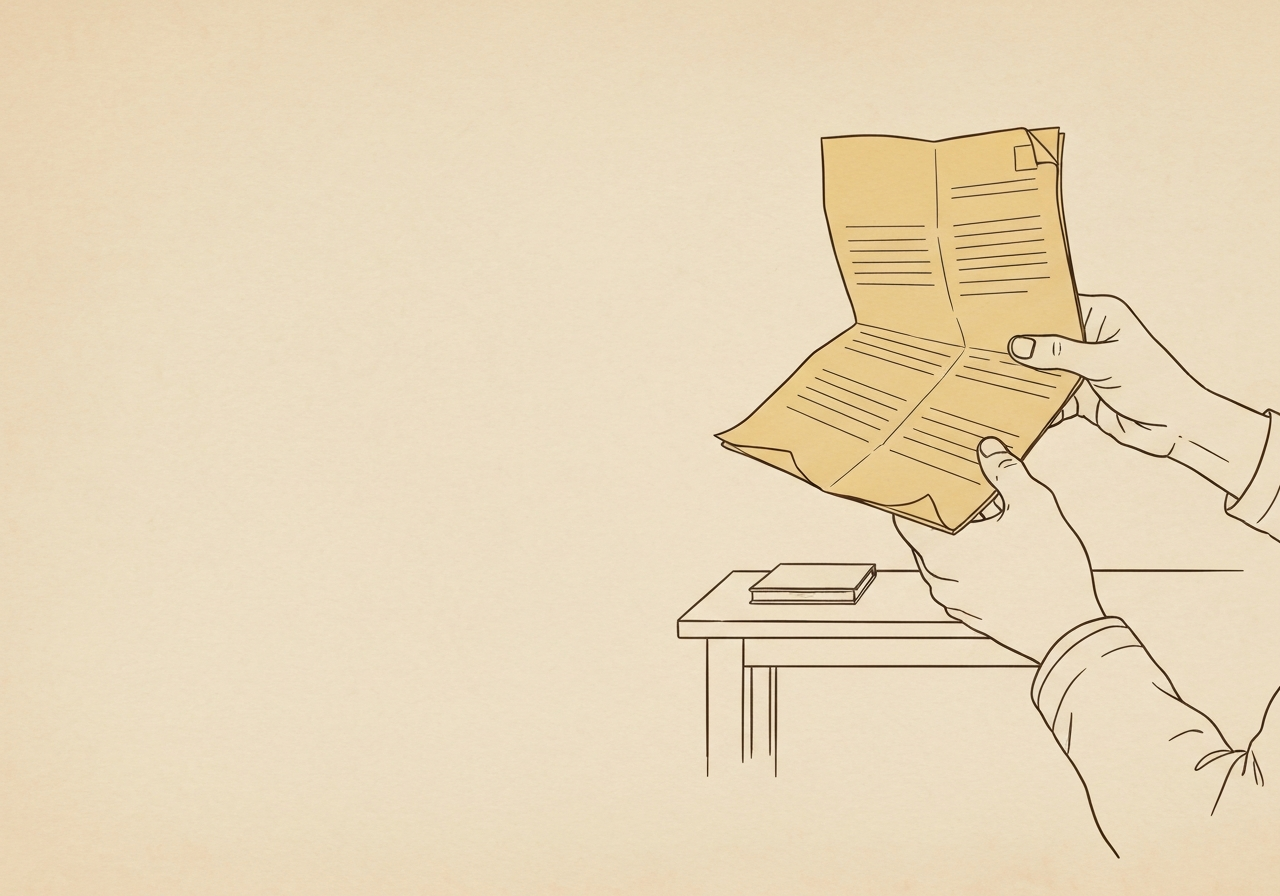
It began with a piece of paper. The plaintiff held out a creased, yellowing document. The defendant did not touch it. She just shook her head. A man walked into court holding an unregistered sale agreement — a document that, if genuine, would give him a legal right over a piece of land. The woman on the other side looked at it and said: that is not my signature. She did not produce a rival document. She did not claim she signed something else. She simply denied it.
The question that landed before the Supreme Court in Thiruvengada Pillai v. Navaneethammal was deceptively simple: when one person says a document is real and the other says it is fake, who has to prove their version?
When the agreement appeared in court
The plaintiff — the person who brought the case — claimed that the first defendant had executed an unregistered agreement of sale in his favour. An unregistered agreement of sale is a written promise to transfer property, but one that has not been officially recorded with the government's registration office. It is a common document in Indian property disputes, often used in informal transactions where parties trust each other enough to skip the formal step.
The defendant — the person being sued — denied having executed the agreement at all. She did not say the document was defective or incomplete. She said it was never hers. The signature, she insisted, was not hers. The document itself, she argued, was a fabrication.
That denial created a fork in the road. If the court accepted the document as genuine, the plaintiff would have a legal right. If the court rejected it, the case collapsed. But before the court could decide which side was telling the truth, it had to decide a prior question: who must produce the evidence?
The burden that follows the claim
The plaintiff argued that since he was the one asserting the agreement existed, he had already done his part by producing the document in court. The defendant, he said, should now prove that her signature was forged — that she was the victim of a fake document. After all, she was the one making the accusation of forgery.
The defendant took the opposite position. She said she had done nothing except deny something that was not true. Why should she have to prove a negative — that she did not sign something? That, her lawyers argued, was an impossible task. How does anyone prove they did not do something?
The Supreme Court looked at the fundamental principle of evidence law: the party who asserts a fact must prove that thing. The burden rests on the person who claims the affirmative, not upon the party who simply denies it. The court pointed out that the plaintiff was asserting an affirmative fact — that the agreement was executed. The defendant was merely denying it. That denial, by itself, did not shift the burden.
In the court's own words, as recorded in the judgment: "It is a fundamental principle of law that the burden of proof rests on the person who asserts the affirmative and not on the person who denies it." The court further stated: "When the execution of an unregistered document put forth by the plaintiff was denied by the defendants, it was for the plaintiffs to establish that the document was genuine." These two sentences capture the entire logic of the ruling — the claimant must prove, the denier need only wait.
Why the denial did not flip the burden
The court's reasoning turned on a distinction that is easy to miss. When a defendant denies a document, she is not making a positive claim of forgery. She is simply saying: I did not do this. The burden to prove forgery — that someone else faked the signature — lies with the person who alleges forgery, which is usually the person relying on the document who must prove it is genuine in the first place.
In this case, the plaintiff was the one relying on the unregistered sale agreement for his legal right. He was the one who walked into court holding that piece of paper. The court held that when the execution of an unregistered document put forth by the plaintiff was denied by the defendants, it was for the plaintiffs to establish that the document was genuine. It was not the defendant's burden to prove the negative — that she did not execute the agreement.
The court recognised that requiring a defendant to prove she did not sign a document would create an absurd situation — what the court described as requiring a party to prove a negative, an exercise that would be an absurdity. Every person who denies a document would have to become a detective, gathering evidence of their own non-involvement. The law does not demand that. It demands that the person who asserts the existence of a fact — the affirmative claim — must prove it.
How the case reached the Supreme Court
Before the Supreme Court could lay down this principle, the case had travelled through the lower courts. In the trial court, the plaintiff had produced the unregistered sale agreement and argued that the defendant's denial was insufficient to shift the burden of proof. The trial court had to decide, as a preliminary issue, who bore the burden of proving the document's execution. That decision would determine the entire course of the trial — which side would have to lead evidence first, which side would face the consequences if evidence was inconclusive.
The matter was not simple. The trial court had to weigh the plaintiff's assertion — that the document was genuine — against the defendant's flat denial. The plaintiff argued that the mere production of the document was enough to shift the burden to the defendant. The defendant countered that the law required the plaintiff to prove execution, not merely to produce the paper. The trial court's decision on this preliminary point would shape the entire litigation, because the party bearing the burden of proof faces a structural disadvantage: if evidence is evenly balanced, that party loses.
From the trial court, the matter moved up. Each level of the judicial hierarchy had to grapple with the same question: who must prove the execution of an unregistered document when its authenticity is denied? The case eventually reached the Supreme Court, which settled the question with a clear statement of the evidentiary principle.
The courtroom itself, when the Supreme Court heard the matter, would have been a study in contrasts. On one side, the plaintiff's counsel, clutching the disputed document, arguing that its very existence in court was proof enough to shift the burden. On the other side, the defendant's counsel, perhaps with nothing more than a brief, insisting that the law required the plaintiff to prove every element of his case. The bench listened, the files were passed, the arguments were made. And then the court delivered its ruling — spare, precise, and binding.
A hypothetical to illustrate the principle
Consider a simple example. A man walks into court and says: "This woman promised to sell me her land. Here is the agreement she signed." The woman says: "I never signed that." Who must prove the truth?
If the burden fell on the woman, she would have to gather evidence that she did not sign — perhaps handwriting experts, perhaps alibi witnesses, perhaps proof that she was out of the country on the date the agreement was supposedly signed. She would have to prove a negative: that she did not do something. That is an expensive, time-consuming, and often impossible task.
If the burden falls on the man, as the law requires, he must prove that the signature is genuine. He must produce handwriting experts, witnesses to the signing, or other evidence that the document is what he claims it is. This is a positive act of proof — proving that something happened, not that something did not happen. The law prefers this because it is the person who makes a claim who should bear the cost and risk of proving it.
The Supreme Court's ruling in Thiruvengada Pillai v. Navaneethammal confirms that the law follows this logic. The claimant — the person who relies on the document for a legal right — must prove its authenticity. The defendant need only deny.
Now imagine a second scenario. A woman produces a promissory note and says a man borrowed money from her. The man denies signing the note. The same principle applies: she must prove the signature is his. He does not have to prove he never signed it. The burden follows the claim, not the denial. This is the logic that runs through every disputed document case in Indian courts.
What this means for every disputed document
The ruling in Thiruvengada Pillai v. Navaneethammal reinforces a principle that applies far beyond unregistered sale agreements. Whenever a party relies on a document to claim a legal right, that party carries the initial and substantive burden of establishing its authenticity and valid execution. The other side does not have to prove the document is fake. The other side can simply say: prove it.
This is not a technicality. It is a structural protection. If the burden could be shifted by a simple denial, then anyone who produced a questionable document could force the other side to disprove it — an expensive, time-consuming, and often impossible task. The law does not allow that. The claimant must prove the document is real before the defendant is required to respond to its contents.
THE PLAY: If you are the party relying on a disputed document, do not expect the court to ask the other side to prove it is fake. You must prove it is real — starting with the signature.
The court ended where it began: with a piece of paper and a simple denial. The plaintiff held the document. The defendant shook her head. And the law said: you brought the claim, you bring the proof.