Highway blocked. Farmers won't move. The Supreme Court chose a committee, not coercion.
The Supreme Court declined to enforce highway clearance by coercion, instead appointing a five-member committee to mediate with farmers, setting a new template for protest disputes that balances public inconvenience against agrarian grievances.
5
members.
The Supreme Court declined to enforce highway clearance by coercion, instead appointing a five-member committee to mediate with farmers, setting a new template for protest disputes that balances public inconvenience against agrarian grievances.
When the Highway Became the Protest Ground: The Supreme Court’s Unusual Fix for the ‘Delhi Chalo’ Impasse
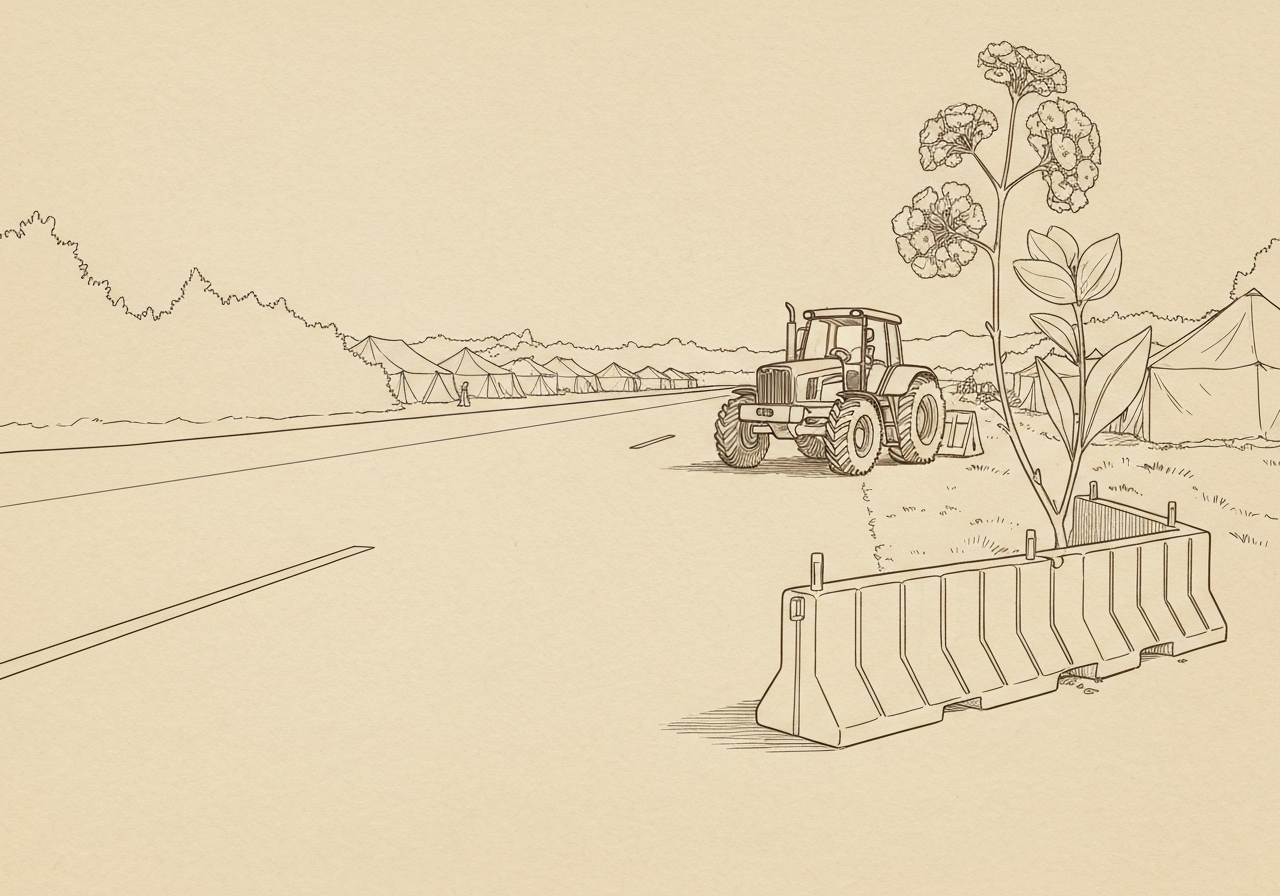
In February 2024, thousands of farmers from Punjab and Haryana began marching towards Delhi. Their demand: a legal guarantee for Minimum Support Price (MSP) and other agrarian reforms. They called it ‘Delhi Chalo’. By the time they reached the Shambu Border—the boundary between the two states—the National Highway was blocked. Tractors and trolleys lined the asphalt. Tents went up. The protest became a siege.
For the general public, it was a nightmare. Commuters stranded for hours. Railway tracks blocked. One protester lost his life in the violence that erupted on multiple dates. The State of Haryana, facing mounting public anger, barricaded the border. The farmers refused to move. The Punjab and Haryana High Court stepped in, ordering the barricades opened and an inquiry committee formed. But the deadlock remained.
Then the Supreme Court did something unexpected. Instead of simply deciding who was right—the State or the farmers—it created a committee. Not just any committee. A High-powered Committee of five eminent persons, tasked with one job: talk to the farmers, understand their demands, and find a way out. The Court’s order, dated September 2, 2024, in State of Haryana & Anr. v. Uday Pratap Singh & Ors., is a masterclass in judicial pragmatism. It’s also a warning: the right to protest has limits, and those limits are now being drawn in real time.
The Protest That Wouldn’t End
The story begins with a Public Interest Litigation (PIL) filed in the Punjab and Haryana High Court on February 1, 2024. The petitioner sought directions to remove restrictions on the farmers’ protest while ensuring that National Highways and railway tracks remained unblocked. The High Court entertained the PIL. On March 7, 2024, it constituted an inquiry committee headed by a former High Court judge to scrutinise the incidents of violence.
But the core issue—the blockade—remained unresolved. On July 10, 2024, the High Court passed an interlocutory order that became the flashpoint. It directed the opening of barricades at the Shambu Border within a week. It also directed the Kisan Unions to maintain law and order, and the State of Punjab to control demonstrators and remove obstructions from the highway.
The State of Haryana was not happy. It filed Special Leave Petitions (SLP(C) Nos. 6950-6953/2024 and SLP(C) Nos. 15407-15410/2024) before the Supreme Court under Article 136 of the Constitution. The State argued that the High Court’s order was unworkable—that opening the barricades without a clear plan would only worsen the situation. The farmers, on the other hand, insisted on their right to protest.
The Court’s First Move: A Suggestion, Not a Command
When the matter first came up before a three-judge bench on July 20, 2024, the Court did not issue a stay or a direction. Instead, it suggested something unusual: an independent committee of eminent persons to reach out to the farmers and find viable solutions. The parties agreed. The Court then referred the matter to a two-judge bench for further orders.
That bench—Justice Surya Kant (author of the judgment) and Justice Ujjal Bhuyan—took the suggestion and turned it into an order. On September 2, 2024, they constituted a five-member High-powered Committee. The members: Justice (Retd.) Nawab Singh (former judge of the Punjab and Haryana High Court) as Chairperson; Shri B.S. Sandhu, IPS (Retd.); Shri Devinder Sharma (agricultural economist); Prof. Ranjit Singh Ghumman (domain expert); and Dr. Sukhpal Singh (academic). Prof. Baldev Raj Kamboj was named a Special Invitee as needed.
The Committee’s mandate was broad: formulate issues, reach out to the agitating farmers at the Shambu Border, and impress upon them to remove tractors, trolleys, and tents from the National Highway. The Court also directed the Chief Secretaries and Directors General of Police of both states to provide logistic support. The matter was posted for further hearing on October 14, 2024.
What the Court Actually Did—And Why It Matters
This is not a typical Supreme Court order. There is no detailed analysis of legal provisions. No lengthy discussion of precedents. The Court did not even decide the challenge to the High Court’s order on its merits. Instead, it adopted a conciliatory approach—what the judgment itself calls a “committee-based resolution.”
The ratio decidendi is clear: where large-scale farmers’ protests cause public inconvenience through highway blockades but involve genuine agrarian grievances, the appropriate judicial response is to constitute an independent High-powered Committee of domain experts. The Committee’s job is to engage with farmers, formulate issues, and recommend phased solutions. Purely coercive enforcement of highway clearance orders is not the answer.
But the Court also laid down a second principle: agitating farmers must vacate National Highways and shift to alternative protest sites identified by the states. Their genuine demands will be examined through an institutional mechanism, but the right to protest does not include the right to block public infrastructure indefinitely.
THE PLAY: When faced with a protest that blocks public infrastructure, do not rush to court for a coercive order. Instead, push for an independent committee of domain experts to mediate. The Court will back you—if the grievances are genuine.
The Obiter That Could Reshape Protest Law
Two observations in the judgment are worth watching. First, the Court noted that there is a “sizeable population of non-agriculture communities in Punjab and Haryana, largely belonging to marginalized sections living below poverty line, who are the backbone of agricultural activities.” Their legitimate aspirations, the Court said, “also deserve empathy and due consideration while examining issues confronting the farming community.”
This is significant. It expands the scope of agricultural policy discussions to include landless labourers and non-farmer rural populations. Future committees or policy deliberations may now be required to consider their interests alongside those of farmers.
Second, the Court cautioned agitating farmers to “keep themselves at a safe distance from political parties, political issues, and not to insist on demands which are not feasible to be accepted outrightly.” This could be invoked to delegitimise protest movements that become politically aligned or make maximalist demands. It is a warning shot: the Court’s patience has limits.
What This Means for Practitioners
For advocates, this judgment is a template. If you represent a state government facing a protest that blocks public infrastructure, your best move may not be a contempt petition or a plea for police action. Instead, ask the court to constitute a committee. The Supreme Court has now blessed this approach.
For CFOs and founders, the lesson is different. Protests can disrupt supply chains, block logistics, and halt operations. The traditional response—seeking court orders for clearance—may not work if the court decides to mediate instead. Plan for delays. Build relationships with local authorities who can facilitate committee-based resolutions.
For the general public, the message is mixed. The Court has acknowledged the inconvenience caused by the blockade. But it has also refused to simply order the farmers to leave. Instead, it has created a mechanism to address their grievances. Whether that mechanism works—whether the Committee can actually persuade the farmers to vacate the highway—remains to be seen.
The Bottom Line
The Supreme Court has drawn a line: the right to protest is not absolute, and blocking National Highways is not a legitimate form of protest. But instead of enforcing that line through coercion, the Court has chosen dialogue. The High-powered Committee is the instrument. Its success or failure will determine whether this approach becomes a precedent—or a cautionary tale.
One actionable takeaway: If you are a state government or a public authority facing a protest that blocks infrastructure, move the court for a committee of domain experts. The Supreme Court has shown that this is the preferred judicial response—and it may be the only way to break the deadlock without inflaming tensions further.