Marked as evidence in court? That isn't proof.
The Supreme Court says a document's truth isn't established just because it's admitted as an exhibit. A life insurance case shows why.
0
witnesses.
The Supreme Court says a document's truth isn't established just because it's admitted as an exhibit. A life insurance case shows why.
An inquiry report was marked as an exhibit in court. But the judge said: that doesn't prove a single word in it.
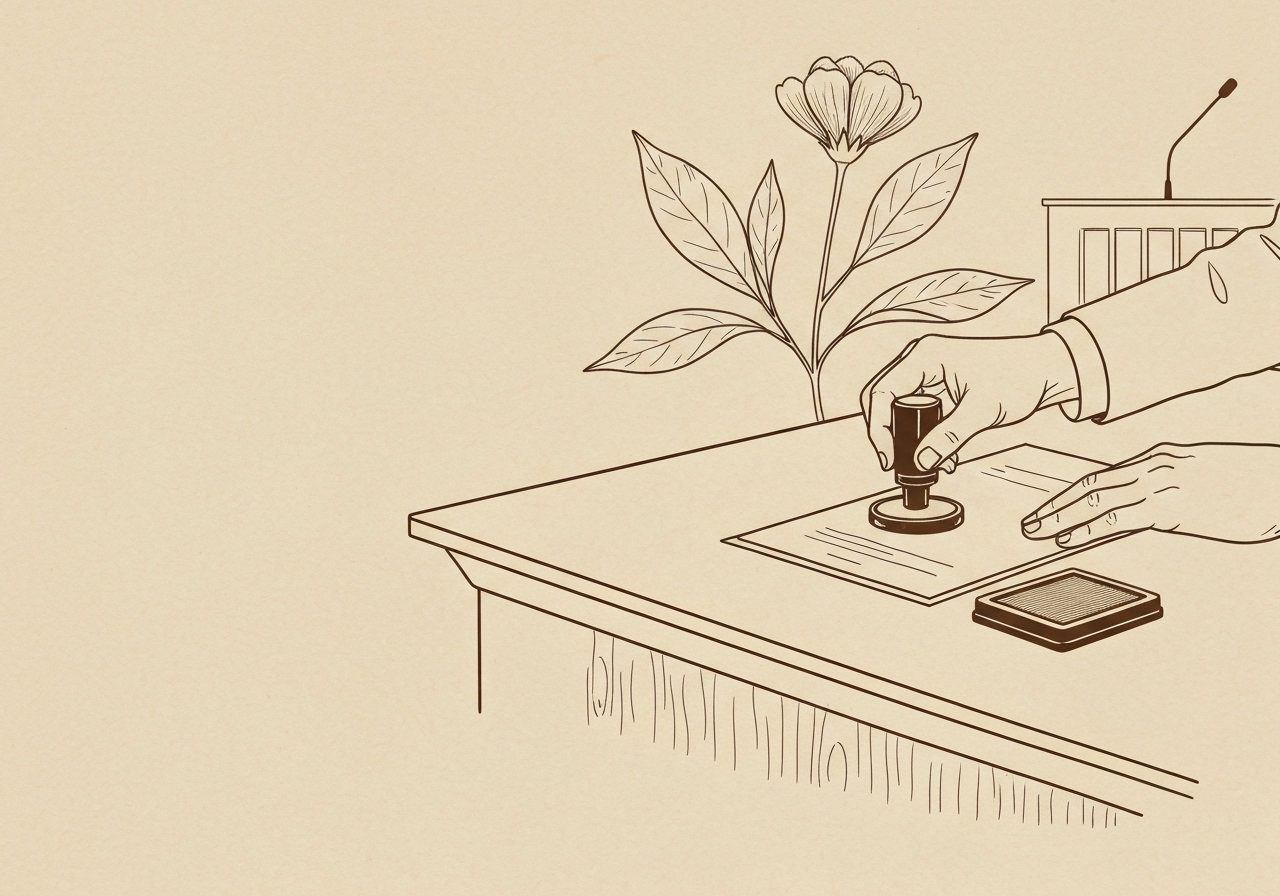
The Life Insurance Corporation of India had fired an employee, Ram Pal Singh Bisen. To justify the termination, LIC needed to show the court the internal inquiry report that had found him guilty. So LIC's lawyer handed the report to the court clerk. The clerk stamped it, wrote an exhibit number on it, and placed it on record. The case seemed straightforward.
But the Supreme Court stopped everything. It asked a question that sounds simple but cuts to the heart of how evidence works in Indian courts: just because a piece of paper has been marked as an exhibit, does that mean everything written in it is automatically true?
The clerk stamped it. LIC thought the case was over.
The dispute began when LIC terminated Ram Pal Singh Bisen after a domestic inquiry — an internal investigation conducted by the employer itself. Bisen challenged his dismissal. The case travelled through the lower courts, and eventually reached the Supreme Court.
LIC's central argument was simple: we have the inquiry report. It's right here. It was marked as an exhibit in the trial court. That means it's evidence. And since it's evidence, the court should accept that the inquiry was properly conducted and that Bisen was guilty.
Bisen's lawyer said something different. He said: yes, the report is on the court's file. But nobody proved it. Nobody called the inquiry officer to the witness stand. Nobody showed that the report was prepared fairly, that the findings were based on actual evidence, or that the conclusions were correct. The report is just a piece of paper with a stamp on it.
Two ways a document enters court. One of them is a trap.
This is where the law draws a line that many litigants — and even some lawyers — miss. Under the Indian Evidence Act, a document can be "admitted" into the court record in two very different ways.
The first is mechanical. A lawyer hands a document to the court. The court clerk marks it as an exhibit. That's it. The document is now physically part of the case file. But the law says this act alone — the marking of an exhibit number — does not mean the document's contents are true. It only means the document exists and has been identified.
The second is substantive. To prove a document means to bring evidence that establishes what the document says is accurate. For a written contract, you call the person who signed it. For a medical report, you call the doctor who prepared it. For an inquiry report, you call the inquiry officer who wrote it. That person must take the witness stand, swear to tell the truth, and then confirm under cross-examination that the document is genuine and its contents are correct.
LIC had done the first step. It had skipped the second entirely.
The Court's holding: a stamp is not a shortcut
The Supreme Court examined the record and found that LIC had not called a single witness to prove the inquiry report. No inquiry officer. No company official who had participated in the inquiry. No one who could say under oath: "I prepared this report, and its findings are based on the evidence I saw."
The Court then delivered its central holding in words that are now being cited in courtrooms across the country. The Court affirmed: "We are of the firm opinion that mere admission of document in evidence does not amount to its proof. In other words, mere marking of exhibit on a document does not dispense with its proof, which is required to be done in accordance with law."
What the Court was saying is this: the act of marking a document as an exhibit is a procedural formality. It tells the court what documents exist. But proving the document — establishing that its contents are true — is a separate, mandatory step. And that step cannot be waived simply because the other side did not object at the time the document was marked.
The trap that catches litigants who skip proof
There is a common belief in Indian litigation that if the opposing lawyer does not object when a document is marked as an exhibit, the document is automatically proved. The Supreme Court rejected this idea. It said that even if both sides agree to admit a document into the record, that agreement only goes to the document's admissibility — whether the court can look at it at all. It does not go to the document's probative value — whether the court should believe what it says.
That is exactly what happened with LIC's inquiry report. The report was on the court's file. But nobody proved it was a genuine, reliable document prepared after a fair inquiry. The Court therefore held that LIC had failed to prove its case.
What this means for every litigant and every lawyer
The practical lesson from this case is simple but expensive to learn the hard way. If you are a party to a case and you want the court to rely on a document — any document — you must call a witness to prove it. That witness must be someone who can speak to the document's authenticity and contents from personal knowledge.
For employers defending disciplinary actions, this means the inquiry officer must take the stand. For banks suing on loan agreements, the loan officer who signed the documents must testify. For insurance companies denying claims, the surveyor who prepared the loss assessment must appear in court.
The marking of an exhibit number is not a shortcut. It is not a substitute for proof. And the failure to prove a document cannot be cured by the other side's silence.
THE PLAY: Before you hand a document to the court clerk, ask yourself: who will I call to the witness stand to swear that this document is genuine and its contents are true? If you don't have an answer, you don't have evidence — you have a piece of paper with a number on it.
The inquiry report sat in the court file, stamped and numbered, but silent. And silence, the Supreme Court reminded everyone, is not proof.