NOIDA leased land for 90 years. The Supreme Court says it's not a financial deal.
A government authority claimed it was a financial creditor in a builder's insolvency. The court disagreed—because land doesn't depreciate and the lease gave NOIDA too much control.
90
years.
A government authority claimed it was a financial creditor in a builder's insolvency. The court disagreed—because land doesn't depreciate and the lease gave NOIDA too much control.
NOIDA leased land to a builder for 90 years. When the builder went bust, NOIDA wanted to sit on the creditors' committee. The Supreme Court said: you're not a lender.
The question seemed simple. A government authority gives land to a builder on a long lease. The builder pays in instalments. Is the authority a creditor who lent money — or just someone who sold a right? The answer would decide whether NOIDA got a seat at the table where the builder's fate was decided, or whether it had to stand in line with everyone else.
The builder's empty site
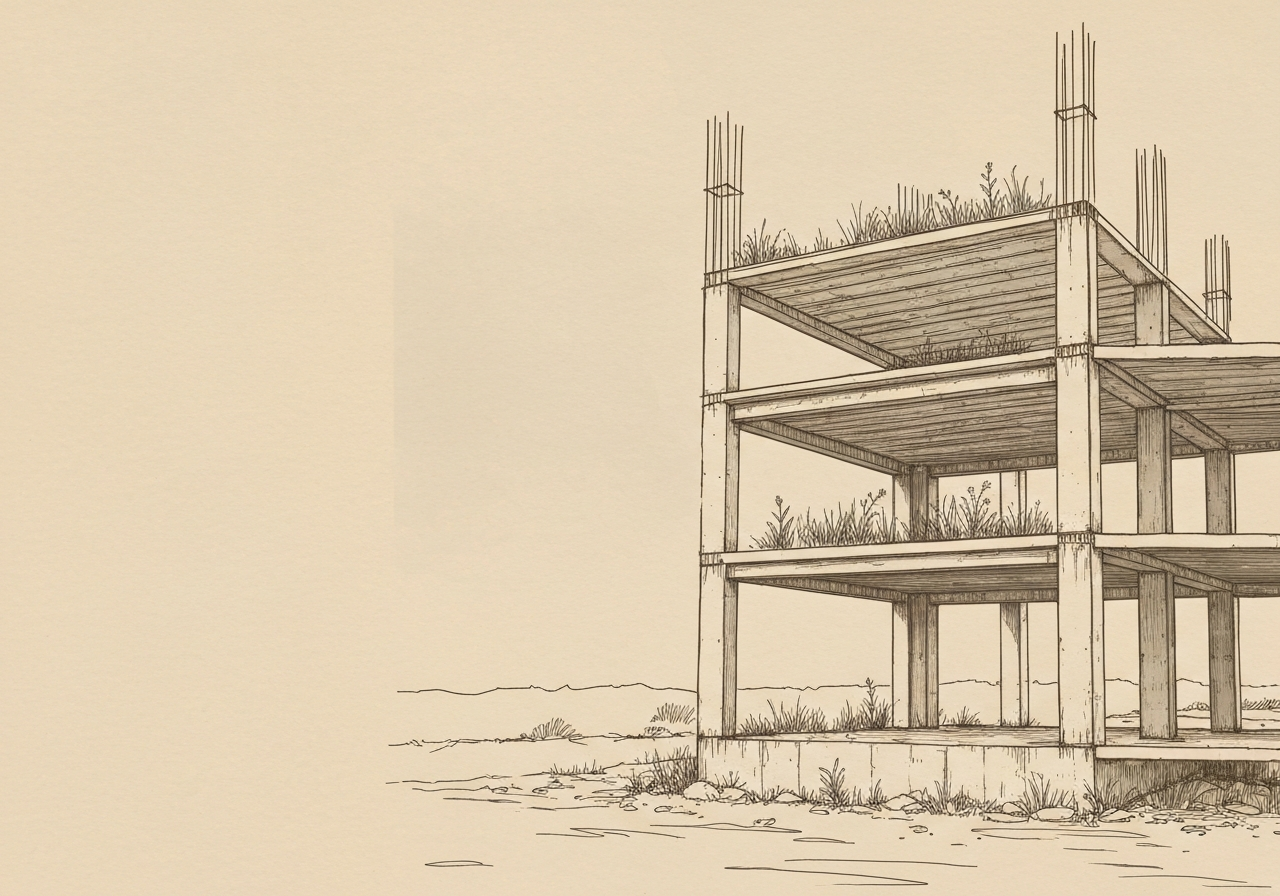
The lease document, thick with clauses and spanning nine decades, sat in the court file. NOIDA — the New Okhla Industrial Development Authority — had leased a plot of land to a builder for 90 years. The builder was supposed to construct residential flats on it. Under the lease, the builder paid 10% of the total price upfront. The rest was to be paid in instalments over time. On the ground, the site remained half-constructed, the skeleton of a project that never finished.
Then the builder ran into financial trouble. Insolvency proceedings began against it under the Insolvency and Bankruptcy Code, 2016 (the law that governs what happens when a company cannot pay its debts).
NOIDA filed a claim. Initially, it filed as an "operational creditor" — a category that typically includes suppliers of goods or services, or government authorities owed statutory dues. But then it changed its mind. It filed a second claim, this time as a "financial creditor" — the category that includes banks, lenders, and anyone who has given money that functions like a loan.
The difference matters. Under the IBC, financial creditors sit on the Committee of Creditors — the powerful body that decides whether to revive the company or liquidate it. Operational creditors have no voting rights on the committee unless their claim is large enough. NOIDA wanted to vote.
Why NOIDA thought it was a lender
NOIDA argued that the 90-year lease was essentially a financial transaction. It pointed to two provisions of the IBC that define "financial debt".
First, Section 5(8)(d) — which covers debt raised under a "finance lease" as defined by Indian Accounting Standards (accounting rules that determine how leases are recorded on a company's books). NOIDA said the lease was a finance lease because the builder was paying for the land over time, just like someone paying off a loan.
Second, Section 5(8)(f) — which covers any transaction that has the "commercial effect of borrowing". NOIDA argued that giving land to a builder and letting him pay later was, in economic terms, the same as lending him money to buy the land.
The National Company Law Tribunal (NCLT — the specialised court that hears insolvency cases) and the National Company Law Appellate Tribunal (NCLAT — the appeal court above it) both rejected NOIDA's claim. They said the lease was not a finance lease, and no amount had been "raised" by the builder from NOIDA.
NOIDA appealed to the Supreme Court.
What the Supreme Court looked at
The Supreme Court bench — Justice K.M. Joseph and Justice Hrishikesh Roy — examined two things: the nature of the lease, and the definition of financial debt under the IBC. When NOIDA's counsel argued, the courtroom fell silent, the only sound the rustle of paper as the bench studied the lease's fine print.
On the lease, the court looked at the Indian Accounting Standards that define a finance lease. Under those rules, a lease is a finance lease if it transfers "substantially all the risks and rewards incidental to ownership" from the lessor to the lessee. One key indicator: the lease term covers the "major part" of the asset's economic life.
But land is different from a machine or a building. The court stated directly: "Land does not depreciate and has unlimited economic life." So the court said: you cannot apply the "major part of economic life" test to a land lease the same way you apply it to a piece of equipment. A 90-year lease on land does not automatically become a finance lease just because it is long.
The court also noted that under the U.P. Industrial Area Development Act, 1976 (the law that created NOIDA and governs its powers), NOIDA retained extensive control over the land. It could cancel the lease. It could re-enter the property. It kept mineral rights. The builder did not get the full bundle of ownership rights — only the right to use the land for a specific purpose, subject to NOIDA's oversight.
On the second argument — the "commercial effect of borrowing" — the court found a simpler problem. No money had flowed from NOIDA to the builder. NOIDA had not handed over cash. It had not given a loan. It had given land, and the builder had agreed to pay for it over time. The court said: a seller who allows a buyer to pay in instalments is not a lender. The builder did not "raise" any amount from NOIDA. The instalment plan was just a payment facility, not a borrowing.
The problem with calling it a financial lease
The court also pointed to a deeper structural issue. Under Indian Accounting Standards, a finance lease is treated as if the lessee has bought the asset with borrowed money. The lessee records the asset on its books and also records a liability for the future lease payments. That only makes sense if the lessee has received something of value — the asset — and owes money for it.
But in this case, the builder had not received the land in the same way a buyer receives a house. The builder had a leasehold interest, not full ownership. And NOIDA had not given up control. The risks and rewards of owning the land — the right to sell it, the right to decide what happens to it, the risk that its value might fall — remained largely with NOIDA. The court held that "substantially all risks and rewards incidental to ownership are not transferred" to the lessee.
The court cited its own earlier judgment in Pioneer Urban Land and Infrastructure Ltd. v. Union of India (2019), where it had interpreted the definition of financial debt broadly to include homebuyers who paid money to builders. But the court distinguished that case: homebuyers had paid money and received nothing in return except a promise. Here, NOIDA had received money from the builder (the upfront payment and instalments) and had given the builder the right to use the land. The flow of value was reversed.
NOIDA's seat at the table
The procedural journey itself revealed the confusion. In one set of proceedings, the NCLT had initially admitted NOIDA as a financial creditor — only for the NCLAT to stay that order. In a separate claim, the NCLT had rejected NOIDA's financial creditor status altogether, and the NCLAT had affirmed that rejection. The Supreme Court was left to resolve the conflict.
The court held that NOIDA was not a financial creditor. It was an operational creditor — someone who provides services (in this case, the right to use land) and is owed money for those services. That means NOIDA cannot sit on the Committee of Creditors. It cannot vote on the builder's revival plan. It must stand in line with other operational creditors and hope the committee decides to pay them.
THE PLAY: If you are a development authority leasing land, file your insolvency claim as an operational creditor — not a financial creditor — unless you have actually advanced funds to the builder.
The court ended where it began: with a lease, not a loan.