She gave him 89 gold sovereigns on wedding night. He said they were gone.
The Supreme Court said a wife doesn't need a receipt to prove her own jewellery is hers. The High Court had demanded documentary proof — and was reversed.
89
sovereigns.
The Supreme Court said a wife doesn't need a receipt to prove her own jewellery is hers. The High Court had demanded documentary proof — and was reversed.
On her wedding night, she handed 89 sovereigns of gold to her husband. He gave them to his mother. Years later, he said she never proved they existed.
The Supreme Court has now answered a question that touches every Indian marriage: does a wife need a receipt to prove her own wedding jewellery is hers? The answer is no. The High Court had demanded documentary proof — and was reversed.
The wedding night
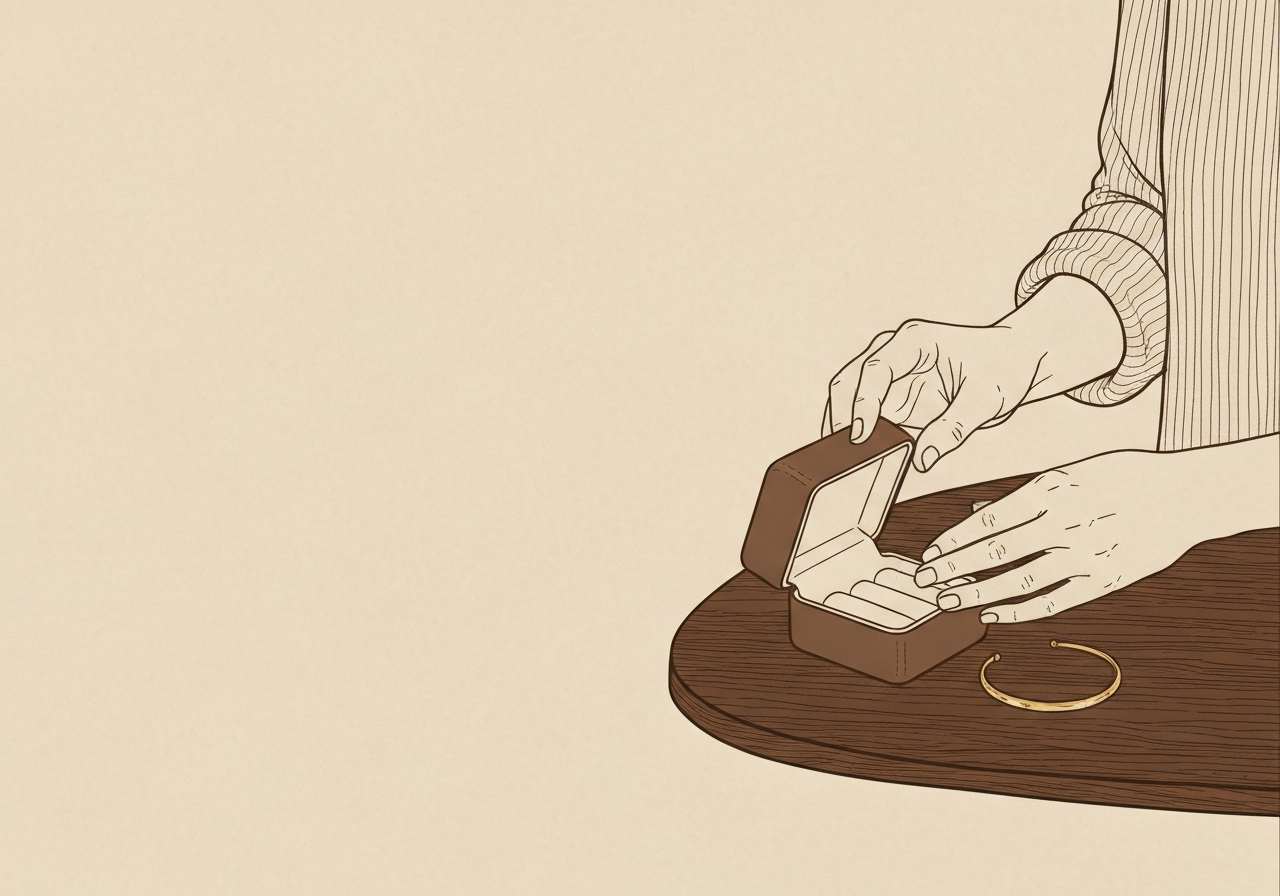
Maya Gopinathan married Anoop S.B. in 2003. It was a second marriage for both. That night, she did what countless Indian brides have done before her — she entrusted her stridhan (the jewellery and gifts a woman receives at marriage, which remain her absolute property) to the man she married. He took custody of the 89 sovereigns — roughly 712 grams of gold, a weight that would have made the jewellery box heavy in her hands — and passed them to his mother for safekeeping. The click of the box closing that night was the last sound she would hear of her gold. Later, Maya's father also paid Rs. 2 lakhs to the husband.
The marriage lasted barely three years. By 2006, the couple had separated. Maya alleged the gold was misappropriated (used improperly) by her husband and mother-in-law to pay off pre-existing debts. The jewellery was gone. She wanted its value returned.
When the Family Court believed her
Maya filed a civil petition in 2009. The Family Court in Alappuzha, Kerala, heard the case. The courtroom was small, the air thick with the smell of old files and the quiet rustle of paper as the judge examined photographs of Maya on her wedding day, gold glinting at her neck and ears. The judge believed Maya's version of events. In 2011, the court dissolved the marriage and awarded Maya Rs. 8.9 lakhs for the gold jewellery plus Rs. 2 lakhs for the cash her father had paid — all with interest. The husband's counterclaim was dismissed.
But Anoop S.B. appealed to the Kerala High Court. In April 2022, the High Court partly allowed his appeal. It reversed the gold jewellery claim entirely. The reasoning: Maya had failed to prove misappropriation. The High Court effectively demanded documentary proof — purchase receipts, bank statements, some paper trail — to establish that the 89 sovereigns had ever existed and had been wrongfully taken.
This was the problem. In civil matrimonial disputes, the standard of proof is not the same as in criminal trials. A wife does not need to prove her case beyond reasonable doubt. She only needs to show that her version is more likely true than not — what the law calls "preponderance of probabilities" (the balance of evidence tilting in her favour). The High Court had applied what the Supreme Court later called "an erroneously high standard of proof," closer to what a criminal court would demand.
The Supreme Court's question
Maya appealed to the Supreme Court. The bench — Justice Sanjiv Khanna and Justice Dipankar Datta — heard the matter and delivered judgment on April 24, 2024. The courtroom fell silent as the judgment was read, the only sound the turning of pages and the weight of a decision that would affect countless women.
The court began with a foundational question: what is stridhan? Under settled law, properties gifted to a woman before, at, or after marriage are her stridhan — her absolute property. She has all rights to dispose of it at her pleasure. The husband has no control over it. He may only use it during genuine distress, and even then, he has a moral obligation to restore it.
The Supreme Court held that the High Court's approach was legally unsustainable. In civil cases, including matrimonial disputes of a civil nature, the standard of proof is preponderance of probabilities — not proof beyond reasonable doubt. The appellate court errs if it demands documentary proof chains akin to criminal trials for recovery of stridhan.
For a claim of return of stridhan to succeed, the court said, the wife need not prove the mode and manner of acquisition of the jewellery. Where the existence of stridhan is admitted or evidenced through photographs, demanding documentary proof of purchase is an erroneous approach.
The logic of trust
The court then applied common sense to the facts. "The concept of marriage rests on mutual trust," the bench observed. "It is more plausible that a newly-wed bride would entrust her jewellery to her husband for safekeeping than that she would lock it away showing distrust from day one." Entrustment can be inferred from probabilities associated with matrimonial situations.
On comparative analysis of evidence, the Supreme Court found Maya's version more plausible. The Family Court had believed her. The High Court had reversed that finding by applying the wrong standard. The Supreme Court restored the Family Court's finding on the gold jewellery claim.
But the court did not stop there. It noted the passage of time — the marriage had ended in 2006, and the case had dragged on for nearly two decades. The value of gold had risen substantially. Simple restitution at 2006 prices would be unjust.
Twenty-five lakhs and Article 142
The Supreme Court invoked Article 142 of the Constitution (the Supreme Court's power to pass any order necessary to do complete justice in a case before it). Using this power, the court enhanced the compensation from the Family Court's Rs. 8.9 lakhs plus Rs. 2 lakhs to a consolidated sum of Rs. 25 lakhs.
The court directed Anoop S.B. to pay this amount within six months. If he failed, the amount would carry 6% interest per annum from the date of the judgment. The High Court's judgment was set aside. The Family Court's finding that Maya was entitled to relief was accepted. Both parties were to bear their own costs.
The judgment also drew on several key precedents. In Dr. N.G. Dastane v. Mrs. S. Dastane (1975), the Supreme Court had first clarified that matrimonial cases require only preponderance of probabilities. Roopa Soni v. Kamalnarayan Soni (2023) reinforced that stridhan remains the wife's absolute property. Rashmi Kumar v. Mahesh Kumar Bhada (1997) and Pratibha Rani v. Suraj Kumar (1985) established that entrustment of stridhan to the husband does not transfer ownership — the wife retains full rights over it. The bench applied these principles to hold that the High Court had erred in demanding proof of acquisition and misappropriation as if the case were a criminal trial under Section 406 of the Indian Penal Code (criminal breach of trust).
The procedural journey itself tells a story of legal persistence. From the Family Court in 2011 to the High Court in 2022, and finally to the Supreme Court in 2024 — thirteen years of litigation, each layer of appeal adding new arguments and fresh scrutiny. The Family Court judge had weighed the evidence on the standard of preponderance of probabilities and found in Maya's favour. The High Court, acting as the first appellate court, had reversed that finding by silently shifting the goalposts — demanding a standard of proof that the Supreme Court would later describe as appropriate only for criminal trials. The Supreme Court's judgment did not merely restore the Family Court's order; it enhanced the award, recognizing that delay itself had become a form of injustice.
The court's reasoning on Section 3 of the Indian Evidence Act — the definition of what it means for a fact to be "proved" — was central to the outcome. In civil cases, a fact is proved when the court believes it to exist or considers its existence so probable that a prudent man ought to act on the supposition that it exists. The High Court had demanded certainty. The Supreme Court reminded the legal system that probability, not certainty, is the civil standard. The photographs of Maya on her wedding day, the gold visible at her neck and ears, the consistent testimony — these were enough to tilt the balance. The husband's bare denial, without evidence of how the jewellery had been returned or accounted for, could not outweigh that.
For the millions of Indian women who hand over their wedding jewellery to their husbands or in-laws on the first night of marriage, the Supreme Court has said something simple and powerful: your word matters. You don't need a receipt to prove your own gold is yours.
THE PLAY: In a civil matrimonial dispute for recovery of stridhan, the wife need only prove her case on preponderance of probabilities — the court must not demand documentary proof chains as if it were a criminal trial.
What this means
For practitioners, the judgment clarifies that appellate courts cannot reverse a Family Court's factual finding on stridhan by silently applying a criminal standard of proof. The ratio (the court's central reasoning) is clear: where the existence of stridhan is admitted or evidenced through photographs, demanding purchase receipts is an erroneous approach. The wife's testimony, tested against probabilities, can be sufficient.
The judgment also carries implications for how courts handle proceedings under the Hindu Marriage Act. Sections 10 and 23 of that Act, which deal with judicial separation and the conditions for granting matrimonial relief, were interpreted in light of the Evidence Act's definition of proof. The Supreme Court's message is that matrimonial disputes, though emotionally charged, remain civil proceedings. The criminal standard has no place there unless a specific criminal complaint is filed separately. This distinction protects wives who seek the return of their stridhan through civil courts from being held to an impossible standard of proof.
For the millions of Indian women who hand over their wedding jewellery to their husbands or in-laws on the first night of marriage, the Supreme Court has said something simple and powerful: your word matters. You don't need a receipt to prove your own gold is yours.