The Supreme Court's single-paragraph test for stopping bulldozer demolitions.
The Supreme Court stops a Gujarat demolition, ruling that an alleged crime by one family member cannot justify destroying another's legally constructed house.
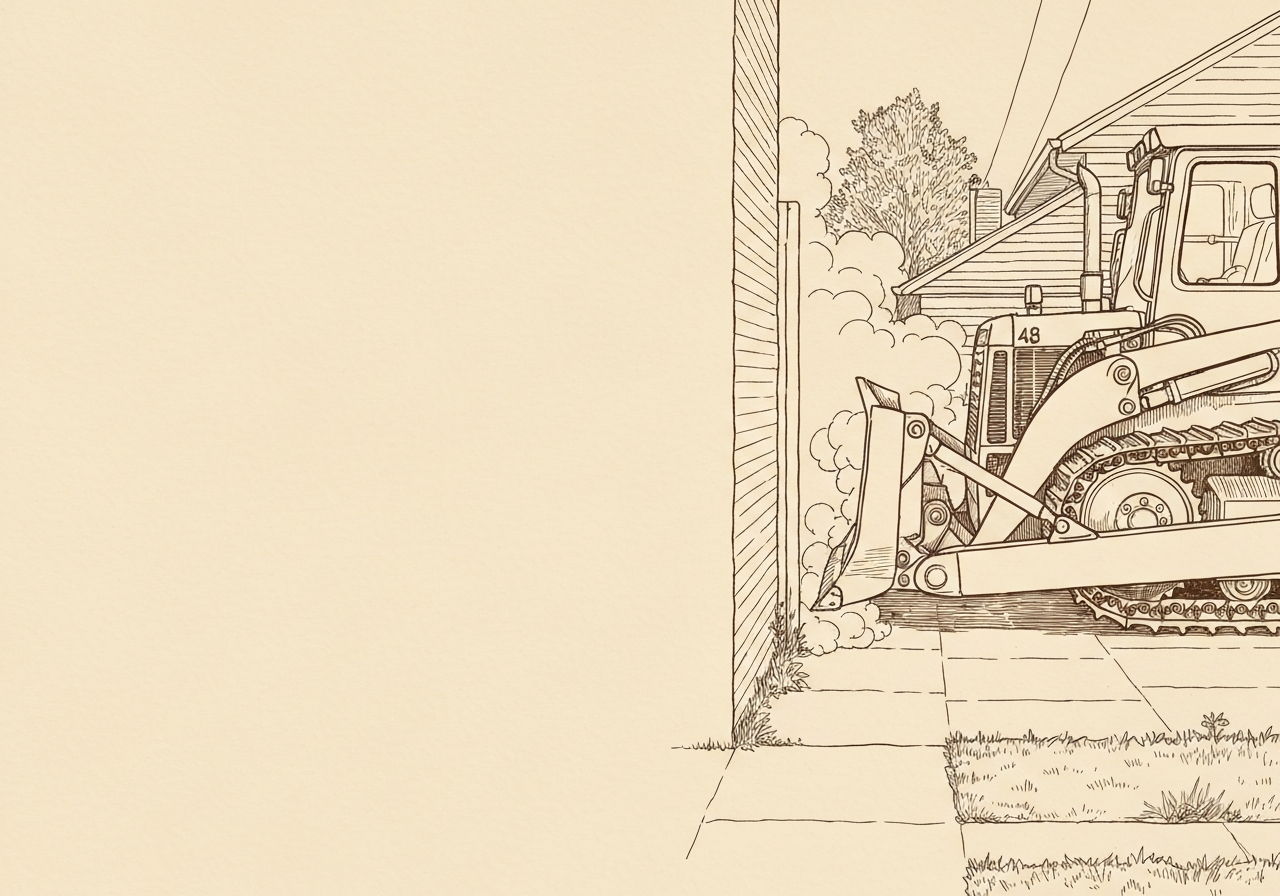
Stopped.
Status quo on
the bulldozer.
The Supreme Court stops a Gujarat demolition, ruling that an alleged crime by one family member cannot justify destroying another's legally constructed house.
One FIR, One Family, One House: The Supreme Court’s Status Quo on the Bulldozer
Javedali Mahebubmiya Saiyed is a co-owner of land in Village Kathlal, Kheda District, Gujarat. His family built two residential houses — Nos. 26 and 48 — on that land in 2004, with permission from the Gram Panchayat. Three generations have lived there for nearly two decades. On 1 September 2024, an FIR was registered against one family member. Days later, municipal authorities threatened to bulldoze the family home. The stakes were immediate and physical: a legally constructed house, a family’s shelter, and the question of whether an allegation against one person can justify the demolition of another’s roof.
The permission that mattered
The story begins in 2004. The Gram Panchayat of Kathlal passed a resolution on 21 August 2004, granting building permission for residential houses on the petitioner’s land. Javedali Saiyed and his family built two houses. They lived there. They paid taxes. They raised children and buried elders. For twenty years, no one questioned the legality of those walls.
Then came 1 September 2024. An FIR was registered against one family member under Section 333 of the Bharatiya Nyaya Sanhita, 2023. The precise allegation is not detailed in the judgment, but it triggered a chain of events that brought the family to the Supreme Court within eleven days.
The threat that followed
On 6 September 2024, Javedali Saiyed filed a complaint with the Deputy Superintendent of Police. His plea was measured: let the law take its course against the accused family member, he said, but the Nagar Palika should not threaten or demolish a house that was legally constructed. He did not ask for immunity for the accused. He asked for the house to be left alone.
The municipal authorities did not relent. The threat of demolition remained. On 12 September 2024, Javedali Saiyed approached the Supreme Court of India under Article 32 of the Constitution — the right to constitutional remedies. He sought protection for his family’s home.
What the Court heard
The matter came before a three-judge Bench of the Supreme Court: Justice Hrishikesh Roy (who authored the judgment), Justice Sudhanshu Dhulia, and Justice S.V.N. Bhatti. The petitioner’s counsel argued that the threatened demolition was punitive — a response to the FIR against a family member, not to any defect in the building itself. The property had been constructed with Gram Panchayat permission. It had stood for two decades. The only new fact was the criminal allegation against one occupant.
The Court did not need to hear the respondents. It issued notice, returnable in four weeks, and ordered status quo on the property. The demolition was stopped in its tracks.
The rule the Court applied
The Bench did not write a long judgment. It did not need to. The ratio is contained in a single paragraph, and it is devastatingly simple.
First: In a rule-of-law state, the transgression by a family member cannot invite action against other members of the family or their legally constructed residence. The Court said this directly: “Alleged involvement in crime is no ground for demolition of property.”
Second: An alleged crime must be proved through due legal process in a court of law. The mere allegation cannot justify executive action against property. The presumption of innocence — a bedrock of criminal law — bars the state from treating an accused person’s family as collateral damage.
The Court also referenced its own order dated 2 September 2024 in WP(C) No. 295 of 2022 — the “Bulldozer demolition case.” In that matter, the Supreme Court had proposed to take pan-India action against threats of bulldozing residences of persons accused of crimes. The present case was a direct application of that principle.
THE PLAY: When a municipal authority threatens demolition based solely on a criminal allegation against a family member, move the Court under Article 32. The ratio is clear: alleged crime is no ground for demolition. The presumption of innocence bars punitive executive action against property.
The obiter that stung
Justice Hrishikesh Roy added a rhetorical observation that will be cited for years. He said that such demolition actions “may be seen as running a bulldozer over the laws of the land.” The phrase is not part of the ratio — it is obiter dictum, not strictly necessary for the decision. But it signals the Court’s strong disapproval. It tells every municipal commissioner, every district magistrate, every police officer: if you bulldoze a house because someone in it is accused of a crime, you are not enforcing the law. You are running over it.
Why this matters in practice
For advocates, this judgment is a ready template. The facts are common: an FIR against one family member, a municipal threat, a legally constructed house. The ratio is short and portable. Cite it. The Court has already said that alleged crime is no ground for demolition. The burden shifts to the state to show that the demolition is based on a legal defect in the building, not on the criminal allegation.
For CFOs and founders, the lesson is broader. If your business owns property — a factory, a warehouse, an office — and a criminal case is filed against a director or an employee, the state cannot use that as a pretext to demolish the building. The property rights of the entity are separate from the criminal liability of the individual. This judgment reinforces that separation.
For the general reader, the takeaway is simple: your house is not your family member’s crime. The Constitution protects your shelter even when the law pursues your relative.
The bottom line
The Supreme Court has stopped the bulldozer in Gujarat. The status quo order in Javedali Mahebubmiya Saiyed v. State of Gujarat & Anr. is a reminder that in a rule-of-law state, the state must prove its case in court — not on the street with a bulldozer.