Why 1,540 hectares of leased land became a battleground over temples.
A Kerala High Court ruling forces eviction of temples built on leased government land, citing secularism and the duty to redistribute property to the landless
1,540
hectares.
A Kerala High Court ruling forces eviction of temples built on leased government land, citing secularism and the duty to redistribute property to the landless
When a Temple on Government Land Becomes an Encroachment
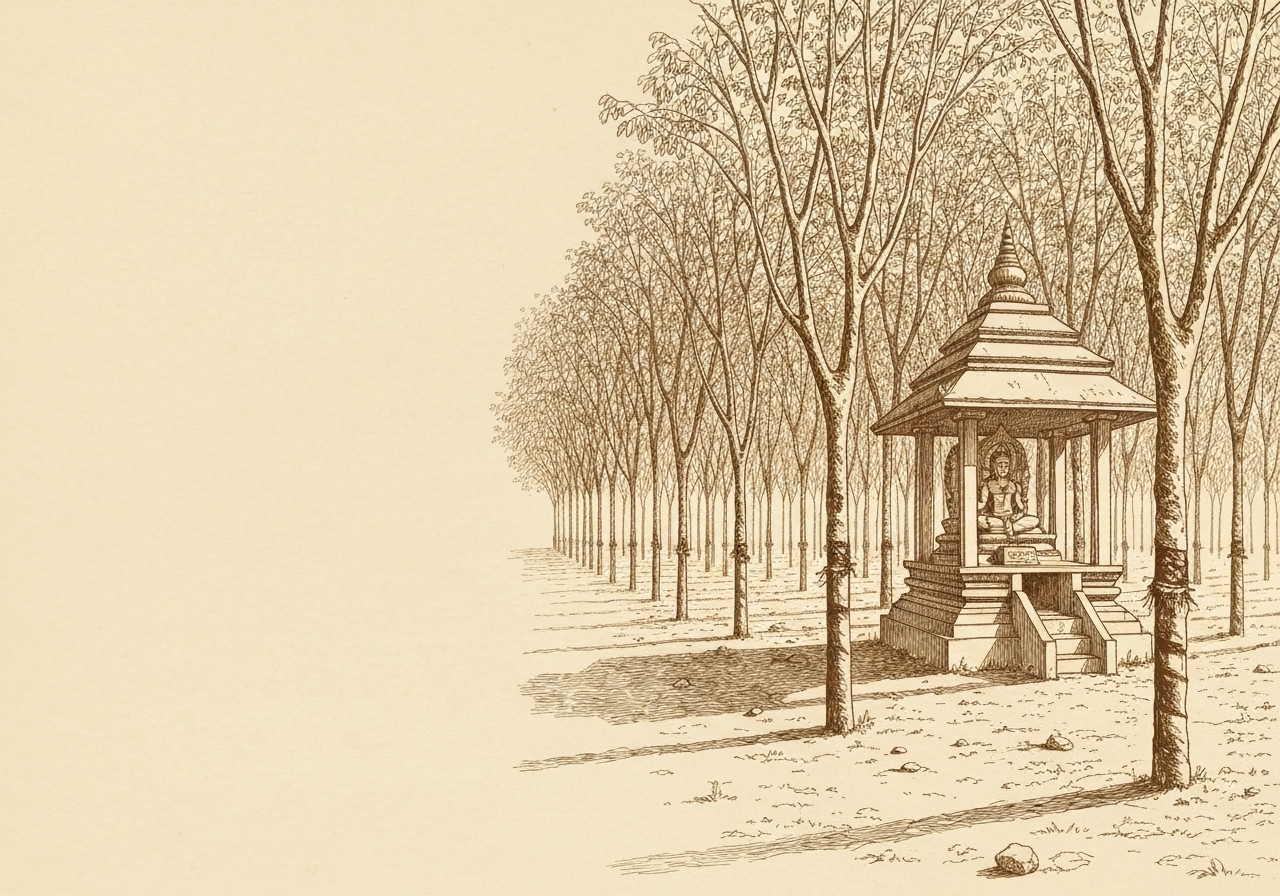
The Plantation Corporation of Kerala Limited had a problem. For decades, it held about 1,540 hectares of government land on lease for rubber cultivation. But on that land, small temples and religious structures had begun to appear. What started as a few idols placed by workers living on the estate had, by 2016, grown into something the Corporation could no longer ignore. It approached the High Court of Kerala at Ernakulam with a single question: could it get its land back?
The stakes were not just about one plantation. The Court's answer would determine whether any religious structure, however humble, could be allowed to remain on government land anywhere in Kerala. And the answer, delivered by Justice P.V. Kunhikrishnan on May 27, 2024, was a firm no.
The Land That Was Never Meant for Worship
The story begins in 1971, when the State of Kerala leased about 1,540 hectares of government land to the Plantation Corporation of Kerala Limited under a lease deed (Ext.P1). The Corporation, a government-owned company, was to use this land for rubber cultivation. For years, it did. But the Chandanappally Estate, where the land was located, had workers who lived on the estate. And some of those workers, over time, began to place small idols and build small temples.
What began as personal devotion soon turned into a pattern. Local residents, and even some outsiders, started erecting larger religious structures on the leased government land. The Corporation tried to stop them. It complained to the Revenue Divisional Officer, Adoor, the District Collector, Pathanamthitta, the District Police Superintendent, and the Divisional Forest Officer, Konni. It filed representations as early as July 2010. But the encroachments continued across multiple divisions of the estate.
The Corporation faced threats from religious groups when it tried to intervene. The police did intervene at times, but the structures kept coming back. By 2016, the Corporation had had enough. It filed a writ petition under Article 226 of the Constitution before the High Court of Kerala, seeking a writ of mandamus directing the respondents — the State of Kerala, the District Collector, the Revenue Divisional Officer, the Tahsildar, the Village Officer, the District Police Superintendent, and the Divisional Forest Officer — to identify its leased properties and evict all encroachers.
What the 6th Respondent Confirmed
The 6th respondent, the District Police Superintendent, filed a statement in Court. It confirmed what the Corporation had been saying all along: there were illegal constructions on the government land. The statement did not mince words. The structures were unauthorized. They were on government land. And they had to go.
The Court noted that the Corporation had been trying to get the authorities to act for years. But the authorities had done nothing effective. The encroachments continued. And the Corporation, a public sector company, was left with no option but to approach the High Court.
The Argument That Failed
The respondents did not seriously contest the fact that the structures were illegal. But the Court anticipated a possible argument: that the religious structures, having been there for years, had acquired some kind of legitimacy. That argument did not fly.
Justice Kunhikrishnan turned to Article 26 of the Constitution, which gives every religious denomination the right to establish and maintain institutions for religious and charitable purposes. But that right, the Court held, is subject to public order, morality, and health. It does not give anyone the right to encroach on government land.
The Court also invoked the Preamble to the Constitution, which declares India to be a Sovereign Socialist Secular Democratic Republic. Secularism, the Court said, means that the State does not favour any religion. But it also means that the State cannot allow any religion to take over government land. If one religion is allowed to erect its deity on government land, other religions will also start erecting their religious institutions. That would create law and order issues and religious disharmony.
The Precedent That Cleared the Path
The Court relied on two key precedents. The first was Balakrishna Pillai and Others v. Union of India and Others, reported in 2021 (4) KHC 282. In that case, the Court had held that for the development of a National Highway, if religious institutions are affected, God will forgive us. Courts should not interfere in acquisition proceedings on the basis that a mosque or temple exists, unless there is mala fides or patent illegality.
The second was Noorul Islam Samskarika Sangam Thottekkad, Malappuram v. District Collector, Malappuram and Others, reported in 2022 (5) KHC 595. That case had made a striking observation: Kerala is exhausted with religious institutions and prayer halls. Approval for new religious places should be only in the rarest of rare cases. Change of category of buildings to religious purpose should normally not be approved. Illegal functioning of religious places without permission should be closed down.
Justice Kunhikrishnan followed both precedents. The message was clear: religious structures cannot stand in the way of legitimate government purposes and public interest. And Kerala does not need more religious places on government land.
The Obiter That Stung
The Court did not stop at the legal reasoning. It added observations that were not strictly necessary for the decision but carried their own weight. God almighty, the Court said, is omnipotent and omnipresent. Believers need not encroach on government land to construct religious structures. God is everywhere — in their bodies, in their homes, wherever they go. Government land should instead be distributed to landless people.
This was not just a legal judgment. It was a philosophical statement. The Court was saying that religious devotion does not require physical structures on public land. And that the State has a higher duty to use its land for the benefit of the landless, not for the construction of temples, mosques, or churches.
The Court also warned of the practical consequences. If one religion is allowed to erect its deity on government land, other religions will follow. That will create law and order issues and religious disharmony. The only workable approach, the Court suggested, is a blanket prohibition.
What the Court Ordered
The operative order was comprehensive. The Court directed respondents 1 to 7 — the State of Kerala, the District Collector, the Revenue Divisional Officer, the Tahsildar, the Village Officer, the District Police Superintendent, and the Divisional Forest Officer — to identify the properties covered by the lease deed (Ext.P1) and evict all encroachers, including those who had built illegal religious structures, within six months.
But the Court did not stop there. It issued statewide directions. The Chief Secretary was directed to instruct all District Collectors across Kerala to conduct enquiries through Tahsildars and Village Officers to identify illegal religious structures on government land. The District Collectors were then directed to evict those structures with police aid, after hearing the affected parties. All of this was to be done within six months. An action taken report was to be placed before the Registrar General of the High Court within one year. The Registry was directed to forward a copy of the judgment to the Chief Secretary.
The Court was not just solving the Corporation's problem. It was sending a message to every district in Kerala.
THE PLAY: If you hold government land on lease and find illegal religious structures on it, file a writ petition under Article 226. The Court will not only order eviction of those structures from your land but may also trigger a statewide crackdown on all such encroachments.
Why This Matters in Practice
For advocates, this judgment is a powerful tool. If you represent a public sector company or any entity holding government land, and you find illegal religious structures on that land, you now have a clear precedent. The Court has held that no illegal religious structure can be allowed on government land, regardless of the religion involved. The State has a duty to remove them. And the Court is willing to issue statewide directions to ensure compliance.
For CFOs and founders of companies that hold government land on lease, the message is equally clear. You cannot ignore encroachments, even if they are religious in nature. You must take proactive steps to protect your land. File representations with the authorities. If they do not act, approach the High Court. The Court will back you.
For the State, the judgment is a directive. The Chief Secretary must now ensure that every District Collector in Kerala identifies and removes illegal religious structures on government land. This is not optional. It is a court order.
The Bottom Line
No illegal religious structure, however old or however devout, can remain on government land in Kerala. The State must remove them all. And if you hold government land on lease, the Court will help you get it back.