Witness abroad, testimony by video: Supreme Court sets strict rules
To ensure electronic evidence is valid, the Court mandated a multi-step process: reading, correction, email, embassy authentication, and judge's re-endorsement.
"Read out in front of the accused"
The Supreme Court's first requirement for valid video testimonySujoy Mitra v. State of West Bengal — 2023 LiveLaw (SC) 980
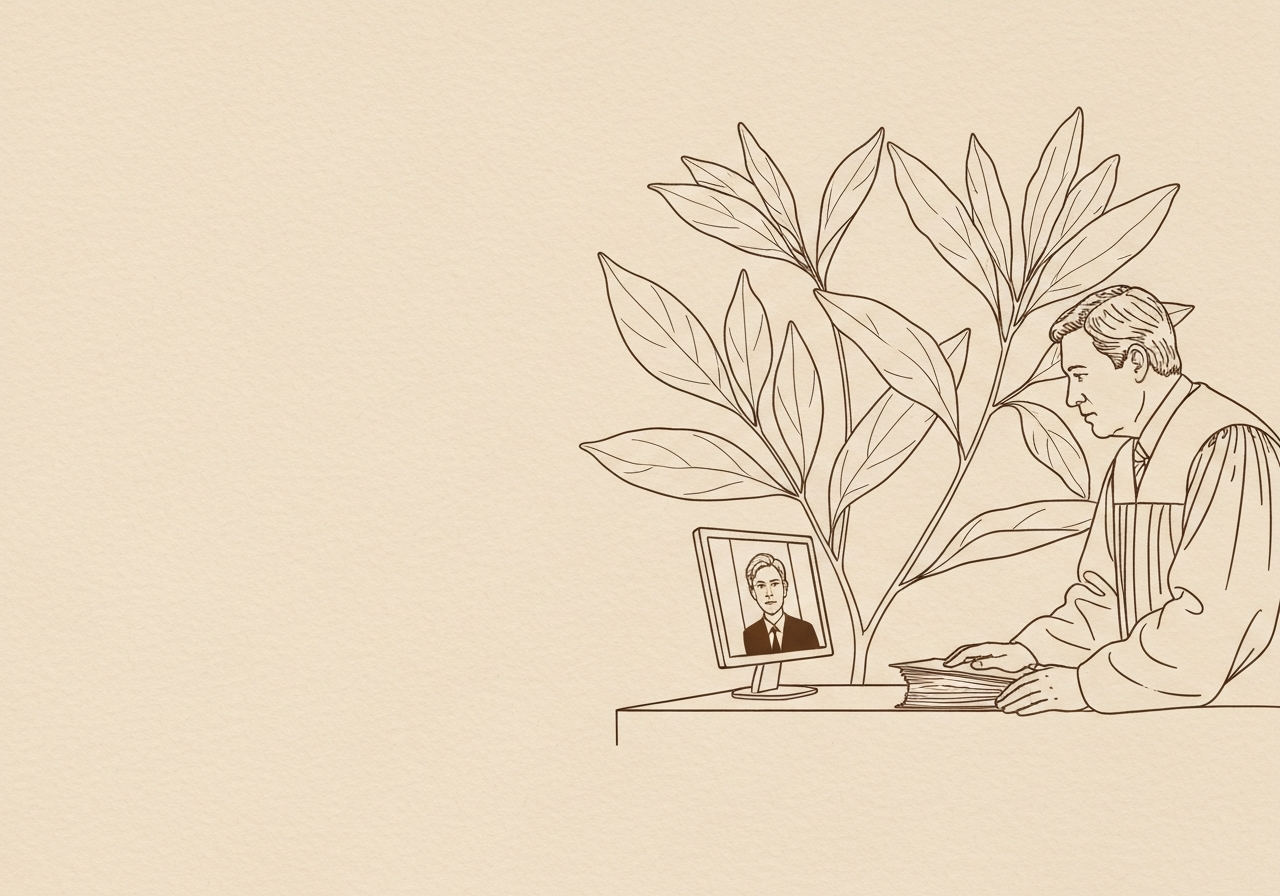
To ensure electronic evidence is valid, the Court mandated a multi-step process: reading, correction, email, embassy authentication, and judge's re-endorsement.
A witness testifies from another country via video call. But to make that testimony count in court, the Supreme Court says it must go through a chain of steps — starting with a read-out in front of the accused. On a winter morning in a Kolkata courtroom, a judge stared at a screen. On it sat a woman — the prosecutrix — thousands of kilometres away, in a foreign country. Her voice was clear. Her face was visible. But the question that hung in the air was this: would her words, spoken through a camera, ever become legal evidence that could send a man to prison?
The Supreme Court had to answer that question. And its answer, in Sujoy Mitra v. State of West Bengal, created a strict checklist — a series of hoops that every trial court must now jump through before a video testimony from abroad becomes valid.
When the screen became the courtroom
A woman — referred to in court records as PW 5 (Prosecution Witness 5) — had accused a man of a crime. She no longer lived in India. She was in a foreign territory. The trial court in West Bengal needed her testimony to proceed. Video conferencing was the obvious solution. Courts across India had already begun using it, especially after the pandemic. But there was a problem: no one had clearly laid down what made such testimony legally watertight. Could a defence lawyer cross-examine a witness who was not in the same room? Could the judge be sure the witness was not being coached off-screen? And most importantly, if the witness never signed a physical document in front of the court, was her statement even real evidence?
The trial court was stuck. The accused was in custody. The prosecutrix was abroad. The case could not move forward without her testimony. So the matter reached the Supreme Court, which had to design a process that balanced the right to a fair trial with the practical need to record testimony from a foreign jurisdiction.
The courtroom that morning was tense. The judge’s robe rustled as he leaned toward the screen, his fingers resting on a thick, unmarked file. The only sound was the low hum of the video equipment and the occasional crackle of static from the speaker. The prosecutrix’s face flickered on the monitor — she was waiting, too.
The legal knot: Section 278 and the video screen
The core of the problem lay in Section 278 of the Code of Criminal Procedure (the law that governs how criminal trials are conducted in India). This section requires that after a witness finishes giving evidence, the statement must be read out to her in the presence of the accused. If the witness says something is wrong, the judge must correct it or record the objection. Then the witness signs the statement, and the judge endorses it.
That process was designed for a world where the witness sits in the courtroom, ten feet from the judge. How do you "read out" a statement to someone on a screen? How does she "sign" it when she is in another country? The law had no answer. The Supreme Court had to build one.
Step one: The read-out in front of the accused
The Court began with the first requirement: reading the testimony back to the witness. It ruled that at the end of the video recording, the trial judge must read the entire statement aloud to the witness — while the accused (or his lawyer) is present in the courtroom and can hear every word. If the witness says any part of the statement is incorrect, the judge must either correct it on the spot or record a note of the objection, along with the judge's own remarks about whether the objection is valid. This ensures that the witness has a chance to fix errors, and the accused knows exactly what has been said against him.
The judge’s voice was steady as he read each line, pausing at the end of every paragraph to look at the screen. The prosecutrix nodded, then shook her head at one passage. The judge stopped, made a note, and read the corrected version back to her. The accused sat in the dock, watching the screen, his hands folded.
Step two: The email to the embassy
Here is where the process becomes unusual. Once the statement is corrected (if needed), the trial court must scan the transcript and email it to the Indian embassy in the country where the witness is located. The embassy then calls the witness to its office. There, in the presence of an embassy officer, the witness reads the transcript and signs it. The embassy officer endorses the signed statement — confirming that the person who signed is indeed the witness and that she did so voluntarily. Then the embassy scans the signed document and emails it back to the trial court. But here is the crucial part: the original signed paper is not sent back. It stays in the embassy's custody, in a sealed cover. This creates a physical record outside India, in case the electronic version is ever challenged.
At the embassy, the officer’s stamp thudded onto the paper — a heavy, official sound that sealed the moment. The witness signed with a steady hand, and the officer watched, his eyes tracking her pen. The document was then placed in a manila envelope, which was sealed with red wax and stored in a steel cabinet. The scanned copy, however, was already travelling through the cables under the ocean, back to the trial court.
Step three: The judge's re-endorsement
When the emailed, signed statement arrives at the trial court, the judge must re-endorse it — meaning the judge writes or stamps on it that this is the official testimony. Only after this final step does the document become what the Supreme Court called "the testimony of the prosecutrix, PW 5, for all intents and purposes." The Court was explicit: without this chain — read-out, correction, email, embassy authentication, judge's re-endorsement — the video testimony cannot be treated as valid evidence. It is as if the witness never spoke.
The trial judge’s pen scratched across the printed email as he wrote his endorsement. The file was thin — just a few sheets of paper — but it now carried the weight of a legal process that had crossed continents. The judge closed the file and placed it on the stack of pending matters. The testimony was now part of the record.
Why the chain matters: Lessons from other courts
The Supreme Court did not invent this process from scratch. It looked at how other High Courts had handled similar problems. In Twentieth Century Fox Film Corp v. NRI Film Production Associates Ltd, the Karnataka High Court had ruled that after recording evidence by video, the document must be sent to the witness, who must sign it in front of a Notary Public (a government-authorised officer who verifies signatures). Only then does it become part of the court record. The Calcutta High Court, in Amitabh Bagchi v. Ena Bagchi, went further. It said the witness must sign "as early as possible" before a Magistrate or Notary Public. And if digital signatures (electronic signatures that can be verified online) are available, they must be used immediately after the day's deposition — not days later, when memories fade or doubts creep in.
These earlier rulings share the same anxiety: that a witness’s words, once spoken, must be locked into a document before anyone can tamper with them. The Supreme Court’s new guidelines take that anxiety and turn it into a step-by-step protocol, designed to leave no gap for doubt.
What this means for every trial court
For lawyers and judges, the message is clear: video testimony from abroad is not a shortcut. It is a process with seven distinct steps, and skipping any one of them could make the entire testimony inadmissible (unusable as evidence). The practical burden falls on the trial court. The judge must ensure the read-out happens in the accused's presence. The court staff must scan and email the transcript. The embassy must cooperate. And the judge must re-endorse the emailed document. In a system where court computers often crash and email servers are unreliable, this is not trivial.
But the Supreme Court's logic is hard to argue with. A criminal trial can send a person to prison for years. The evidence that does that work must be beyond reproach. A voice on a screen, without a paper trail, is not enough.
THE PLAY: Before recording video testimony from a witness abroad, the trial court must prepare a checklist: read-out in accused's presence, correction if needed, email to embassy, embassy authentication, email back, and judge's re-endorsement — or the testimony is void.
The woman on the screen in Kolkata finally gave her testimony. But only after a judge read her words back to her, an embassy officer watched her sign, and a piece of paper travelled halfway around the world and back — sealed, signed, and stamped.